 Chatgpt Grow
Why ChatGPT Recommends Your Competitor and Not You — and Why Fixing Your Website Cannot Solve It Alone
An AI assistant recommending your competitor is not a product comparison. It is a count of which brands the sources it reads keep naming. That distinction changes what you have to fix, and most of it is not on your domain.
October 20, 2026 · 9 min read
By Alex Li, Founder · Contact the author
A buyer asks an AI assistant for the best option in your category. Three names come back. Yours is not among them — sometimes replaced by a competitor you beat on every feature. No analytics event fires, no ranking report shows the loss, and the buyer never visits your site to be counted.
The instinct is to treat this as a ranking problem and optimise harder on your own domain. That instinct is what makes the problem persist, because the recommendation is not built from your website.
The short version
- The model is not comparing products. It is reading sources that discuss your category and answering with the consensus brand set those sources name.
- That means your competitor's advantage can be entirely off-site: more third-party mentions, an entity record, comparison pages that name them, and a longer trail in training data.
- The academic evidence on what makes a source quotable points the same way: the KDD 2024 GEO benchmark found citing sources, adding quotations, and adding statistics were the top-performing modifications, at 30–40% relative improvement.
- There is a self-inflicted version of this problem. In our audit of 267 sites, 6.4% of a general sample block
OAI-SearchBot— removing themselves from the live retrieval path while their competitor stays available to it.
The model is not comparing you. It is counting.
The most useful mental correction is this: when an assistant answers "what are the best options for X," it is not evaluating products. It has not used either one. It retrieved a handful of pages that discuss your category, and answered from the brand names those pages repeat.
That reframing explains the outcomes that otherwise look irrational. A worse product with a denser public record wins. A better product with a thin record is absent. A company that has been written about by many independent sources is "known"; a company that has only written about itself is a claim rather than a fact.
The practical consequence is uncomfortable: your competitor's advantage may be entirely off your domain, and no amount of on-site optimisation reaches it.
Two paths reach a recommendation, and they respond to different work
Assistants draw on two channels, and OpenAI's crawler documentation separates them explicitly. GPTBot crawls "content that may be used in training our generative AI foundation models" — a frozen record. OAI-SearchBot "is used to surface websites in search results in ChatGPT's search features" — a live fetch at answer time.
| Training consensus | Live retrieval | |
|---|---|---|
| Built from | Everything crawled up to the model's cutoff | Pages fetched when the question is asked |
| Your lever | Being named consistently across sources, over years | Having a liftable, corroborated answer on a page the engine can reach |
| Time to effect | Slow, tied to model releases | Weeks, once the page and its corroboration exist |
Both matter, and they fail differently. A brand absent from training data needs corroboration over time. A brand present in training data but never surfaced live needs a page that answers the specific question.
What the evidence says makes a source quotable
The strongest available evidence is not vendor content. It is a peer-reviewed benchmark: GEO: Generative Engine Optimization, presented at KDD 2024 by way of arXiv 2311.09735, which tested nine content modifications across 10,000 queries. Their own summary of the result:
"Our top-performing methods, Cite Sources, Quotation Addition, and Statistics Addition, achieved a relative improvement of 30-40% on the Position-Adjusted Word Count metric and 15-30% on the Subjective Impression metric."
Their best-performing methods improved on the baseline by 41% and 28% on those two metrics.
Read the three winning methods together and they share one property: each one points outward to something checkable. Cited sources, quoted material, concrete statistics. None of them is a writing-style intervention. This is the same conclusion our own survey reached from the reader side — in a study of 500 weekly AI chatbot users, visible reasoning (49.8%) and named sources (22%) beat a confident, authoritative tone (8.8%) by a wide margin, reported in full here.
So the content-shape answer and the corroboration answer converge: what travels is what can be checked and attributed, not what is well written.
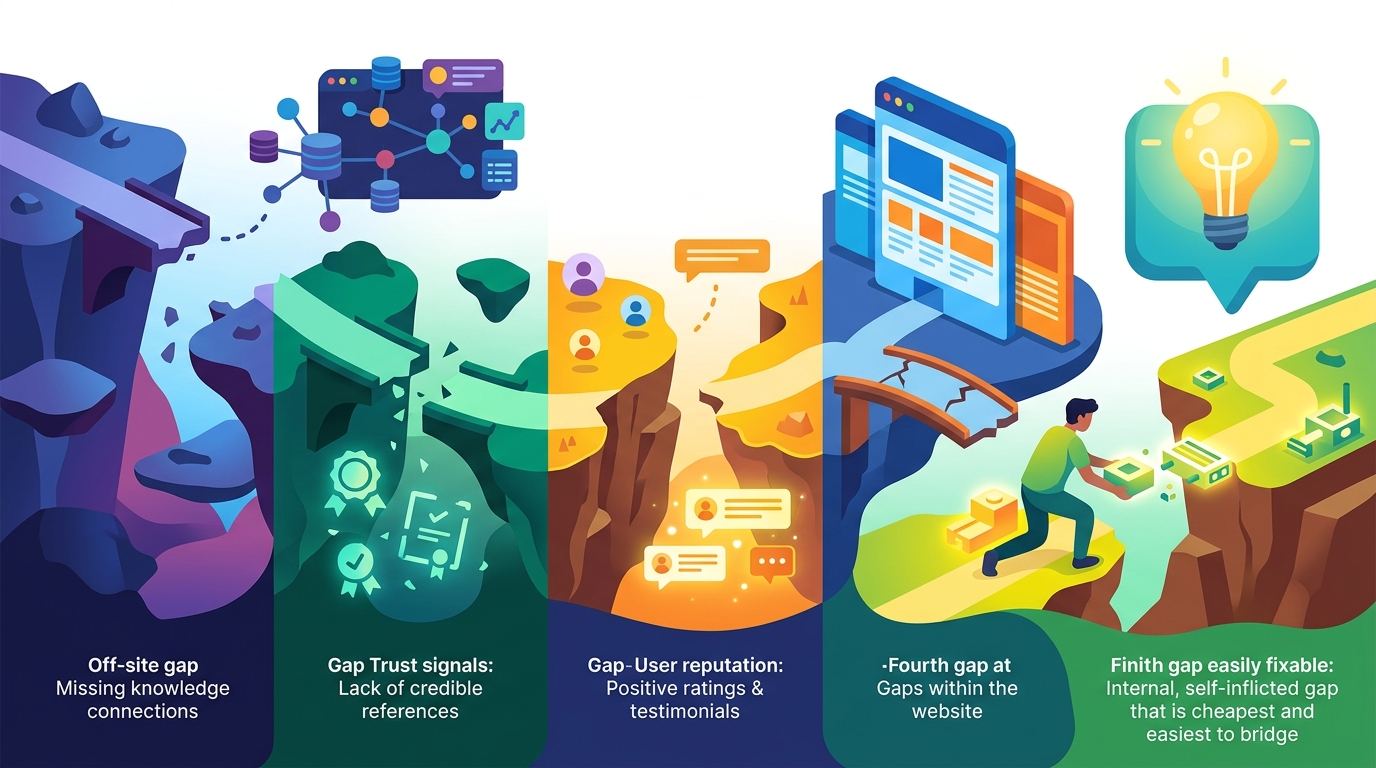
The five gaps that produce a missing recommendation
Work through these in order. The first three are off-site, which is why on-site effort alone stalls.
| Gap | What it looks like | How to test it |
|---|---|---|
| Entity grounding | The model has no stable record of what you are | Ask "what is [your company]?" and see whether the answer is accurate, vague, or a different company |
| Third-party mention density | Few independent pages name you in your category | Search your category term and count how many non-owned domains name you |
| Comparison coverage | Nobody has ever compared you to the alternatives | Search "[you] vs [competitor]" and see whether anything exists that you did not write |
| Answerable content | Your pages describe, but do not answer | curl the page and check whether a self-contained answer exists near the top |
| Reachability | Live retrieval cannot fetch you at all | Check /robots.txt for OAI-SearchBot; curl the page for raw-HTML content |
The fifth gap is the one people inflict on themselves, and it is the cheapest to fix.
Why improving your own website cannot fix this alone
Here is the structural reason the on-site-only strategy stalls, stated plainly.
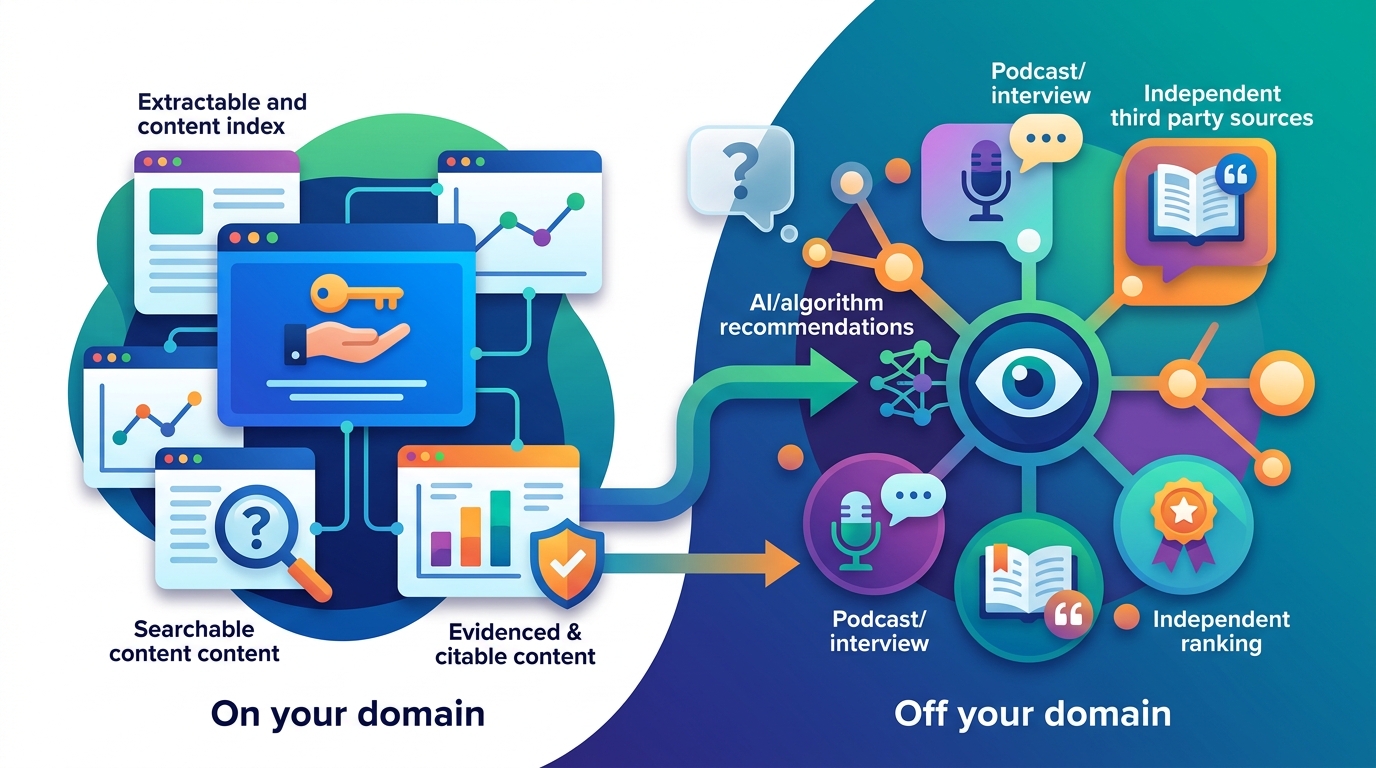
A recommendation is assembled from other people's pages about your category. Your homepage is one page in that pool, and it carries a handicap: it is self-interested. Independent sources carry more weight precisely because they are not you. So the work divides into two halves, and only one of them is on your domain:
On your domain: be reachable, be extractable, and publish answers that are specific enough and evidenced enough to be quoted. This is necessary and it is not sufficient.
Off your domain: be named, in your category, by sources that are not you — with the kind of specificity that makes you identifiable. This is the half that produces recommendations.
The second half is also where original data earns its keep. A study, a survey, a measured benchmark is a fact that other people can cite. In the KDD benchmark's terms it is the "Statistics Addition" lever, and it has a property no amount of copywriting has: a third party can reference it without having to trust you. That is what converts a claim into a citable source.
The check that comes first
Before accepting any of the above as your diagnosis, eliminate the self-inflicted cause. Two checks, both free:
- Fetch
/robots.txtand look forOAI-SearchBot. If it is disallowed — or if aUser-agent: *block covers everything — you are not in the live retrieval path at all. Your competitor is. In our audit, 6.4% of a general website sample have this configuration, while none of 57 AI-visibility vendors do. curlyour most important page and grep for your key claim. If the text is not in the raw HTML, AI crawlers do not see it; Vercel and MERJ measured that the major AI crawlers do not execute JavaScript. Details in our four-layer diagnostic.
If both pass and you are still absent, the constraint is corroboration, and that is a publishing problem rather than a configuration problem.
Frequently asked questions
Why does ChatGPT recommend my competitor and not my company? Because the recommendation is assembled from the brand names that sources discussing your category repeatedly mention, not from a product comparison. A competitor with denser third-party coverage, a clearer entity record, and existing comparison pages will be named more often, regardless of product quality.
Can I fix this by optimising my own website harder? Partly. On-site work makes you reachable and quotable, which is necessary. It does not create the third-party corroboration that produces a recommendation, because a recommendation is built substantially from pages that are not yours.
How long does it take to appear in AI recommendations? Live retrieval can change within weeks once a page and its corroboration exist. Training-based knowledge moves on model release cycles and is not on a timeline you can schedule. Treat it as two separate clocks.
What content actually helps an AI recommend us? The KDD 2024 GEO benchmark found citing sources, adding quotations, and adding statistics were the strongest content-level levers, at 30–40% relative improvement on their visibility metric. Original data has the additional property that a third party can cite it without having to trust you.
Do backlinks matter for AI recommendations? Third-party mentions matter because they are what the consensus is built from. Whether you build them through links, press, comparison pieces, or original research that others cite, the mechanism is the same: independent pages naming you in your category.
We rank above our competitor on Google and still lose the recommendation. Why? Because the recommendation is not a ranking. It is assembled from the sources the assistant reads, which include pages that rank below you, community discussions, and third-party roundups. Your Google position is not the input.
Fix the reachability first — it is free
Run the two checks above before you spend anything. A surprising share of "the AI ignores us" cases are a robots.txt line or a client-rendered page, and both are fixable today.
If those are clean, the constraint is the public record: being named, in your category, by sources that are not you. Chatgpt Grow is built for that half — a customer question turned into original research and a published, quotable article, one a day, on autopilot. And if you want to know whether your pages can be lifted at all, our free AI citeability checker tests exactly that, at the content level rather than as a claim about citations.
Sources. Crawler roles and the training-versus-search split: OpenAI's official crawler documentation (developers.openai.com/api/docs/bots). Content-level evidence: Aggarwal et al., GEO: Generative Engine Optimization, KDD 2024 (arXiv 2311.09735), with the quoted figures taken from the paper's own results. JavaScript rendering: Vercel and MERJ, "The rise of the AI crawler." Reader-side trust findings: our survey of 500 US adults who use an AI chatbot weekly, reported in full here. Reachability figures: our audit of 267 domains, detailed in GPTBot vs OAI-SearchBot. The "consensus brand set" framing follows from the documented retrieval architecture rather than from published model internals.