 Chatgpt Grow
A fair comparison · Updated September 2026
Chatgpt Grow vs Frase
Of the tools on this list, Frase is the one doing the most of the same job. It researches, writes, publishes on a schedule, provides a content calendar, watches published pages for decay, and reports how your brand shows up in AI answers. It also runs on MCP and a CLI, which nothing else here does.
So this page is a real head-to-head rather than a category explanation. The differences come down to what happens inside an article, what you get per dollar at each tier, and how much of the workflow you want handled automatically — and Frase wins some of those rows outright.
The short version
Choose Frase if
- You want one subscription covering writing, publishing, page audits and AI visibility rather than separate tools
- Content Guard matters to you: Frase watches existing pages for decay, proposes the fix and republishes on approval
- You work from an MCP client or CLI — Claude, ChatGPT, Codex, Cursor — and want your SEO tool inside it
- You want a big team: 5–10 seats and up to 10 domains, with white-label client reporting at the top tier
Choose Chatgpt Grow if
- You want original research inside the article — a commissioned survey with a public report — rather than AI articles and optimization scores
- You publish to Ghost or Notion, which Frase does not support
- You want one price and 30 articles a month rather than choosing between 10, 40 and 100 articles at $49/$129/$299
- You want a seven-dimension quality scorecard with an AI-suspicion score before publishing, not after
What is Frase?
A full content platform: research, an AI agent that writes and publishes, on-page optimization, and AI visibility tracking.
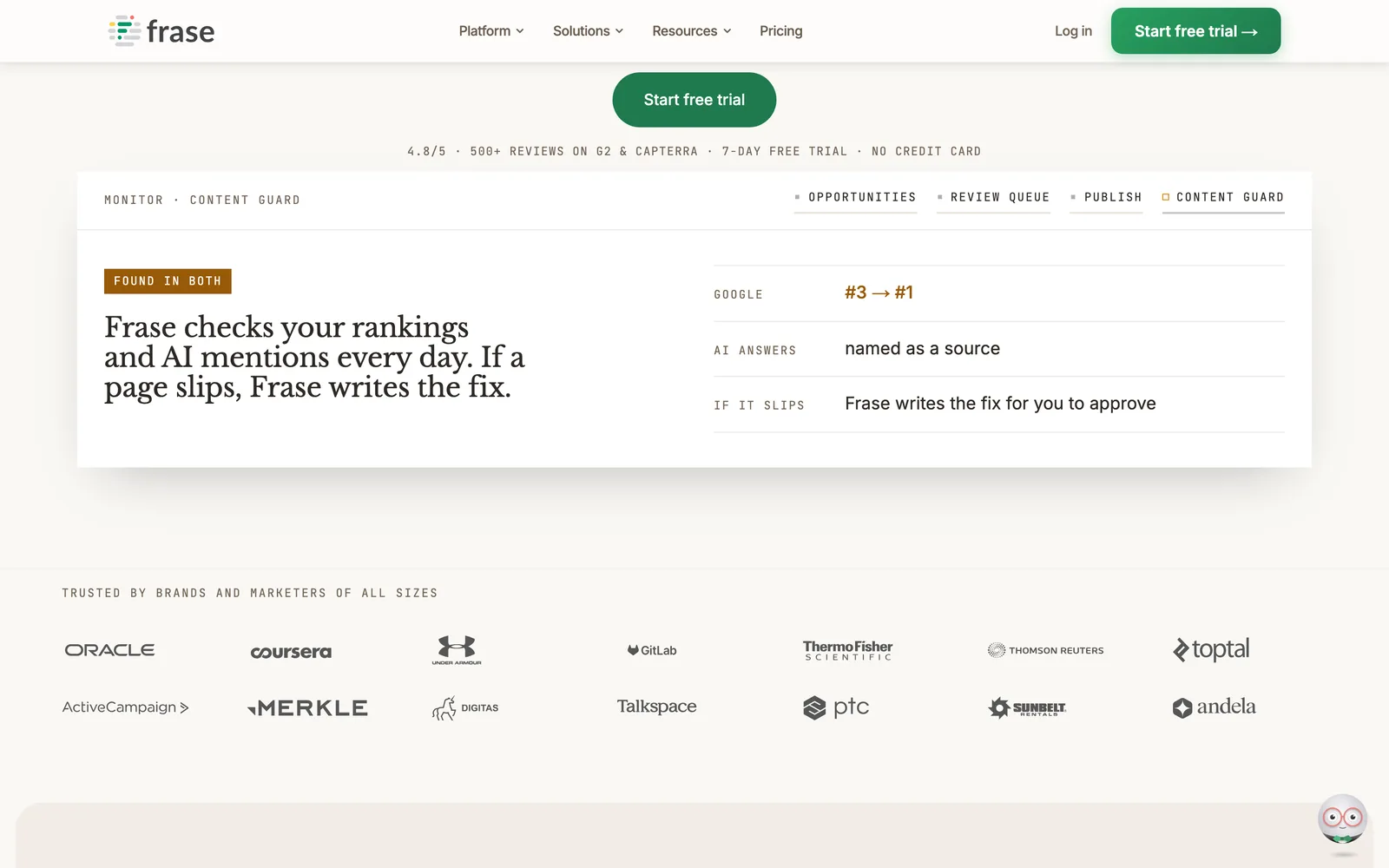
Frase started as a research and optimization workspace and has grown into one of the broadest products in this category. The agent drafts and publishes on your schedule, Content Guard monitors pages you already have for Google decay and republishes them when you approve the fix, and AI Visibility reports whether your brand is named in ChatGPT, Google AI, Perplexity, Claude and Gemini.
It is priced by articles and audit pages: Starter at $49 a month gives you 10 articles and 50 audit pages on one site and one seat; Professional at $129 gives you 40 articles, 250 audit pages, 5 sites and 3 seats; Scale at $299 gives you 100 articles, 1,000 audit pages, 10 domains and 5 seats. Annual billing takes roughly 20% off, extra seats are $29 each, and there is a seven-day trial capped at five articles.
Where Frase shines
- The broadest single subscription here: writing, publishing, page audits, internal linking suggestions, a content calendar and AI visibility
- Content Guard — monitors 10, 75 or 300 existing pages for rank and traffic decay, proposes the fix, republishes on approval
- AI visibility across more engines as you pay more: ChatGPT and Google AI on Starter, Perplexity on Professional, Claude and Gemini on Scale
- MCP server and CLI on every plan, so it runs inside Claude, ChatGPT, Codex or Cursor
- FraseCMS included as a publishing destination, with a free tier up to 100k page views a month
- Team shape for agencies: up to 10 domains, 10 seats and white-label client reports
Where Frase falls short
- No original research: articles and scores are built from existing sources, so nothing in them is citable for the first time
- Publishing excludes Ghost and Notion, which we support, and nothing on their pricing page covers a hosted blog on your own domain
- The entry tier is thin for daily publishing: $49 buys 10 articles a month, against our 30 for $99
- Unit prices are not published, so the cost per article has to be worked out per tier — $4.90 at Starter, $3.23 at Professional, $2.99 at Scale
- AI Visibility reports visibility; it does not act on it, which their own pricing page is explicit about
- Decay handling is approval-based, so someone still has to review the proposed fixes
What is Chatgpt Grow?
An AI content service that answers the questions your buyers ask — with research behind the answer.
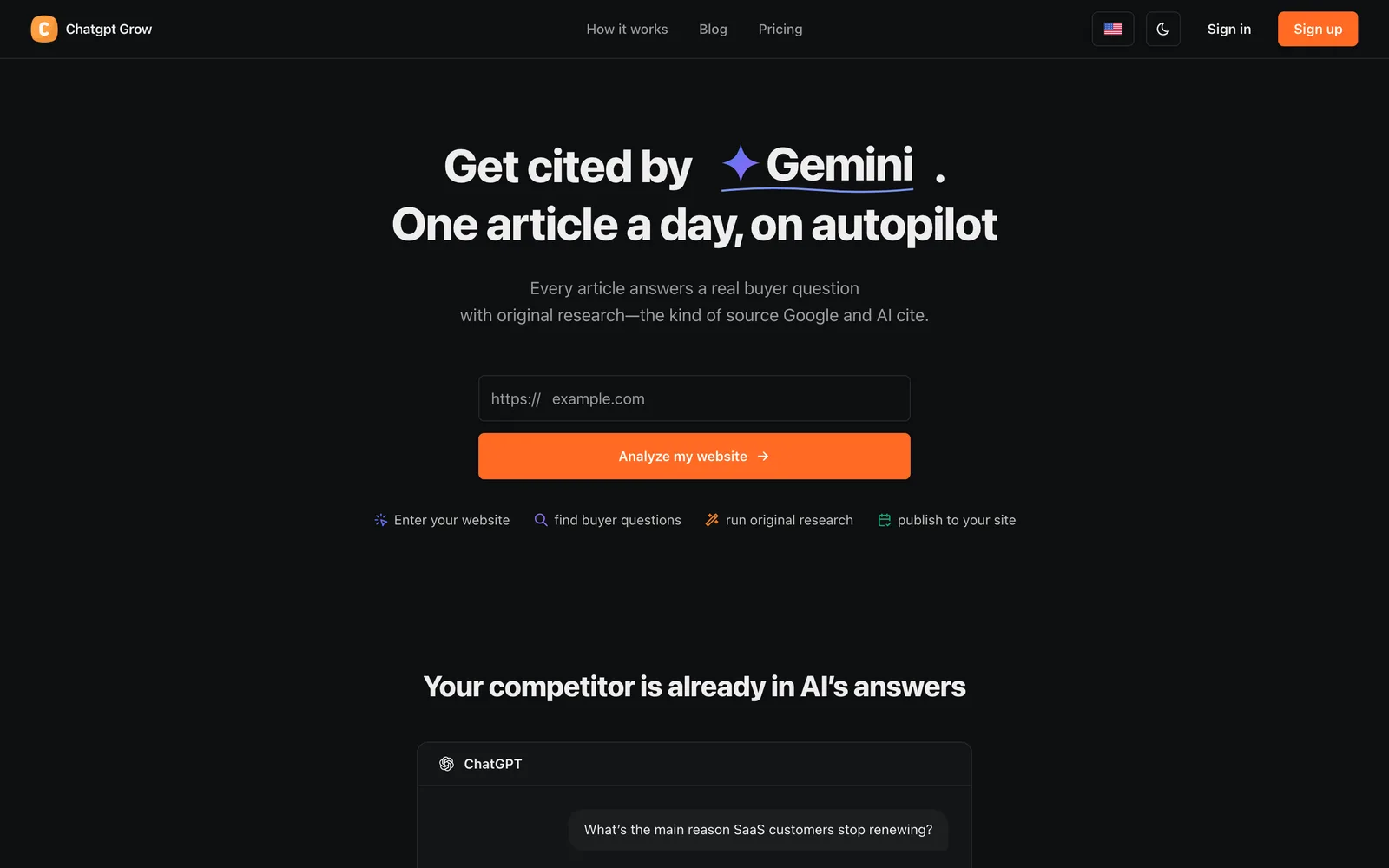
You paste your website once. Chatgpt Grow crawls it, works out what the brand actually sells, finds the competitors already being recommended by AI, and turns that into the buyer questions your site does not answer yet. Those questions become the topics, the topics become a schedule, and one researched article goes out every day.
The part we spend the most on is not the writing. Articles that carry an original number — a survey of 200 buyers, run for that article — are the ones search engines and AI assistants can quote, so the pipeline commissions that research where the topic needs it and publishes the report alongside the article. Every article is then scored on seven editorial dimensions before it goes out, including how AI-detectable it reads and whether the brand is actually named where the question is answered.
Where Chatgpt Grow shines
- One article a day for $99 a month, with the research commissioned inside the pipeline instead of bolted on
- Each researched article ships with a public report, so the numbers in it can be checked and cited
- A seven-dimension quality scorecard that includes an AI-suspicion score and brand-query alignment
- Buyer questions, competitors and topics come from your own site and your Search Console data, not from a keyword list you have to maintain
- Search Console is read per article — impressions, clicks and average position — so you can see which pieces earned their place
- Backlinks come from other brands on the same platform, and you can switch that off per site
- A public blog on your own subdomain, so a site with no CMS still has somewhere to publish
Where Chatgpt Grow falls short
- One connected publishing target per site — you cannot push the same article to WordPress and Ghost at once
- No Shopify, Wix or Framer publishing, and no Zapier, REST API or RSS feed to build around
- No AI-visibility tracking, so we cannot show you when ChatGPT or Perplexity mentions your brand
- Nothing watches pages you published elsewhere for decay, and we do not rewrite existing articles automatically
- Monthly billing only, and no per-site volume discount for agencies
- 18 publishing languages — fewer than the tools that advertise 40, 50 or 150
Feature by feature
| Feature | Chatgpt Grow | Frase |
|---|---|---|
| Content | ||
| Keep publishing an article every day | Yes — 30 articles a month, one per day | Yes — 10, 40 or 100 articles a month depending on tier |
| Write in your brand voice | Yes — from your own site content | Yes |
| Put original market research inside articles | Yes — commissioned for the article | —articles are written from existing research and sources |
| Publish a research report alongside the article | Yes — public report per researched article | — |
| Per-article quality scorecard | Yes — 7 dimensions, incl. AI-suspicion and AI citeability | Yes — SEO and GEO scores |
| Edit a published article by hand | Yes | Yes — with AI rewrite and diff |
| On-brand AI images | Yes | Yes — a hero image plus in-content visuals per article |
| Watch published pages for decay and rewrite them | — | Yes — Content Guard, 10/75/300 pages by tier, republished on approval |
| Research and data | ||
| Competitor discovery and analysis | Yes | Yes |
| Buyer-question (search intent) discovery | Yes | Yes — research and keyword tools |
| Google Search Console integration | Yes — per-article impressions, clicks and average position | —not listed on their pricing page |
| AI visibility tracking (ChatGPT, Perplexity…) | — | Yes — the strongest on this listChatGPT and Google AI on Starter; + Perplexity on Professional; + Claude and Gemini on Scale; 50/200/500 prompts tracked |
| Publishing languages | 18 — chosen per site, written in that language from the first draft | —not stated on their pricing page |
| Publishing | ||
| WordPress | Yes | Yes |
| WordPress.com | — | — |
| Ghost | Yes | — |
| Webflow | Yes | Yes |
| Notion | Yes | — |
| Shopify | — | — |
| Wix | — | Yes |
| Framer | — | — |
| HubSpot | — | — |
| Sanity | — | Yes |
| Contentful | — | — |
| Google Docs | — | — |
| Blog hosted for you (no CMS needed) | Yes — public blog on your own subdomain | Yes — FraseCMS, free to 100k page views a month |
| Zapier / Make | — | —MCP and API are offered instead |
| REST API and webhooks | — | Yes — MCP server and CLI on every plan, 5k–50k requests a month |
| Other publishing targets | — | — |
| Links | ||
| Automatic internal linking | Yes | Yes — suggestions from Professional up |
| Backlink exchange included | Yes | — |
| Backlink exchange is opt-in per site | Yes | — |
| Plans | ||
| Free trial | Yes — one free article, then the first 14 days for $9 | Yes — 7 days, no card, capped at 5 articles and 50 audit pages |
| Annual billing discount | — | Yes — about 20% off the monthly price |
| Multi-site discount | — | —sites are bundled into tiers: 1, 5 or 10 domains |
“—” means the vendor did not document that capability on its public pricing or feature pages as of September 2026 — not that it is impossible. Where a row is genuinely close, the note under it says so.
Pricing, side by side
Chatgpt Grow
$99/mo
One plan, one site, 30 articles a month.
- $99 per month per site — 30 articles, one published every day
- One free article before you pay, then the first 14 days for $9
- Auto-publishing to WordPress, Ghost, Webflow or Notion
- Original research data and a public report where the topic needs it
- Cross-brand backlink exchange, opt-in per site
- Publishing language chosen per site, out of 18
Frase
$49–$299/mo
Articles, audit pages, sites and seats all bundled into the tier.
- $49/mo — Starter: 10 articles, 50 audit pages, 1 site, 1 seat
- $129/mo — Professional: 40 articles, 250 audit pages, 5 sites, 3 seats
- $299/mo — Scale: 100 articles, 1,000 audit pages, 10 domains, 5 seats
- Annual billing about 20% off; extra seats $29/mo; 7-day trial capped at 5 articles
- FraseCMS hosted blog included, free up to 100k page views a month
Why choose Chatgpt Grow over Frase?
The same feature list, with one thing added
Frase and Chatgpt Grow agree on almost everything: a daily agent, a quality check before publishing, a hosted blog if you have no CMS, and a scorecard on the finished article. The list of rows where Frase is ahead is real and worth reading — Content Guard, AI visibility across five engines, MCP, seats for a team.
The row where we differ is the one that decides what the article is worth. Frase writes from material that already exists, which is fine for coverage. Chatgpt Grow commissions the evidence where a topic needs it, puts the finding in the article, and publishes the report beside it — so the page contains something a reader, a link and an AI assistant cannot get anywhere else.
Ten articles a month is not a publishing habit
Frase’s entry tier is $49 for 10 articles and one site. That is a sensible place to test a product, and it is a real constraint if the goal is compounding organic traffic — the research on publishing cadence is consistent that weekly is the floor and daily is what changes rankings on a new site.
Our smallest plan is 30 articles a month on one site for $99, and there is no tier that publishes fewer than one a day. You can buy more than that from Frase — 40 articles at $129, 100 at $299 — and at those tiers their cost per article ($3.23 and $2.99) is competitive with ours at $3.30.
Where Frase is simply better
Three rows, plainly. Content Guard monitors pages you published before you arrived — including pages we know nothing about — and fixes them when they slide. We do not touch existing pages at all.
AI visibility tracking across ChatGPT, Google AI, Perplexity, Claude and Gemini is the most complete on this list, and we have nothing comparable. And MCP plus a CLI means a team can drive Frase from inside the tools they already have open. If any of those three is your reason for buying, Frase is the right answer and the price difference will not change that.
Frequently asked questions
Frase and Chatgpt Grow look almost identical. What actually differs?
Three things. Frase does more around the article — decay monitoring, AI visibility across five engines, MCP access, more seats. We do more inside it — commissioned original research with a published report, and a seven-dimension quality scorecard before publishing. And the tier shapes differ: Frase sells 10, 40 or 100 articles, we sell 30 for everyone.
Which is cheaper per article?
By published list price, Frase: $4.90 an article at Starter, $3.23 at Professional, $2.99 at Scale. Ours is $3.30 at every volume. So Frase is cheaper at 40 and 100 articles a month and considerably more expensive at 10 — and neither figure counts the audit pages, seats or AI visibility you also get from Frase at those tiers.
Can Chatgpt Grow fix articles I published before I signed up?
No. We only work on articles we publish. Frase’s Content Guard watches pages you already have, including ones you wrote yourself, tells you what is decaying and republishes on your approval. If maintaining an existing library matters more than growing a new one, that is Frase’s advantage and it is not close.
Do either of these help with being cited by AI?
They approach it differently. Frase measures it: it tells you whether your brand appears in ChatGPT, Google AI, Perplexity, Claude and Gemini answers, and which prompts you are missing from. Chatgpt Grow tries to cause it: articles carrying original research and a published report are the kind of source assistants quote. Measurement is the more complete answer to the question — doing both is reasonable.
Can I run both without them conflicting?
Yes. Both publish to WordPress and Webflow, so point one of them at your blog and use the other for what it is better at. The one thing to avoid is running two agents publishing daily articles to the same blog, which produces a volume neither was designed for.
Sources
Every fact on this page was checked against these pages in September 2026:
See what it writes for your own site.
Prices and features change. If something on this page is out of date, tell us and we will correct it.