 Chatgpt Grow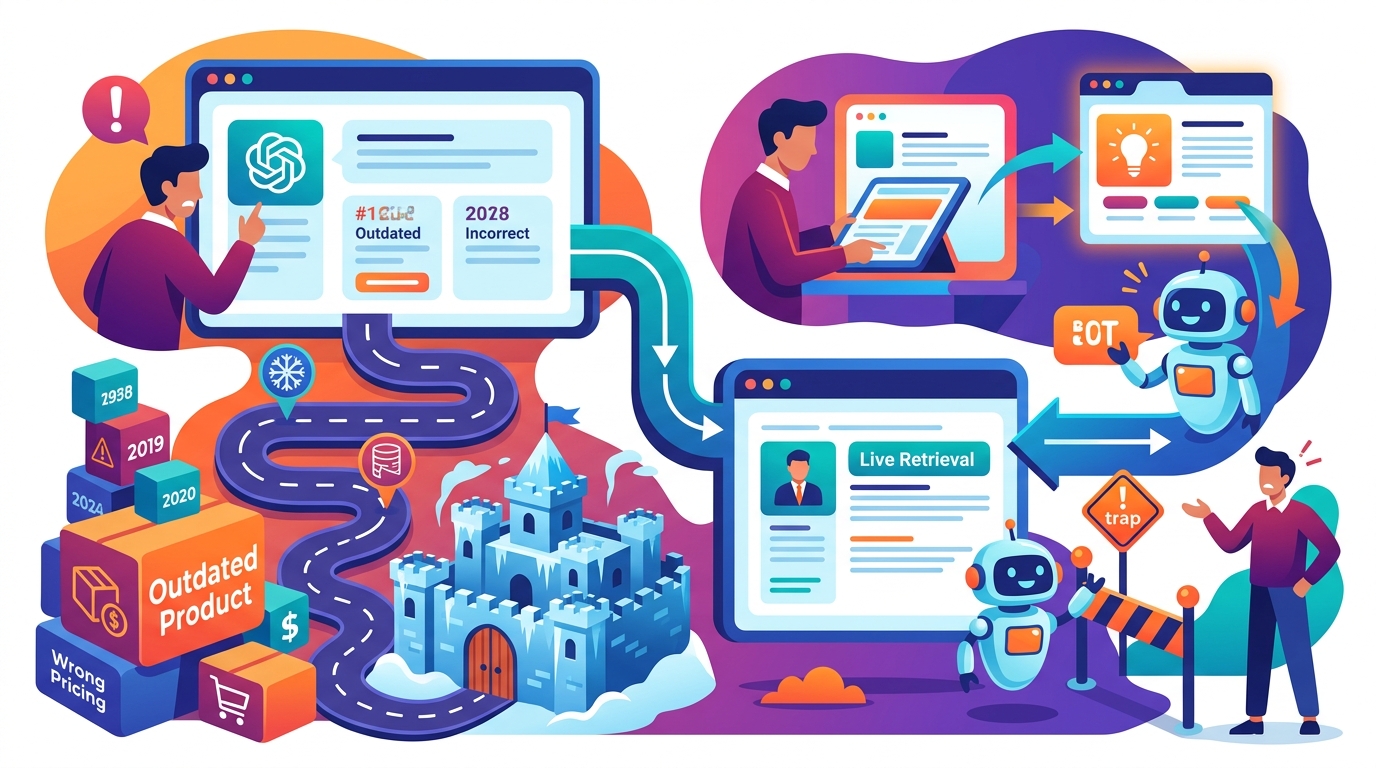
ChatGPT Says Wrong Things About My Company — and Blocking the Search Crawler Makes It Worse
Whether an AI error about your business is fixable depends on which path it came from. OpenAI's crawler documentation tells you how to tell them apart, and why removing yourself from live retrieval locks the error in.
October 13, 2026 · 10 min read
By Alex Li, Founder · Contact the author
You ask an AI assistant about your own company and it gets it wrong. It describes an outdated product. It confuses you with a similarly named business. It states a price you have never charged. There is no edit button, and every guide hands you the same list of generic fixes.
The first useful step is not a fix. It is working out which of two entirely separate systems produced the error, because one of them is correctable this week and the other is not correctable at all.
The short version
- AI assistants have two sources about your company: training data, frozen at the model's cutoff, and live retrieval, fetched at answer time. OpenAI's crawler documentation separates them explicitly.
- The two paths fail differently and are fixed differently. Corroboration and time address the first; source correction addresses the second. Advice that does not distinguish them is advice that half-works at best.
- There is a documented trap: blocking
OAI-SearchBotremoves you from the live retrieval path, which is the only channel through which corrected, current information about your company can reach an answer. In our audit, 6.4% of a general website sample do exactly that. - In-product feedback is a real channel, but it is a signal, not a control. Your leverage is upstream, on the pages the model reads.
Two paths, two different failures
OpenAI's crawler documentation describes a family of crawlers whose separation is the answer to this whole problem.
"GPTBot is used to make our generative AI foundation models more useful and safe. It is used to crawl content that may be used in training our generative AI foundation models."
"OAI-SearchBot is for search. OAI-SearchBot is used to surface websites in search results in ChatGPT's search features."
"ChatGPT-User... When users ask ChatGPT or a CustomGPT a question, it may visit a web page with a ChatGPT-User agent."
Read as a system, that is two information channels plus a user-triggered fetch:
| Training path | Retrieval path | |
|---|---|---|
| Fed by | GPTBot | OAI-SearchBot, ChatGPT-User |
| When it is read | Model training, then frozen | At the moment a user asks |
| How it fails | Stale, generic, or confused with a similar name | Wrong page, wrong version, missing page |
| What fixes it | New corroborating material, published consistently, over time | Correcting or replacing the pages the model reads |
| Time to effect | Unknown — tied to model releases | Hours to weeks, once the page is right |
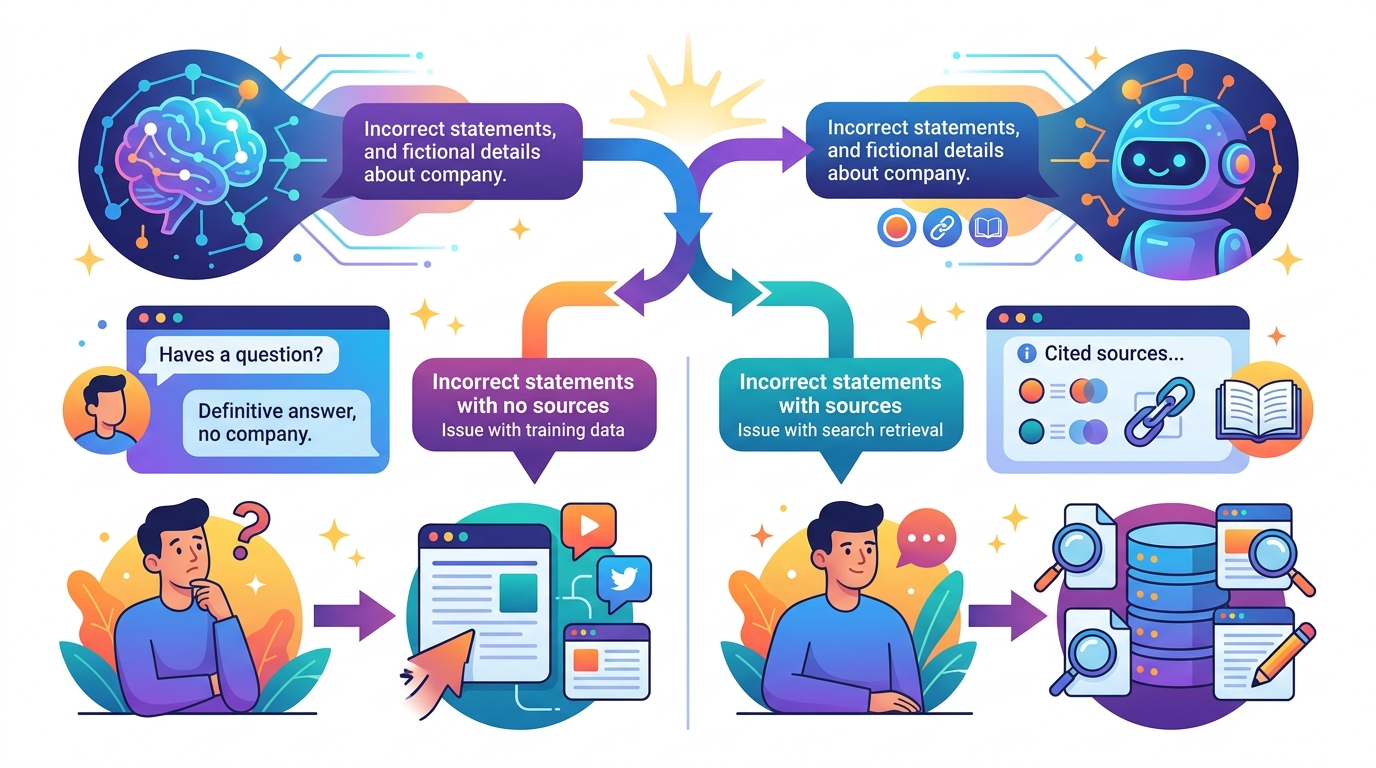
The practical diagnostic follows from the third row. Does the wrong statement arrive with sources? If the answer names or links pages, the error is on the retrieval path and you can go and fix the page. If the answer asserts something about your company with no sources at all, you are most likely looking at training data, and the correction is a publication campaign rather than an edit.
That single question changes what you should do next, and almost no guide asks it.
Why there is no edit button
The most useful thing to accept early is that there is no factual correction form. A model trained on public text cannot hold knowledge that is not in public text. Your org chart, your internal roadmap, your unannounced pricing, and the nuance in your sales deck are not on the public web, so the model has no route to them.
This is why "it hallucinates about how our company actually works" is usually not a hallucination in the technical sense. It is a reasonable reconstruction from incomplete public evidence. The model is not wrong about your business; it is accurately summarising a public record that is thin, outdated, or dominated by other people's descriptions of you.
Which means the fix has to be upstream, on that public record. And that is where the trap is.
The trap: blocking the search crawler locks the error in
Here is the part that turns a nuisance into a permanent problem.
If the live retrieval path is the channel through which current, corrected information about your company can reach an answer, then removing yourself from that path leaves the model with only the frozen training record. That is the opposite of what people intend when they block AI crawlers — usually a privacy gesture, or a preset they never read.
OpenAI's documentation is explicit about the consequence for the search crawler: sites opted out of OAI-SearchBot "will not be shown in ChatGPT search answers, though can still appear as navigational links." Nothing about that removes the company from the model's training-based knowledge. It removes the possibility of updating it.
In our audit of 267 real websites, the crowd most likely to get this right does:
| Population | Blocking OAI-SearchBot | Blocking GPTBot (training) |
|---|---|---|
| AI-visibility vendors (n=57) | 0 (0%) | 3 (5.3%) |
| General sites (n=110) | 7 (6.4%) | 21 (19.1%) |
If your complaint is that an AI assistant describes your company incorrectly, check this before anything else. A site-wide Disallow: / under User-agent: * does the same thing — it blocks both paths at once, including the one that could carry the correction.
The correction workflow, in the order that actually helps
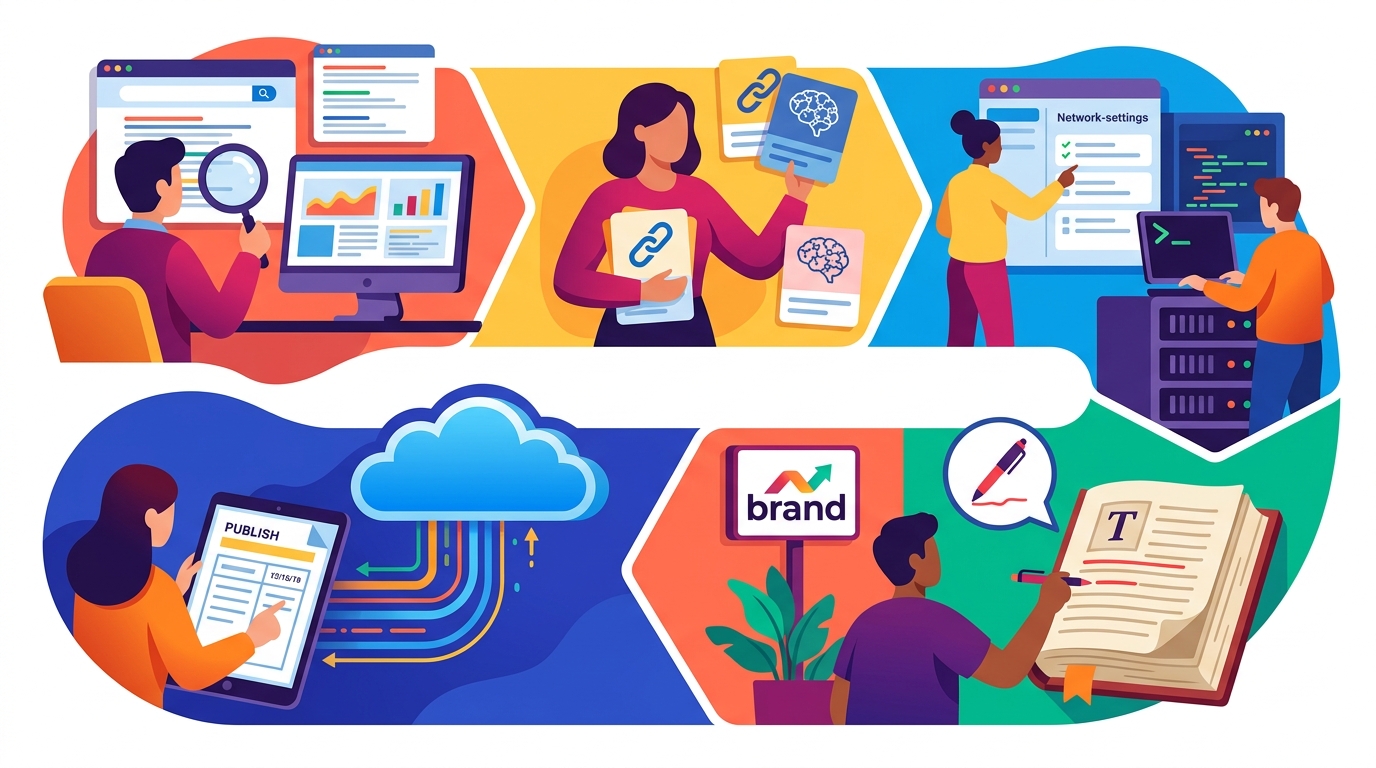
1. Capture the failure precisely, more than once. Ask the same question across several sessions and on more than one engine, and record the exact wording. Answers vary between runs, so a single capture may be an outlier rather than your standing description.
2. Classify it: retrieval or training. Sources cited or linked → retrieval, and you have a page to fix. No sources at all → treat it as training data. Some errors will be both, appearing differently depending on whether web search triggers.
3. Audit your own reachability before anything else. robots.txt for OAI-SearchBot, and a curl of your key pages to confirm the content is in the raw HTML rather than rendered client-side. These are the first two layers of the diagnostic, and they cost minutes.
4. For retrieval errors, correct the source — not your homepage. The model does not read your brand's intentions; it reads whatever page currently ranks for the question. If a 2019 press release or a directory listing is the source, correcting your homepage changes nothing. Find the page that is being read and fix, update, or supersede it.
5. Publish current facts in a form that can be lifted. A dated, self-contained statement — a page that says what your company is, what it does, and what changed, near the top, without needing surrounding context — is quotable in a way that a homepage is not. This is also the only thing that addresses the training path over time: enough consistent, dated, crawlable statements that a future model learns the current version.
6. File in-product feedback for the rest. Every major assistant has a feedback mechanism. It is worth using, and it is a signal rather than a control — treat it as a supplement to the upstream work, not a substitute.
7. Re-test on a schedule, not once. Because answers vary, a single re-check cannot tell you whether a change worked. Run the same prompt set monthly and watch the trend.
What does not help
Correcting a Wikipedia article if the error is not from Wikipedia. Unless you can see the source in the answer, you are guessing at the offending page. Check first.
Rewriting your homepage copy in a more authoritative tone. Tone is not the variable; presence in the sources the model reads is. In our survey of 500 weekly AI chatbot users, a confident, authoritative tone was the least trusted quality in an AI answer, chosen by 8.8% — a separate finding, but a reminder that polish is not the lever here.
Blocking crawlers to force the model to stop talking about you. This does not remove you from training-based knowledge, and it removes the retrieval correction channel. If the goal is genuinely to disappear entirely, blocking both paths is a coherent strategy — but it should be a decision, not a default.
Frequently asked questions
Can I get ChatGPT to correct information about my company? Not directly — there is no factual correction form that edits model knowledge. What you can do is correct the pages it reads when it runs a live search, and publish dated, crawlable, consistent statements so that future training runs learn the current version. In-product feedback is a real signal but not a control.
How do I tell whether the error comes from training data or live search? Check whether the answer cites or links sources. A sourced error is on the retrieval path and traceable to a page. An unsourced statement about your company is more likely from training data, where the correction is corroboration and time rather than an edit.
Does blocking AI crawlers stop ChatGPT from describing my company incorrectly?
It can make it more persistent. Blocking OAI-SearchBot removes your site from ChatGPT search answers — the channel through which current, corrected information reaches an answer — while leaving the training-based description intact. In our audit, 6.4% of a general website sample block it; none of 57 AI-visibility vendors do.
Why does ChatGPT not know my company at all? Training data is frozen at a cutoff, so companies that became notable afterwards may be absent. That is a corroboration problem rather than a configuration problem: what changes it is being described consistently across sources the model has learned to trust, over a long enough period to be picked up.
Why does it confuse my company with a similarly named one? Because the public record does not distinguish you clearly enough. The fix is disambiguation in the sources: consistent naming, a clear description of what distinguishes you, and pieces that exist specifically to separate the two entities.
Do schema markup or an FAQ page fix a wrong description? They help a page be parsed and quoted cleanly when retrieval happens. They do not change what the model believes, and they do nothing if the crawler cannot reach the page. Order of operations matters: reachability, then extractability, then corroboration.
Start with the check that costs two minutes
Before rewriting anything, confirm you are reachable and extractable. Open /robots.txt and look for OAI-SearchBot; then curl the page you expect to be quoted and check that the text is in the raw HTML. Those two checks eliminate the most common self-inflicted causes, and they are covered in detail in GPTBot vs OAI-SearchBot.
If both pass and the description is still wrong, the problem is the public record rather than your configuration. Chatgpt Grow is built for that half: a customer question turned into original research and a published, dated, quotable article — one a day, on autopilot.
Sources. Crawler roles and the search-versus-training split: OpenAI's official crawler documentation (developers.openai.com/api/docs/bots). Retrieval behaviour: OpenAI Help Center, "Searching the web with ChatGPT." Configuration figures: our audit of 267 domains, detailed in GPTBot vs OAI-SearchBot. Confidence-versus-trust finding: our survey of 500 US adults who use an AI chatbot weekly, reported in full here. Model knowledge is deliberately opaque; the two-path framing above follows from the documented crawler separation rather than from any published account of model internals.