 Chatgpt Grow
A fair comparison · Updated September 2026
Chatgpt Grow vs Scalenut
Scalenut has moved further than anyone else on this list. It started as an AI writer with an SEO optimizer, and it now sells AI visibility first: a dashboard that tracks how ChatGPT, Google AIO and Perplexity describe your brand, reports a visibility score and share of voice, shows which URLs those engines cite, and turns the gaps into recommendations for new articles, backlinks and forum threads. The writing tools are still underneath — Cruise Mode drafts an optimised article in about five minutes, and the optimizer scores and rewrites pages you already have.
So it sits on both halves of what we do, and it is clearly ahead on one of them. This page works through where its visibility data is better than anything we sell, where its price per article beats ours, and what neither product does.
The short version
Choose Scalenut if
- You want to know how AI assistants describe your brand — visibility score, share of voice, the URLs they cite — before you write anything
- You want to audit and improve pages you already published, up to 2,000 a month, rather than grow a library from nothing
- You publish to Shopify, or you want scheduling inside the WordPress publisher
- You run several domains: Professional includes unlimited workspaces, and there is a backlinks marketplace
Choose Chatgpt Grow if
- You want the article to go out every day without anyone choosing the topic or pressing go
- You want the evidence in each article to be original, with a published report, rather than assembled from the pages already ranking
- You want the quality score to be part of the pipeline, including an AI-suspicion dimension, rather than a separate add-on to buy
- You have no CMS, or you publish to Ghost and Notion, which Scalenut does not reach
What is Scalenut?
A GEO platform: AI visibility tracking, page audits and recommendations, with an AI writer and an optimizer underneath.
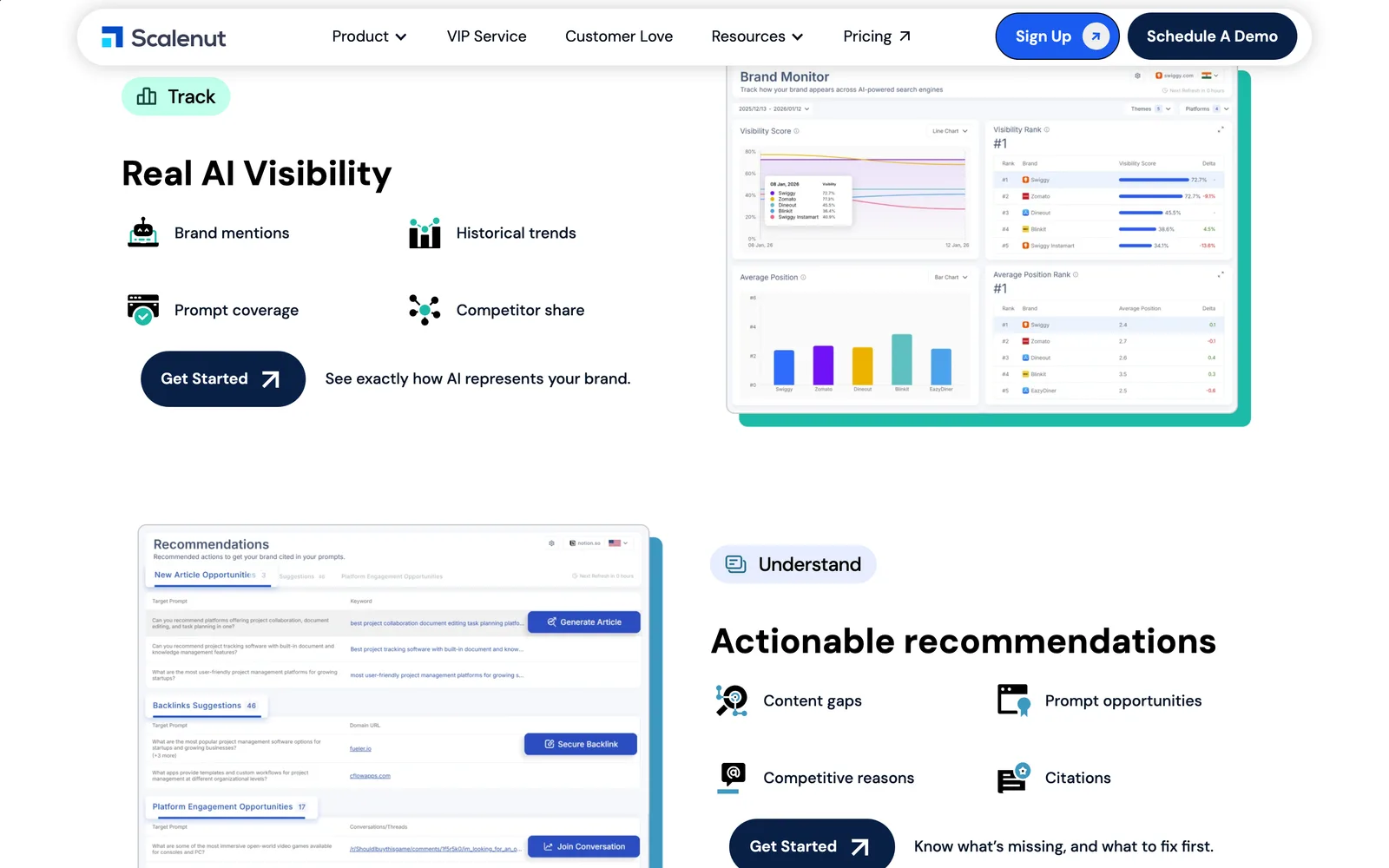
The product is organised around three modules. AI Visibility is the flagship: you enter a brand, domain and country, pick themes, and it tracks a set number of prompts across AI engines on a weekly refresh, reporting visibility score, average position, share of voice, sentiment, citations and a query-fanout view of how the assistant broke the question down. The GEO content engine turns that into work — creating ready-to-rank articles, optimising articles you already have, auditing up to 2,000 webpages a month, and building keyword clusters. And the older writer layer is still there: Cruise Mode, the content optimizer, the keyword planner, interlinking, an SEO score and a GEO score on each piece.
Pricing is quota-based and the quotas move with the tier. Starter is $59 a month list for 10 tracked prompts, 5 GEO articles a month and one workspace. Plus is $89 for 25 prompts, 30 articles a month, up to four seats and auto-publish to WordPress and Shopify. Professional is $199 for 100 prompts, 75 articles a month, unlimited workspaces and Perplexity added alongside ChatGPT and Google AIO. At the time of writing their pricing page was showing all three at 60% off — $24, $36 and $80 — under a Black Friday deal for annual plans that starts on 19 November, and annual plans double the article and audit limits. Above that there is a VIP service with a dedicated strategist, writers and editors. Publishing integrations are WordPress and Shopify, with Semrush, Copyspace and a keyword tool alongside them.
Where Scalenut shines
- AI visibility tracking that goes past counting mentions: visibility score, average position, share of voice, heatmaps, prompt-level citations and sentiment, plus a query-fanout view of how the engine reasoned
- Recommendations that are meant to be acted on: new article opportunities, link suggestions, and Reddit or Quora threads to take part in
- Audits and optimises pages you already published — 200 to 2,000 a month depending on tier — which is work we do not do at all
- The lowest cost per article on this list if you drive it yourself: 75 articles a month at the Professional price, 30 at the Plus price
- Cruise Mode produces an optimised, brand-toned draft in about five minutes, with an editable outline first
- AI Content Detector & Humanizer, AI Link Manager and OnPage Pro as add-ons, plus a free WordPress plugin
- Unlimited workspaces on Professional, which is the shape an agency needs
Where Scalenut falls short
- The articles are triggered by you. There is no plan that writes and publishes a daily cadence on its own, which is the thing we sell
- WordPress and Shopify only: no Ghost, Webflow, Notion, Wix or Framer, and no webhook or API to reach anything else
- No original research. Content comes from SERP analysis, NLP terms and competitor outlines, so the article contains what already ranks
- No Search Console connection; the traffic side is a Cloudflare integration that separates AI bot visits from human ones
- The AI detector is an add-on, separate from the score the optimizer already gives you
- Prompt counts are small on the entry tiers — 10 on Starter, 25 on Plus — and refresh weekly rather than daily
What is Chatgpt Grow?
An AI content service that answers the questions your buyers ask — with research behind the answer.
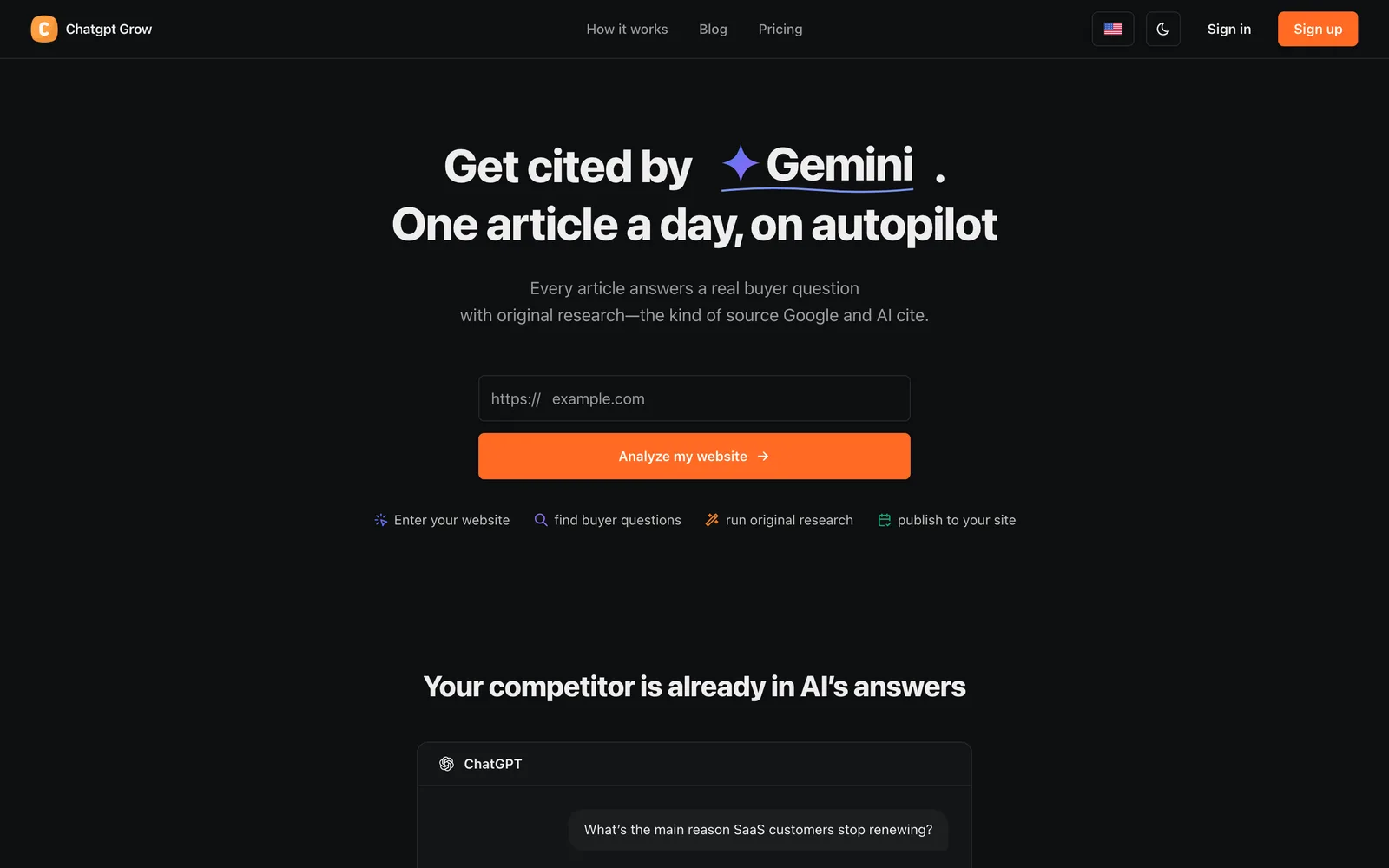
You paste your website once. Chatgpt Grow crawls it, works out what the brand actually sells, finds the competitors already being recommended by AI, and turns that into the buyer questions your site does not answer yet. Those questions become the topics, the topics become a schedule, and one researched article goes out every day.
The part we spend the most on is not the writing. Articles that carry an original number — a survey of 200 buyers, run for that article — are the ones search engines and AI assistants can quote, so the pipeline commissions that research where the topic needs it and publishes the report alongside the article. Every article is then scored on seven editorial dimensions before it goes out, including how AI-detectable it reads and whether the brand is actually named where the question is answered.
Where Chatgpt Grow shines
- One article a day for $99 a month, with the research commissioned inside the pipeline instead of bolted on
- Each researched article ships with a public report, so the numbers in it can be checked and cited
- A seven-dimension quality scorecard that includes an AI-suspicion score and brand-query alignment
- Buyer questions, competitors and topics come from your own site and your Search Console data, not from a keyword list you have to maintain
- Search Console is read per article — impressions, clicks and average position — so you can see which pieces earned their place
- Backlinks come from other brands on the same platform, and you can switch that off per site
- A public blog on your own subdomain, so a site with no CMS still has somewhere to publish
Where Chatgpt Grow falls short
- One connected publishing target per site — you cannot push the same article to WordPress and Ghost at once
- No Shopify, Wix or Framer publishing, and no Zapier, REST API or RSS feed to build around
- No AI-visibility tracking, so we cannot show you when ChatGPT or Perplexity mentions your brand
- Nothing watches pages you published elsewhere for decay, and we do not rewrite existing articles automatically
- Monthly billing only, and no per-site volume discount for agencies
- 18 publishing languages — fewer than the tools that advertise 40, 50 or 150
Feature by feature
| Feature | Chatgpt Grow | Scalenut |
|---|---|---|
| Content | ||
| Keep publishing an article every day | Yes — 30 articles a month, one per day | PartialCruise Mode writes a draft in about five minutes and the publisher can schedule it; each article is triggered by hand |
| Write in your brand voice | Yes — from your own site content | Yes — unlimited tone of voice from Plus up |
| Put original market research inside articles | Yes — commissioned for the article | —written from SERP analysis, NLP terms and competitor outlines |
| Publish a research report alongside the article | Yes — public report per researched article | — |
| Per-article quality scorecard | Yes — 7 dimensions, incl. AI-suspicion and AI citeability | Yes — an SEO score and a GEO score in the optimizerthe AI Content Detector & Humanizer is a separate add-on |
| Edit a published article by hand | Yes | Yes — the editor and optimizer work on existing articles |
| On-brand AI images | Yes | Yes — image quotas by tier |
| Watch published pages for decay and rewrite them | — | —existing pages can be audited and optimized on demand, 200 to 2,000 a month by tier |
| Research and data | ||
| Competitor discovery and analysis | Yes | Yes — auto-detected competitors in AI Visibility, plus keyword clusters and SERP analysis |
| Buyer-question (search intent) discovery | Yes | Yes — tracked prompts, query fanout and keyword clusters |
| Google Search Console integration | Yes — per-article impressions, clicks and average position | —Cloudflare is the integration offered for AI traffic; Search Console is not on their integrations page |
| AI visibility tracking (ChatGPT, Perplexity…) | — | Yes — the most complete on this listChatGPT and Google AIO from Starter, Perplexity from Professional; 10/25/100 prompts, weekly refresh; visibility score, share of voice, citations, sentiment |
| Publishing languages | 18 — chosen per site, written in that language from the first draft | —not stated on their pricing, features or integrations pages |
| Publishing | ||
| WordPress | Yes | Yes — publisher with scheduling, and a free plugin |
| WordPress.com | — | — |
| Ghost | Yes | — |
| Webflow | Yes | — |
| Notion | Yes | — |
| Shopify | — | Yes — publisher |
| Wix | — | — |
| Framer | — | — |
| HubSpot | — | — |
| Sanity | — | — |
| Contentful | — | — |
| Google Docs | — | — |
| Blog hosted for you (no CMS needed) | Yes — public blog on your own subdomain | — |
| Zapier / Make | — | — |
| REST API and webhooks | — | — |
| Other publishing targets | — | — |
| Links | ||
| Automatic internal linking | Yes | Yes — interlinking from your own domain, Plus and above |
| Backlink exchange included | Yes | —a paid backlinks marketplace and AI-generated link suggestions instead |
| Backlink exchange is opt-in per site | Yes | — |
| Plans | ||
| Free trial | Yes — one free article, then the first 14 days for $9 | Yes — no card to start |
| Annual billing discount | — | Yes — 60% off for life on annual plans in the current promotion, and double the limits |
| Multi-site discount | — | —workspaces are bundled: 1, 2 or unlimited domains by tier |
“—” means the vendor did not document that capability on its public pricing or feature pages as of September 2026 — not that it is impossible. Where a row is genuinely close, the note under it says so.
Pricing, side by side
Chatgpt Grow
$99/mo
One plan, one site, 30 articles a month.
- $99 per month per site — 30 articles, one published every day
- One free article before you pay, then the first 14 days for $9
- Auto-publishing to WordPress, Ghost, Webflow or Notion
- Original research data and a public report where the topic needs it
- Cross-brand backlink exchange, opt-in per site
- Publishing language chosen per site, out of 18
Scalenut
$24–$80/mo
Prompts tracked, articles created and pages audited, bundled into each tier.
- List prices $59 / $89 / $199 a month; the pricing page shows them at $24 / $36 / $80 under a Black Friday deal for annual plans starting 19 November
- $24 — Starter: 10 prompts, 5 GEO articles a month (10 on annual), 1 workspace, ChatGPT and Google AIO
- $36 — Plus: 25 prompts, 30 articles a month (60 on annual), 200 audited pages, up to 4 seats, auto-publish to WordPress and Shopify
- $80 — Professional: 100 prompts, 75 articles a month (150 on annual), 1,000 audited pages, unlimited workspaces, Perplexity added
- VIP Service: custom — a dedicated strategist, writers and editors on top of the software
- Add-ons: AI Content Detector & Humanizer, AI Link Manager, OnPage Pro, and a free WordPress plugin
Why choose Chatgpt Grow over Scalenut?
The same three letters doing two different jobs
Scalenut treats generative engine optimisation as a measurement problem: find out what the engines say about you, find the prompts you are missing from, audit the pages you have, and fix the ones that are weak. That is a coherent product, and the visibility module is deeper than anything we sell — visibility score, share of voice, citations, sentiment, query fanout, and a list of the exact threads and pages the engines are reading.
We treat it as an evidence problem. Articles that carry a number nobody has published before are the ones an assistant can cite as the origin rather than summarise, so we commission the research where a topic needs it and publish the report beside the article. The two approaches are complementary: Scalenut tells you where you are invisible, we make something visible worth citing. Neither page contains the other half.
Scalenut is cheaper per article, and it is not close
On the current promotion, Plus is $36 a month for 30 articles — $1.20 each — and Professional is $80 for 75, which is about $1.07. We charge $3.30 an article at every volume. Even at list prices their Professional tier undercuts us roughly threefold per article.
What that price includes and excludes is the whole argument. Their quota covers the article, the score and the publishing slots; the writing is triggered by you, one at a time, and the research behind each piece is what already ranks. Our price covers the research, the scorecard and the calendar, and nobody has to be at the keyboard. If you have the time and want volume cheaply, Scalenut is the better buy and no amount of feature-table scoring changes that.
Where Scalenut is simply better
Visibly better on three things. Visibility tracking is a product we do not have: not just whether you are mentioned, but your share of voice against named competitors, the URLs the engines cite, sentiment, and a fanout view of the reasoning behind an answer. Auditing and rewriting pages you already published is the second — 200 to 2,000 pages a month is a real fix for a site with a history, and we only ever touch articles we publish ourselves.
The third is breadth of extras at a low price: a backlinks marketplace, an AI humanizer, a link manager, OnPage Pro and a free WordPress plugin, all on top of an article engine that already undercuts us per article. What none of it does is put a researched, scored article on your blog tomorrow morning without you — but if that is not what you need, this page should not talk you out of Scalenut.
Frequently asked questions
Do Scalenut and Chatgpt Grow do the same job?
Partly. Both will write and publish an SEO article. Scalenut is built around measuring your visibility in AI answers and fixing the pages you already have; the writing is one module inside that, triggered by you, with quotas for articles and audited pages. Chatgpt Grow is built around publishing: one researched article a day per site, scored before it goes out, on a calendar you never touch. If you want to know where you are invisible, that is Scalenut. If you want tomorrow morning handled, that is us.
Which is cheaper per article?
Scalenut. On the current promotion, Plus gives 30 articles a month for $36 ($1.20 each) and Professional gives 75 for $80 (about $1.07), against our flat $3.30 an article. Their entry tier is the one to watch: $24 for 5 articles a month is $4.80 each, more than we charge, on the smallest allowance.
Who has better AI visibility data?
Scalenut, and there is no argument on our side. It tracks visibility score, share of voice, average position, sentiment, the specific URLs an engine cites, and a query-fanout breakdown of how the answer was assembled, across ChatGPT, Google AIO and Perplexity. We have no equivalent. What we do instead is put original research and a published report inside the article, which is what makes a page quotable — measuring without something worth citing tells you that you are losing.
Does Scalenut publish articles on a schedule?
It can schedule a post: the WordPress publisher exports drafts, schedules them and publishes, and auto-publish to WordPress and Shopify is listed from the Plus tier. What it does not have is a plan that decides the topics and keeps the cadence for you — every article starts with a person and a keyword. That distinction is the main reason someone picks us instead.
Can I use both?
Yes, and the split is clean as long as you keep them apart. Use Scalenut for measurement and for the pages you already have — visibility tracking, audits, GEO optimisation of existing posts — and use us for the new article stream, where the requirement is a published research angle and a daily cadence. Pointing both writers at the same blog is the only combination that goes wrong.
Sources
Every fact on this page was checked against these pages in September 2026:
See what it writes for your own site.
Prices and features change. If something on this page is out of date, tell us and we will correct it.