 Chatgpt Grow
A fair comparison · Updated September 2026
Chatgpt Grow vs Byword
Byword is the volume option. Starter is $83 a month billed annually for twenty-five articles, and at the top of the published range Scale is $833 a month for three hundred — $2.78 an article, which is the cheapest per-article price on this list by a wide margin. It also carries the subscriber count to match: 85,000 users and, by its own count, more than three million articles generated.
Two things make it more than a bulk writer. Every draft gets a real-time SEO score while you write it, which is the closest thing here to a quality gate before publishing. And Research Intelligence reads the SERP, the intent and the questions people ask before the article is written. What it does not do is commission anything: the research is about what already ranks.
The short version
Choose Byword if
- You publish at volume and price per article is the number that matters — $2.78 at the top tier
- You want a real-time SEO score on the draft rather than a report afterwards
- You want programmatic pages built from templates at thousands of pages a month
- You want unlimited domains from the middle tier, and API access to build around it
Choose Chatgpt Grow if
- You want the evidence in the article to be original — commissioned for that topic, with a public report behind it
- You want a multi-dimension quality scorecard on the finished article, not a single SEO score while writing
- You want Search Console read per article, so a piece of content carries its own impressions and clicks
- You need a CMS other than WordPress, or no CMS at all
What is Byword?
A high-volume AI article platform built around one SEO score, priced per article at $2.78 to $3.50.
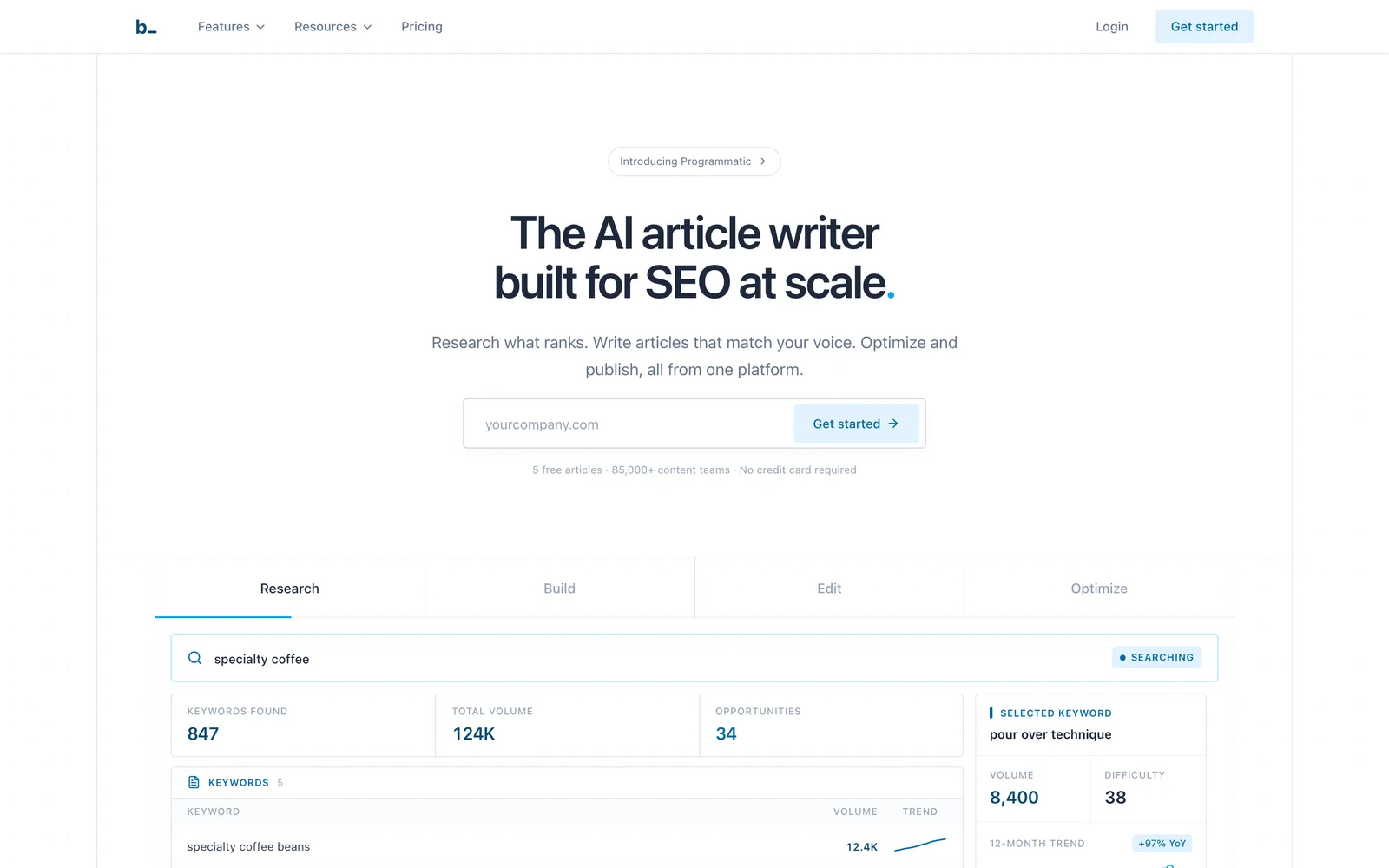
Byword is organised as four stages: Research Intelligence reads the SERP, works out the intent and surfaces the questions; AI Generation writes to a template in a matched brand voice; Smart Optimization scores the draft against SEO signals in real time; and Programmatic SEO turns templates into pages at a scale the manual flow cannot reach. The scoring is the part worth noting, because it is a gate rather than a report — a single number you can hold a draft against before it publishes.
The plans are per article and the arithmetic is unusually clean. Starter is $83 a month billed annually for twenty-five articles, $3.50 each for extra ones, five domains and a single seat. Standard is $249 for eighty articles at $3.00 each, three seats, unlimited domains and API access. Scale is $833 for three hundred articles at $2.50 each and ten seats. Every plan includes all AI models and seventeen image styles; annual billing saves 17%. The published prices above are the annual ones, and the article counts are hard limits rather than rates.
Where Byword shines
- The cheapest per-article price here: $2.78 each on the Scale plan, $2.50 for overflow articles on top
- A real-time SEO score on the draft while you write it, rather than a report after publication
- Programmatic SEO — templates that produce thousands of pages, which none of the other tools on this list advertises
- Research Intelligence does SERP, intent and question analysis before writing
- Unlimited domains and API access from the middle tier
- 47 publishing languages, and all AI models included rather than tier-gated
- A genuinely free start: five articles, no card
Where Byword falls short
- No original research. Research Intelligence analyses what already ranks, so the article contains no finding that did not exist before
- The score is one SEO number, not a multi-dimension quality scorecard, and nothing scores AI-detectability
- Nothing described for watching pages you have already published for decay
- Publishing is narrow as far as the public pages say: WordPress and webhooks are the only destinations named without a login
- Article counts are hard ceilings — there is no per-site or unlimited-article plan short of Enterprise
- Annual billing is where every quoted price applies; you have to read the monthly toggle to compare like for like
What is Chatgpt Grow?
An AI content service that answers the questions your buyers ask — with research behind the answer.
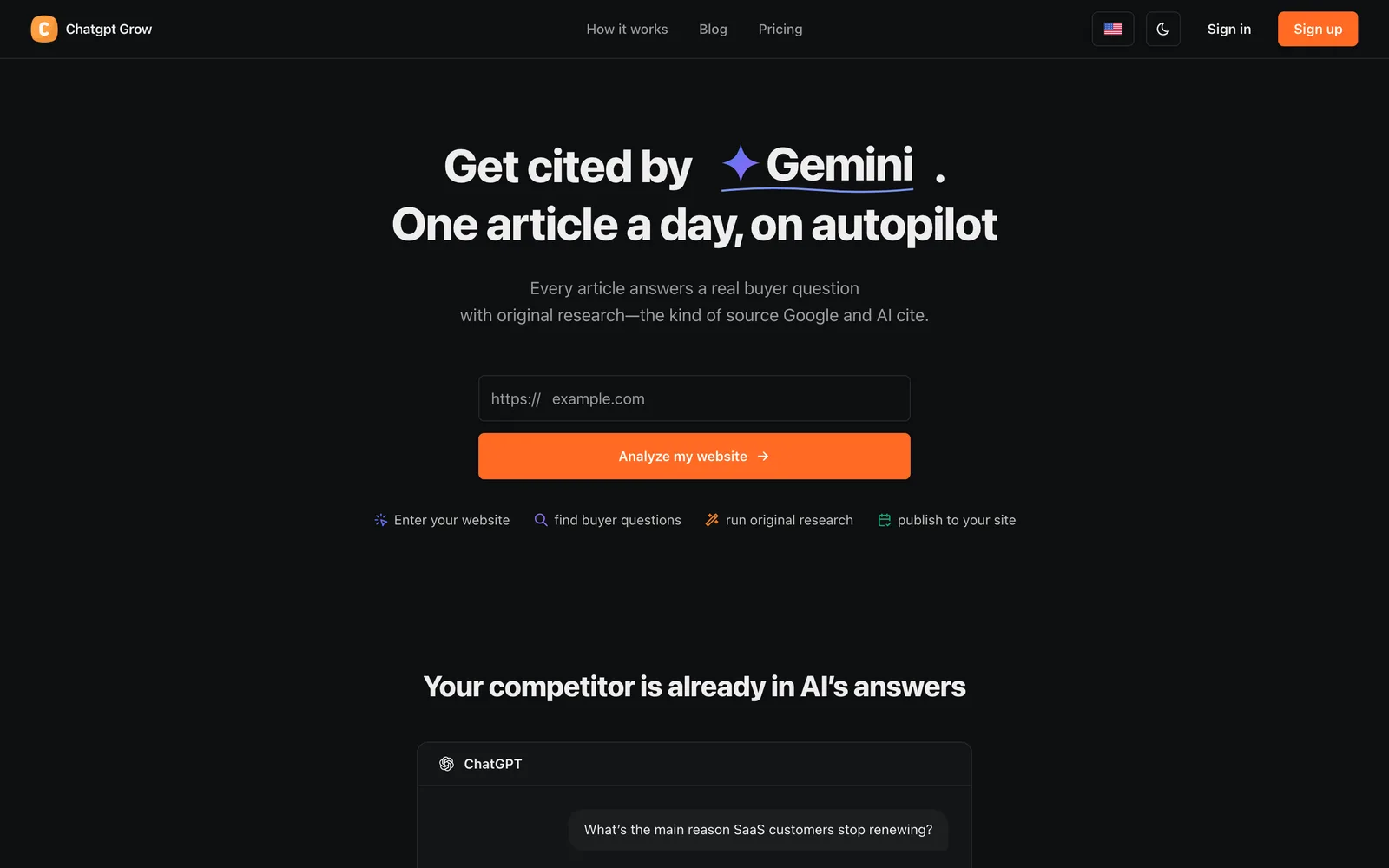
You paste your website once. Chatgpt Grow crawls it, works out what the brand actually sells, finds the competitors already being recommended by AI, and turns that into the buyer questions your site does not answer yet. Those questions become the topics, the topics become a schedule, and one researched article goes out every day.
The part we spend the most on is not the writing. Articles that carry an original number — a survey of 200 buyers, run for that article — are the ones search engines and AI assistants can quote, so the pipeline commissions that research where the topic needs it and publishes the report alongside the article. Every article is then scored on seven editorial dimensions before it goes out, including how AI-detectable it reads and whether the brand is actually named where the question is answered.
Where Chatgpt Grow shines
- One article a day for $99 a month, with the research commissioned inside the pipeline instead of bolted on
- Each researched article ships with a public report, so the numbers in it can be checked and cited
- A seven-dimension quality scorecard that includes an AI-suspicion score and brand-query alignment
- Buyer questions, competitors and topics come from your own site and your Search Console data, not from a keyword list you have to maintain
- Search Console is read per article — impressions, clicks and average position — so you can see which pieces earned their place
- Backlinks come from other brands on the same platform, and you can switch that off per site
- A public blog on your own subdomain, so a site with no CMS still has somewhere to publish
Where Chatgpt Grow falls short
- One connected publishing target per site — you cannot push the same article to WordPress and Ghost at once
- No Shopify, Wix or Framer publishing, and no Zapier, REST API or RSS feed to build around
- No AI-visibility tracking, so we cannot show you when ChatGPT or Perplexity mentions your brand
- Nothing watches pages you published elsewhere for decay, and we do not rewrite existing articles automatically
- Monthly billing only, and no per-site volume discount for agencies
- 18 publishing languages — fewer than the tools that advertise 40, 50 or 150
Feature by feature
| Feature | Chatgpt Grow | Byword |
|---|---|---|
| Content | ||
| Keep publishing an article every day | Yes — 30 articles a month, one per day | Yes — 25 to 300 articles a month by tier, with publishing automation$83/mo billed annually for 25 |
| Write in your brand voice | Yes — from your own site content | Yes — brand voice matching in article generation |
| Put original market research inside articles | Yes — commissioned for the article | —Research Intelligence analyses existing SERP content; nothing is commissioned |
| Publish a research report alongside the article | Yes — public report per researched article | — |
| Per-article quality scorecard | Yes — 7 dimensions, incl. AI-suspicion and AI citeability | Partly — a single real-time SEO score on the draftone SEO number, not a multi-dimension scorecard |
| Edit a published article by hand | Yes | —not stated on the pricing page |
| On-brand AI images | Yes | Yes — 17 image styles on every plan |
| Watch published pages for decay and rewrite them | — | — |
| Research and data | ||
| Competitor discovery and analysis | Yes | Yes — SERP analysis and research intelligence |
| Buyer-question (search intent) discovery | Yes | Yes — intent and PAA questions surface in Research Intelligence |
| Google Search Console integration | Yes — per-article impressions, clicks and average position | —not stated on the pages we reviewed |
| AI visibility tracking (ChatGPT, Perplexity…) | — | — |
| Publishing languages | 18 — chosen per site, written in that language from the first draft | 47 |
| Publishing | ||
| WordPress | Yes | Yes — named in the site navigation |
| WordPress.com | — | — |
| Ghost | Yes | —their integrations page requires a login; only WordPress and webhooks are public |
| Webflow | Yes | —see above |
| Notion | Yes | —see above |
| Shopify | — | —see above |
| Wix | — | —see above |
| Framer | — | —see above |
| HubSpot | — | —see above |
| Sanity | — | —see above |
| Contentful | — | —see above |
| Google Docs | — | —see above |
| Blog hosted for you (no CMS needed) | Yes — public blog on your own subdomain | — |
| Zapier / Make | — | —webhooks are public, which is how Zapier would be wired, but it is not named |
| REST API and webhooks | — | Yes — webhooks publicly; API access from Standard ($249) |
| Other publishing targets | — | —anything else goes through webhooks |
| Links | ||
| Automatic internal linking | Yes | —not stated on the pages we reviewed |
| Backlink exchange included | Yes | — |
| Backlink exchange is opt-in per site | Yes | — |
| Plans | ||
| Free trial | Yes — one free article, then the first 14 days for $9 | Yes — 5 free articles, no credit card |
| Annual billing discount | — | Yes — 17% off |
| Multi-site discount | — | —5 domains on Starter, unlimited from Standard; per-article pricing rather than per-site |
“—” means the vendor did not document that capability on its public pricing or feature pages as of September 2026 — not that it is impossible. Where a row is genuinely close, the note under it says so.
Pricing, side by side
Chatgpt Grow
$99/mo
One plan, one site, 30 articles a month.
- $99 per month per site — 30 articles, one published every day
- One free article before you pay, then the first 14 days for $9
- Auto-publishing to WordPress, Ghost, Webflow or Notion
- Original research data and a public report where the topic needs it
- Cross-brand backlink exchange, opt-in per site
- Publishing language chosen per site, out of 18
Byword
$83–$833/mo
Per-article pricing with hard monthly ceilings and a 17% annual discount.
- $83/mo — Starter: 25 articles, $3.50 each extra, 5 domains, solo use
- $249/mo — Standard: 80 articles, $3.00 each extra, 3 seats, unlimited domains, API access
- $833/mo — Scale: 300 articles, $2.50 each extra, 10 seats, priority support
- Enterprise — Unlimited: bring your own model keys, 500+ articles a month
- All prices above are the annual-billing rates; annual saves 17%
- Free: 5 articles, no credit card
Why choose Chatgpt Grow over Byword?
They win on price per article, and it is not close
At Scale, Byword is $2.78 an article. Our thirty articles a month work out at $3.30 each, and we do not sell a three-hundred-article plan at all. If your constraint is how much text you can produce for a fixed monthly sum, Byword is the better buy and the arithmetic is not in dispute.
What we are selling instead is a fixed number of finished, scored, research-backed articles. Both shapes have a catch. Ours is that you cannot buy ten articles to test a hunch. Theirs is that the article count is a hard ceiling — the overflow rate applies only after you have used the plan up — and that the research behind each piece is a reading of what already ranks.
One SEO score against a seven-dimension scorecard
This is the closest thing on the list to what we do before publishing, and it deserves credit: scoring the draft while it is being written is more useful than a report a month later. If a single SEO number is the gate you want, Byword gives it to you cheaply.
Our scorecard answers a different question. Seven dimensions including how AI-detectable the prose reads, how well-sourced the claims are and whether the piece actually answers the question it was written for. The difference matters when the article is going to be judged by a reader and a retrieval system rather than by a keyword table.
Where Byword is simply better
Three rows, plainly. It is cheaper per article at every tier. It builds programmatic pages from templates, which we do not offer at all. And it publishes in 47 languages against our four.
One caveat that is not a difference of opinion: their integrations page requires an account, so the only publishing destinations named publicly are WordPress and webhooks. We have listed the rest as unknown rather than guessing, which means this table understates them if they connect to more. Check their site directly before deciding on that row.
Frequently asked questions
Is Byword cheaper than Chatgpt Grow?
Yes. Byword is $83 a month billed annually for twenty-five articles and $833 for three hundred, which is $3.32 and $2.78 an article. Ours is $99 a month for thirty articles, $3.30 each. At the entry tier the two are close; by the time Byword reaches three hundred articles a month there is no comparison to make.
Does Byword do original research?
No. Its Research Intelligence stage reads the SERP, the intent and the people-also-ask questions for the target keyword, then writes to match. That is a good way to build coverage and it is what most tools here do, but the article contains no finding that did not exist before, so there is nothing in it for another site to link to or an AI assistant to quote as the origin.
What does the SEO score actually measure?
Byword describes it as real-time SEO scoring on the draft, so it is a single optimisation number rather than a set of dimensions. Our scorecard scores seven things separately, including how AI-detectable the prose reads and whether the piece answers the question it targets. A single number is faster to act on; seven numbers tell you which part failed.
Which platforms does each one publish to?
For Byword we can only confirm WordPress and webhooks from public pages — their integrations page needs an account, so we have marked the rest unknown rather than guess. We publish to WordPress, WordPress.com, Ghost, Webflow, Notion and Shopify, plus a webhook, and we host the blog on your own subdomain if you have no CMS. If a specific CMS is a requirement, check Byword directly.
Can I try either one before paying?
Yes, both. Byword gives five free articles with no credit card, which is a real trial of the writing. We do not have a free tier — the plan is monthly and you cancel it — so the cheaper way to judge our output is to read the articles we publish ourselves under Research, which carry the same research and scoring we sell.
Sources
Every fact on this page was checked against these pages in September 2026:
See what it writes for your own site.
Prices and features change. If something on this page is out of date, tell us and we will correct it.