 Chatgpt Grow
A fair comparison · Updated September 2026
Chatgpt Grow vs Arvow
Arvow packs more into its middle tier than anything else on this list. Business, at $69 a month on the annual rates shown, adds automatic backlinks, LLM brand visibility tracking, local SEO, an AI SEO editor, custom content templates, knowledge bases, auto-translation and webhooks to everything in Solo — which already includes autoblogging, site optimisation, internal and external linking, API access and 150+ publishing languages.
The catch is that it is priced in credits rather than articles, and the credit costs are itemised on the pricing page: fifteen credits for an article, ten more if it comes from a feed, six for each LLM visibility prompt, two per optimised page, one per image or edit. Solo includes a thousand credits a month, Business two thousand and Ultimate eight thousand, so the article count depends entirely on what else you spend them on.
The short version
Choose Arvow if
- You want the most rows in a feature table for the money: backlinks, LLM visibility, local SEO and translation from $69
- You publish in many languages — 150+ are supported, and auto-translate is on the middle tier
- You want an MCP connector so an AI agent can drive the tool, which is unusual on this list
- You will use the credit system across articles, images, optimisation and prompt tracking rather than articles alone
Choose Chatgpt Grow if
- You want a fixed number of finished articles a month, and you do not want to budget credits across four kinds of task
- You want the evidence in the article to be original — commissioned for that topic, with a public report behind it
- You want a seven-dimension quality scorecard on the finished article before it publishes
- You want Search Console read per article rather than a site-level view
What is Arvow?
A credit-metered SEO automation platform with the broadest bundled feature list on this list, from $39 a month.
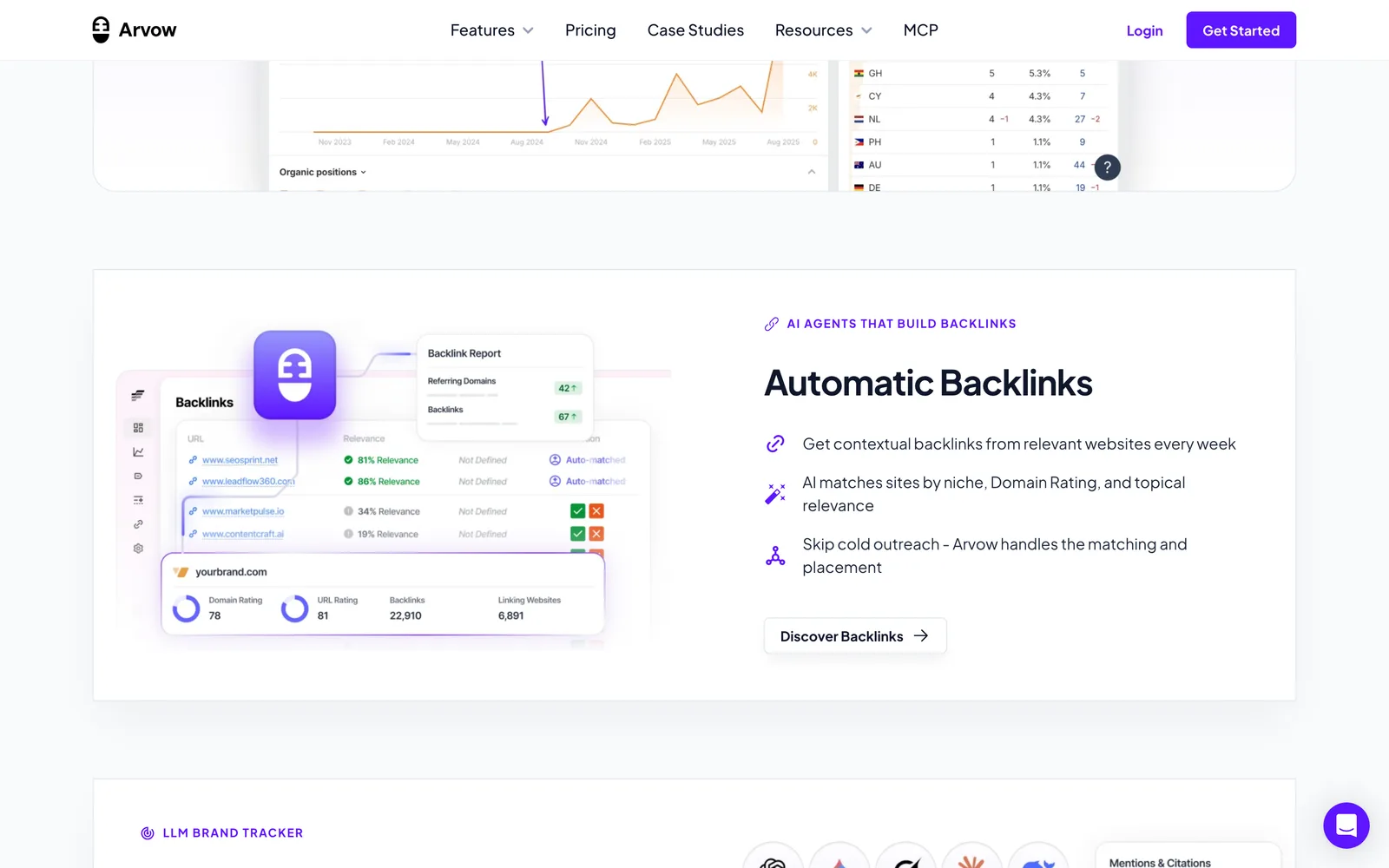
Arvow is three plans and a credit pool, and it sells breadth. Solo at $39 a month on the annual rates shown covers autoblogging, Site Optimizer, internal and external linking, all integrations, 150+ publishing languages, featured and in-article images, YouTube embeds, automatic keyword research, API access and an MCP connector for driving the tool from an AI agent. It is one website and a thousand credits.
Business at $69 is where the list gets long. It adds automatic backlinks, LLM brand visibility, a local SEO booster, an AI SEO editor, custom content templates, knowledge bases, auto-translate, custom images, webhooks and one sub-account, and doubles the credits to two thousand across five websites. Ultimate at $249 gives eight thousand credits, unlimited websites and sub-accounts, white-label SEO reports, Slack support and one-to-one coaching. Above the software there is also a managed human service from $2,000 a month. Credits are consumed per task rather than per article, and top-up credits do not expire.
Where Arvow shines
- Automatic backlinks on the $69 tier, which is the closest thing on this list to a backlink feature
- LLM brand visibility tracking on the same tier, and only six credits per prompt
- 150+ publishing languages with auto-translate included from Business
- An MCP connector, so an AI agent can operate the platform rather than you clicking through it
- Internal and external linking, site optimisation and automatic keyword research all on the cheapest plan
- Credits are itemised and top-ups never expire, so unused capacity is not lost at the end of the month
Where Arvow falls short
- Credited rather than article-based, so what a month produces depends on how you spend: an article is fifteen credits, a visibility prompt six
- No original research. Keyword research and site optimisation analyse what already exists
- No per-article quality scorecard described
- No free tier and no free trial is stated on the pricing page
- Nothing described for watching published pages for decay
- The prices shown are the annual rates; the page does not print the monthly equivalents alongside them
What is Chatgpt Grow?
An AI content service that answers the questions your buyers ask — with research behind the answer.
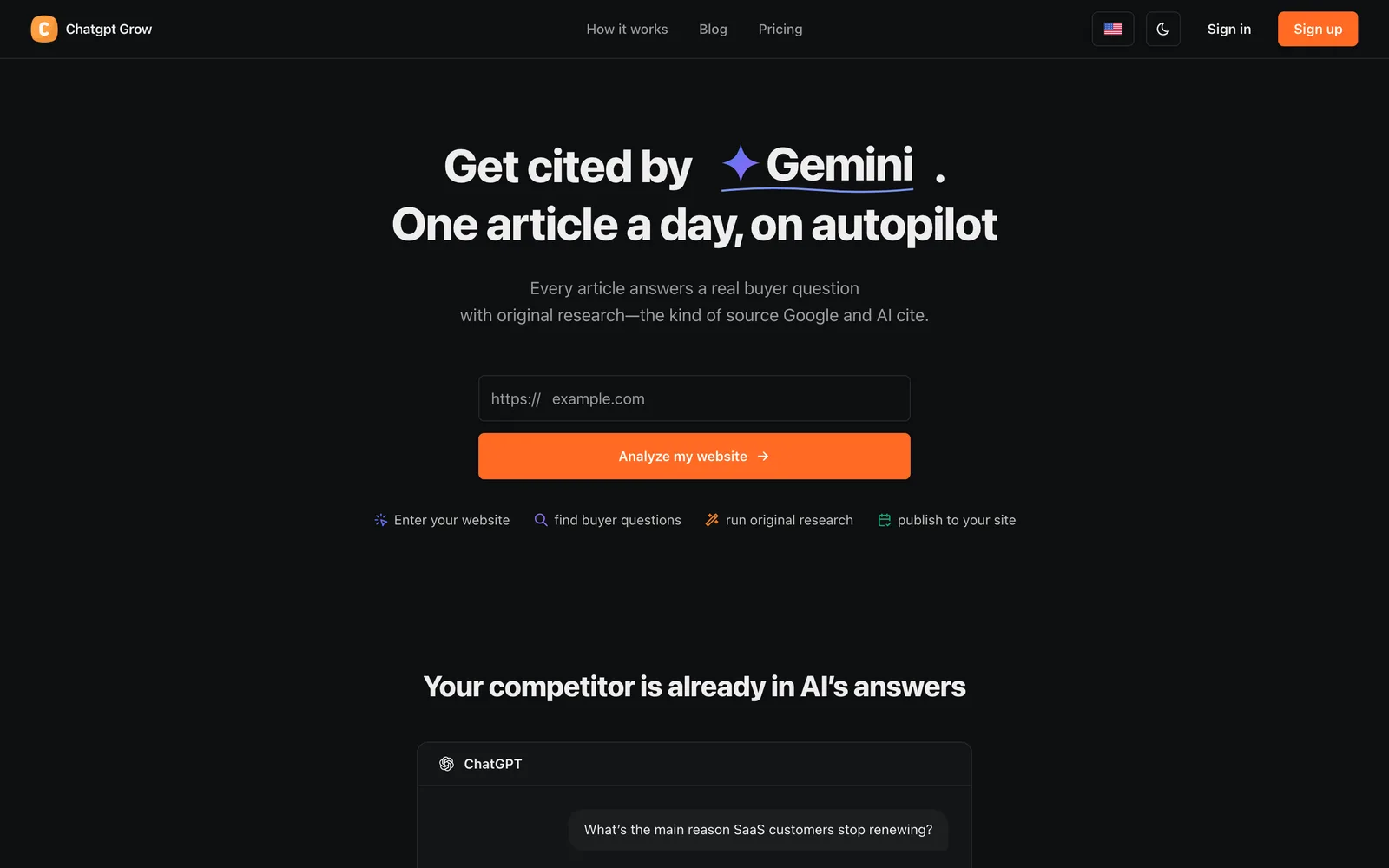
You paste your website once. Chatgpt Grow crawls it, works out what the brand actually sells, finds the competitors already being recommended by AI, and turns that into the buyer questions your site does not answer yet. Those questions become the topics, the topics become a schedule, and one researched article goes out every day.
The part we spend the most on is not the writing. Articles that carry an original number — a survey of 200 buyers, run for that article — are the ones search engines and AI assistants can quote, so the pipeline commissions that research where the topic needs it and publishes the report alongside the article. Every article is then scored on seven editorial dimensions before it goes out, including how AI-detectable it reads and whether the brand is actually named where the question is answered.
Where Chatgpt Grow shines
- One article a day for $99 a month, with the research commissioned inside the pipeline instead of bolted on
- Each researched article ships with a public report, so the numbers in it can be checked and cited
- A seven-dimension quality scorecard that includes an AI-suspicion score and brand-query alignment
- Buyer questions, competitors and topics come from your own site and your Search Console data, not from a keyword list you have to maintain
- Search Console is read per article — impressions, clicks and average position — so you can see which pieces earned their place
- Backlinks come from other brands on the same platform, and you can switch that off per site
- A public blog on your own subdomain, so a site with no CMS still has somewhere to publish
Where Chatgpt Grow falls short
- One connected publishing target per site — you cannot push the same article to WordPress and Ghost at once
- No Shopify, Wix or Framer publishing, and no Zapier, REST API or RSS feed to build around
- No AI-visibility tracking, so we cannot show you when ChatGPT or Perplexity mentions your brand
- Nothing watches pages you published elsewhere for decay, and we do not rewrite existing articles automatically
- Monthly billing only, and no per-site volume discount for agencies
- 18 publishing languages — fewer than the tools that advertise 40, 50 or 150
Feature by feature
| Feature | Chatgpt Grow | Arvow |
|---|---|---|
| Content | ||
| Keep publishing an article every day | Yes — 30 articles a month, one per day | Yes — AutoBlog on every planan article costs 15 credits; 1,000 credits on Solo |
| Write in your brand voice | Yes — from your own site content | Yes — custom content templates and knowledge bases from Business |
| Put original market research inside articles | Yes — commissioned for the article | —automatic keyword research and site optimisation read what already exists |
| Publish a research report alongside the article | Yes — public report per researched article | — |
| Per-article quality scorecard | Yes — 7 dimensions, incl. AI-suspicion and AI citeability | —an AI SEO editor is listed from Business; no scorecard is described |
| Edit a published article by hand | Yes | Yes — AI SEO editor and article edits at 1 credit each |
| On-brand AI images | Yes | Yes — featured and in-article images, 1 credit each or 5 for premium |
| Watch published pages for decay and rewrite them | — | —Site Optimizer works on pages you point it at, at 2 credits each |
| Research and data | ||
| Competitor discovery and analysis | Yes | Yes — keyword research and site optimisation |
| Buyer-question (search intent) discovery | Yes | Yes — automatic keyword research on every plan |
| Google Search Console integration | Yes — per-article impressions, clicks and average position | —not named on the pricing page |
| AI visibility tracking (ChatGPT, Perplexity…) | — | Yes — LLM brand visibility from Business, 6 credits per prompt |
| Publishing languages | 18 — chosen per site, written in that language from the first draft | 150+, with auto-translate from Business |
| Publishing | ||
| WordPress | Yes | Yes — all integrations included on every plan |
| WordPress.com | — | — |
| Ghost | Yes | —the pricing page says all integrations are included but does not name them individually |
| Webflow | Yes | —see above |
| Notion | Yes | —see above |
| Shopify | — | —see above |
| Wix | — | —see above |
| Framer | — | —see above |
| HubSpot | — | —see above |
| Sanity | — | —see above |
| Contentful | — | —see above |
| Google Docs | — | —see above |
| Blog hosted for you (no CMS needed) | Yes — public blog on your own subdomain | — |
| Zapier / Make | — | —webhooks available from Business, which is how Zapier would be wired |
| REST API and webhooks | — | Yes — API access on every plan; webhooks from Business |
| Other publishing targets | — | Squarespace, through a documented manual publishing flow |
| Links | ||
| Automatic internal linking | Yes | Yes — internal and external linking on every plan |
| Backlink exchange included | Yes | Yes — automatic backlinks from Business ($69) |
| Backlink exchange is opt-in per site | Yes | —described as automatic; no opt-in control is stated |
| Plans | ||
| Free trial | Yes — one free article, then the first 14 days for $9 | —not stated on the pricing page |
| Annual billing discount | — | Yes — advertised as saving 50%+, with annual savings of $720 to $2,400 by tier |
| Multi-site discount | — | Yes — 1 site on Solo, 5 on Business, unlimited on Ultimate |
“—” means the vendor did not document that capability on its public pricing or feature pages as of September 2026 — not that it is impossible. Where a row is genuinely close, the note under it says so.
Pricing, side by side
Chatgpt Grow
$99/mo
One plan, one site, 30 articles a month.
- $99 per month per site — 30 articles, one published every day
- One free article before you pay, then the first 14 days for $9
- Auto-publishing to WordPress, Ghost, Webflow or Notion
- Original research data and a public report where the topic needs it
- Cross-brand backlink exchange, opt-in per site
- Publishing language chosen per site, out of 18
Arvow
$39–$249/mo
Three credit-metered plans on the annual rates shown, with backlinks and LLM visibility from the middle tier.
- $39/mo — Solo: 1,000 credits, 1 website, AutoBlog, Site Optimizer, internal and external linking, API, MCP, 150+ languages
- $69/mo — Business: 2,000 credits, 5 websites, plus automatic backlinks, LLM brand visibility, local SEO, AI editor, knowledge bases, auto-translate, webhooks
- $249/mo — Ultimate: 8,000 credits, unlimited websites, plus white-label reports, unlimited sub-accounts, Slack support, coaching
- Credit costs: article 15, feed article +10, AI image 1 (premium 5), Site Optimizer 2 per page, edit or import 1, LLM visibility prompt 6
- Top-up credits never expire; the figures above are the annual rates the page displays
- Above the software: a managed human service from $2,000/mo
Why choose Chatgpt Grow over Arvow?
More rows per dollar, and one of them is backlinks
On feature count for the money, Arvow is the strongest offer on this list. Automatic backlinks, LLM visibility tracking, local SEO, translation into 150+ languages, an MCP connector and API access, all from $69 a month, is more than we include at $99. If you are shopping by the table, Arvow wins the table.
Our position is narrower on purpose: one article a day, each carrying commissioned research and a seven-dimension score. Both products will publish to your blog. Only one of them puts a finding in the article that did not exist before, and that is the whole of the argument.
Credits against articles
Arvow prices in credits and itemises them, which is fairer than a vague token system and more transparent than most. It also means the article count is a variable rather than a promise: a thousand credits is sixty-six articles, or fewer once images, site optimisation and visibility prompts are paid for. Six credits a prompt is cheap, but a hundred tracked prompts is a third of the Solo allowance.
We sell articles. Thirty a month, scored, with the research behind each one, and nothing else drawing on the budget. If you already know how you want to spend across articles and monitoring, credits are the more flexible shape. If you want a number to hold, articles are.
Where Arvow is simply better
Four rows, plainly. It includes backlinks, which we do not sell. It tracks LLM brand visibility, which we do not. It publishes in 150+ languages and translates automatically against our four. And its entry price of $39 is well under our $99.
One caveat on the publishing rows: the pricing page says all integrations are included on every plan but does not name them, and we have not listed destinations we could not read for ourselves. As with Byword, this table may understate Arvow on that line — check their site before deciding on a specific CMS.
Frequently asked questions
What does a credit buy in Arvow?
The pricing page itemises it: fifteen credits for an article, ten more if it is generated from a feed, six for each LLM visibility prompt, two per page optimised by Site Optimizer, five for a premium AI image and one for a standard one, and one each for an article edit or import. Solo includes a thousand credits a month, so the article count depends on what else you spend them on.
Does Arvow track AI visibility?
Yes, from the Business tier at $69, at six credits per prompt. We do not sell prompt tracking at all, so if that is what you are shopping for, Arvow is the answer on this page and the rest of it will not change your mind.
Do either of them include backlinks?
Arvow does, from the Business tier, described as automatic backlinks. We do not sell backlinks in any form — our article makes the case that a page with an original finding attracts links on its own, and we would rather that be the reason.
Is Arvow cheaper than Chatgpt Grow?
On the annual rates shown, yes: $39 against our $99. The comparison is not like for like though, because Arvow bills in credits across four kinds of task and we bill in articles only. If you would spend the Solo allowance mostly on articles, sixty-six of them for $39 is a much lower price per article than $3.30, and worth taking seriously.
Which platforms does each one publish to?
We publish to WordPress, WordPress.com, Ghost, Webflow, Notion and Shopify, plus a webhook, and we host the blog for you on your own subdomain if you have no CMS. Arvow says all integrations are included on every plan and supports Squarespace through a documented manual flow, but does not name the rest publicly, so we have left those rows unknown rather than guess.
Sources
Every fact on this page was checked against these pages in September 2026:
See what it writes for your own site.
Prices and features change. If something on this page is out of date, tell us and we will correct it.