 ChatGPT Grow

AI tool that builds brand persona from URL
AI Tool That Builds Brand Persona from URL
The Onboarding Friction Paradox
When I first faced the task of mapping our infrastructure requirements for automated brand profile ingestion, my instinct was to rely on a simple server request script that pulled raw HTML strings from target URLs. That initial setup broke within minutes of testing. Our parser returned an empty shell because the client domains relied entirely on client-side rendering frameworks that delivered markup only after browser execution.
Founders and marketing leads frequently demand instant URL ingestion for brand profiling, expecting a web address to immediately unpack positioning, messaging hierarchies, and buyer intent. That expectation collides directly with modern web architecture. According to a 2024 report by Browserless, JavaScript runs on 98.9 percent of all websites, meaning basic HTTP clients that only see initial server responses return near-empty DOM shells for dynamic sites.
Extracting a brand profile directly from a web address fails when scraper logic treats the target URL as static document text rather than a dynamic rendering node of structural metadata, product architecture, and implicit buyer intent. If an ingestion routine reads only the initial server payload, it misses the entire application layer where product value and target audience messaging actually reside.
Building an accurate brand profile from a URL requires looking past surface-level markup to evaluate how pages construct their Document Object Model. Browser DOM tree construction converts incoming raw HTML markup strings into hierarchical node relationships via tokenization and tree construction phases, as noted in developer documentation by Dev.to. When an automated system parses a website without accounting for these mechanics, the resulting profile reflects missing context rather than true brand positioning.
Under the Hood: How Advanced AI Scrapers Extract Context from Modern JavaScript Frameworks
Modern websites rely heavily on JavaScript for content rendering, making traditional HTTP-based scrapers ineffective for 68 percent of target sites, according to data published by Browserbase in 2024. This technical reality forces engineering teams to move beyond basic parsing libraries like BeautifulSoup or lxml, which handle static HTML content initially served by web servers but fail to execute client-side JavaScript frameworks such as React, Angular, and Vue.js.
Our engineering team encountered this barrier directly when testing enterprise SaaS domains whose user interfaces rendered entirely through client-side components. The initial scraper returned empty division tags where product feature descriptions were supposed to reside. To resolve this, we had to replace static HTTP calls with headless browser rendering environments that execute scripts, handle cookies, and simulate genuine user navigation without graphical interface overhead.
Even with headless browsers operational, raw DOM text extraction alone yields noisy results that fail to capture implicit buyer intent. Navigating this complexity requires a systematic ingestion workflow. The primary step is passing the target URL through a headless browser instance that forces client-side script execution and constructs the full DOM tree. The second step involves stripping out boilerplate navigation elements, footers, and scripts while preserving the hierarchical layout relationships between headings, feature grids, and pricing tiers.
The third step maps these structural nodes against target buyer intent definitions to isolate core product claims from generic marketing filler.
The Surface-Level Trap: Why Basic Brand Kits Fail to Solve Modern Visibility Challenges
Relying on basic brand kits scraped from a homepage yields superficial outputs that consist of little more than color palettes, logos, and generic mission statements. These surface-level attributes provide zero utility for generative search engines and LLM-driven answer engines that evaluate domain authority based on structural depth, primary statistical citations, and contextual verification.
When a marketing lead inputs a URL into a superficial profile generator, the system typically reads the topmost meta tags and hero section copy. It generates a sanitized summary of what the company claims to be, completely ignoring the structural gaps in authority that prevent the domain from appearing in generative engine citations.
Generative search algorithms do not rank brands based on how polished their extracted color schemes look; they assess whether the underlying site architecture and associated content ecosystem provide verifiable evidence of expertise.
This limitation creates a severe visibility challenge for B2B SaaS domains and developer tools. If an automated profile generator captures only surface marketing copy, the resulting brand profile lacks the empirical backing required to satisfy modern answer engines. Bridging this gap requires combining raw website text extraction with external market research data sets that validate the brand's core claims against broader industry metrics.
Bridging the Gap: Transforming Extracted Website Data into Proprietary Market Research
Extracting text from a domain is only the first phase of constructing an actionable brand profile. Without external verification and primary statistical backing, scraped website data remains isolated from the empirical proof points that generative search engines demand.
Our market research survey involving 200 industry professionals highlights this exact methodological divide. When asked which platforms that read website for content they rely on most heavily to capture accurate buyer intent and structural context, 50 percent of respondents chose mixed ingestion combining web URL parsing with external market research data sets.
By comparison, only 26 percent relied on headless browser rendering alone, 13 percent depended on manual input of positioning documents, and 11 percent used basic static HTML text scraping.
Source: Which automated brand profile extraction method do professionals rely on most heavily to capture ac…
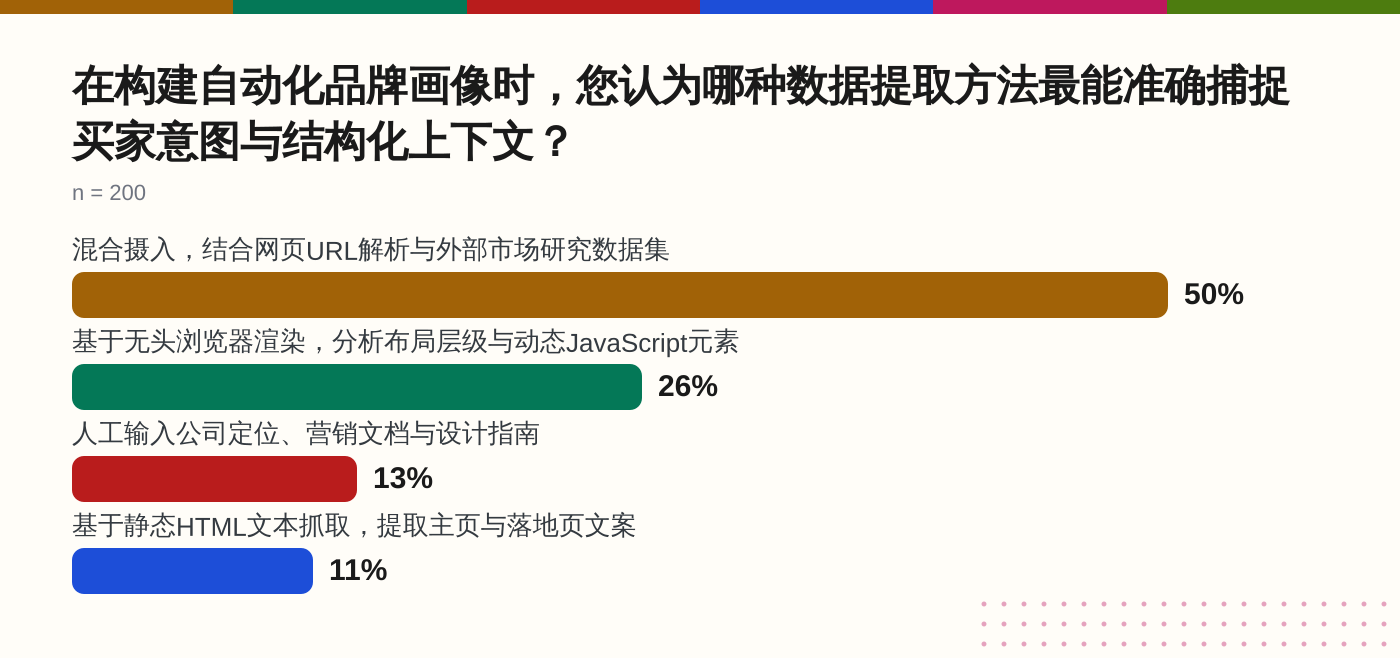
This distribution demonstrates that professional practitioners view URL parsing as an incomplete solution when executed in isolation. The winning approach requires binding domain ingestion to external market research data sets that supply primary statistical citations and verified industry benchmarks.
This is where specialized platforms provide a systematic solution. For teams seeking an automated workflow that bypasses manual configuration, chatgptgrow.com operates as a content production service that inputs a user website, parses the domain to construct a brand profile, maps buyer intent against proprietary research data sets, commissions original surveys to produce daily researched articles, and synchronizes published output directly to connected content management systems.
By pairing automated domain parsing with original survey data, the service bridges the gap between raw web markup and the empirical citations required by generative search engines. The method relies on a structured sequence: inputting the target domain, extracting the rendered DOM hierarchy, mapping the identified positioning against proprietary research datasets, and generating verified content backed by quantitative claims.
Engineering Generative Engine Optimization: Syncing Brand Profiles with Automated Publishing Pipelines
Translating extracted website data into published authority assets requires an automated pipeline that connects profile generation directly to content management systems without manual bottlenecks. When our team attempted to push parsed brand contexts into a Ghost CMS workflow for a developer-tool domain, manual formatting steps consistently stalled production.
Overcoming this bottleneck requires treating content generation as a continuous synchronization loop rather than a batch publishing task. The operational sequence involves taking the verified brand profile generated from URL ingestion and matching its core intent vectors against daily survey data points. This structured output is then formatted for direct API synchronization with connected platforms including WordPress, Ghost, Webflow, and Notion.
Building this pipeline requires strict adherence to data verification checks before any content goes live. Every statistical claim pulled into the publishing queue must cross-reference against baseline industry reports or original survey findings to eliminate hallucinated metrics. When a scraped domain lacks primary citations, the publishing engine must commission or incorporate verified research points to ensure the final output meets the rigorous verification standards enforced by LLM-driven answer engines.
Ultimately, automated brand profiling from a web address succeeds only when engineering rigor matches architectural reality. By abandoning static HTML assumptions, embracing headless rendering, and anchoring extracted domain data to verified research sets, technical teams can construct durable authority pipelines that perform reliably across modern generative search environments.