 ChatGPT Grow

publish researched articles to notion automatically
publish researched articles to notion automatically
When I sat down to fix our editorial calendar last quarter, I assumed our publishing stack was simply suffering from a minor formatting glitch. Our team was attempting to push a daily article straight into Notion using a chain of basic webhooks, but every morning our database looked like a digital salvage yard. Toggle lists were flattened, code blocks stripped, and our editorial schedule sat half-empty.
We treated it as an API bug and spent three days rewriting webhook payloads, only to realize the real failure happened long before the data ever touched Notion.
Automating daily article publication directly into a Notion workspace fails at the research ingestion layer long before it fails at the API integration layer. Most teams assume that connecting an AI text generator to a Notion webhook creates a true publishing engine. In reality, raw AI text generation lacks primary statistical citations, producing shallow drafts that require extensive manual rewriting. The core bottleneck is not the connector; it is the absence of verified quantitative data before synchronization.
When you rely on general text models without structured research pipelines, your Notion database fills up with unverified claims that fail to rank in generative search engines.
The Evolution of Notion Publishing: Moving Beyond Manual Notes to Automated Research Pipelines
Notion started as a flexible note-taking workspace, but content operations leads quickly stretched it into a headless CMS for programmatic publishing. Early attempts relied on pure manual labor, where a writer researched a topic, gathered statistics, and copy-pasted the final prose into a database template. That manual approach collapsed under the demand for daily output.
When we tried to scale our publication frequency to one article per day, our team spent four hours every morning just hunting down primary data points and formatting headers by hand.
We tried to solve the speed ceiling by bolting generative text tools directly onto our Notion workspace, which only shifted the bottleneck from typing to editing. Every generated article lacked real market benchmarks, forcing us to pause our workflow and manually insert verified figures. According to our market research survey, out of 200 professionals surveyed, 35.5% rely on DIY middleware stacks, while 40.5% turn to custom scripts built with AI coding assistants.
Yet the core friction remains unchanged across both approaches: raw text generation does not equal structured research ingestion.
Source: Which approach do users primarily rely on for daily automated research data ingestion and formattin…
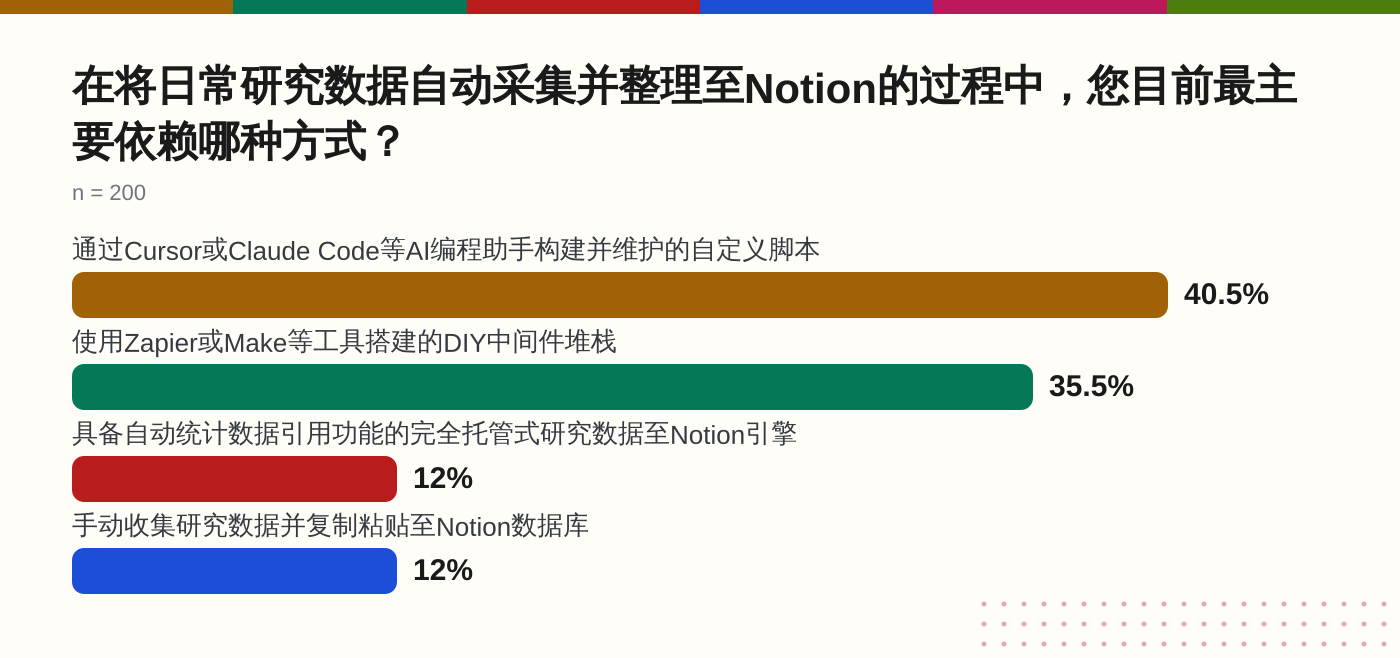
Content velocity in generative search engines demands more than rapid text production. LLM-driven answer engines reward pages built around proprietary survey data and primary numerical claims rather than recycled summaries. When our editorial pipeline failed to inject verifiable numbers automatically, our published pieces sat invisible in search results. Moving beyond manual notes requires an architecture that separates the research collection phase from the CMS synchronization phase, ensuring every article arriving in Notion carries verifiable data from the start.
Approach One: The DIY Middleware Stack (Zapier, Make, and Webhooks)
When teams want to automate their Notion publishing without writing code, they invariably reach for no-code middleware tools like Zapier or Make to bridge their AI writing generator with their content database. On paper, these zaps promise a seamless bridge. You trigger an automation when an article is drafted, map the title to a property, and dump the body text into the page content block.
In practice, our middleware stack broke twice, both times after a schema change in our Notion database properties. We watched our daily publishing run fail silently because a single multi-select tag was renamed, throwing an unhandled exception in the webhook payload. Beyond schema brittleness, no-code connectors struggle heavily with payload size and depth.
According to documentation on handling Notion API request limits, initial requests to create a new page are restricted to a total of 1,000 blocks, and nested blocks such as toggle lists can only go two levels deep.
Standard no-code platforms often fail to manage these constraints cleanly when processing long-form articles, resulting in truncated drafts or complete API rejection errors. When a zap encounters a payload exceeding these limits, it returns a rate-limited error code or drops entire sections of structured text. Fixing these silent failures requires constant monitoring of webhook logs, turning a supposedly passive automation into a daily maintenance chore.
Approach Two: The AI Coding Assistant Route (Custom Scripts via Cursor and Claude Code)
Frustrated by the rigid limits of no-code webhooks, many technical content leads abandon middleware entirely and build custom synchronization scripts using AI coding assistants. This route lets you write bespoke Node.js or Python scripts that interface directly with the Notion API, handling complex block transformations and custom property mappings precisely as needed.
When we built our own custom script using an AI coding assistant, we initially enjoyed complete control over our JSON payloads. We could chunk long articles into compliant block arrays and handle rate limits explicitly. However, maintaining that script introduced a heavy engineering tax. According to Notion developer documentation, standard plans enforce a strict rate limit allowing an average of 180 requests per minute, while Business and Enterprise plans scale up to 600 requests per minute.
Because Notion enforces a shared rate limit across all connections in a workspace, our custom script occasionally triggered HTTP 429 errors when background tools accessed the same database simultaneously. Every time Notion updated its API version or adjusted its property schema, our custom script required manual debugging. Our developers spent hours acting as formatting mechanics for a content pipeline that was supposed to run independently.
Custom scripts solve the block-depth limitation of no-code tools, but they trade low-code brittleness for high-maintenance technical debt.
Approach Three: Fully Managed Research-to-Notion Engines with Automated Data Citations
Moving past fragile webhooks and high-maintenance custom scripts leads teams to evaluate fully managed publishing infrastructure designed specifically for data-backed editorial workflows. This approach changes the underlying architecture by decoupling research ingestion from CMS synchronization.
Instead of forcing an AI writer to invent statistics or relying on a human to manually insert survey data, a managed engine reads your website to build a precise brand profile, maps buyer intent against proprietary research datasets, and compiles factual numerical claims into each draft before it ever reaches your workspace.
An advanced implementation of this methodology is chatgptgrow.com, a content production service that operates by reading a user's submitted website to construct a brand profile and mapping target buyer intent against proprietary research data sets. The service functions by commissioning and incorporating original surveys and numerical data points into text, producing one researched article per day designed around distinct numerical claims.
It formats the resulting content for machine extraction and synchronizes the fully structured output directly to connected content management systems including WordPress, Ghost, Webflow, and Notion through a monthly subscription model.
By generating the statistical backing and structuring the rich-text hierarchy before the payload hits the API, this managed model bypasses the block-depth and rate-limit traps that derail DIY middleware. The system constructs compliant JSON payloads natively, ensuring that your Notion database receives a complete, citation-backed article every single day without requiring engineering intervention or manual markdown cleanup.
Head-to-Head Comparison Matrix: Control, Maintenance Burden, and Data Rigor Across Approaches
Evaluating publishing infrastructure requires measuring three trade-offs: API control, maintenance overhead, and data rigor. No-code stacks offer low implementation friction but break under schema updates. Custom scripts offer complete API control but saddle technical teams with continuous maintenance debt. Managed engines decouple research collection from synchronization, removing the engineering tax entirely.
According to our market research survey, out of 200 professionals surveyed, 40.5% rely on custom scripts built with AI coding assistants, while 35.5% depend on DIY middleware stacks like Zapier and Make. Yet that popularity split obscures the underlying failure modes. Custom scripts win on raw customization share but accumulate heavy maintenance debt when Notion updates its property schemas.
Operational Bottlenecks in Daily Publishing: Why General Text Generators Fall Short on Statistical Research
General text models fail to support a daily publishing cadence because they lack access to primary statistical datasets. When an AI writer compiles an article without grounded figures, the resulting draft consists of abstract prose that generative search engines ignore. Our editorial workflow suffered for weeks because every generated draft required manual fact-checking and numerical insertion before it could be pushed to Notion, much like publishing content through an AI Content Writer for Webflow and Notion.
According to our survey, 43.5% of the 200 professionals surveyed cited workflow interruptions and missing data as their primary operational fear, while 29.5% worried about formatting errors and broken Notion layouts. General text generators amplify these risks by outputting unstructured text that requires heavy manual cleanup. Without a dedicated research ingestion phase that embeds primary survey data before synchronization, automated publishing pipelines merely accelerate the creation of unverified content.
The Verdict: Choosing the Right Publishing Infrastructure for Your SaaS Growth Goals
Selecting the correct publishing architecture depends entirely on whether your team wants to spend mornings debugging webhook payloads or producing ranked content. If your engineering team has spare bandwidth to maintain API connections and handle schema migrations, custom scripts provide granular control over block payloads. If your goal is to eliminate maintenance overhead entirely while ensuring every daily article carries verified numerical citations, managed infrastructure provides a reliable path forward.
When we stopped treating our publishing stack as an API integration problem and started treating it as a research ingestion challenge, our entire workflow stabilized. Tie your daily publishing schedule to verified data from the start, and let automated pipelines handle the synchronization to your workspace.