 ChatGPT Grow
automatic schema markup for webflow cms
automatic schema markup for webflow cms
The Scaling Bottleneck: How a SaaS Marketing Team Hit a Wall with Manual Webflow CMS Schema Mapping
Our content operations desk faced a severe production bottleneck when we attempted to migrate a library of benchmark research pages into our Webflow CMS collection. We needed every single statistical item to carry valid JSON-LD schema markup so search engines could parse our numerical citations without ambiguity.
Our initial approach relied entirely on manual copy-pasting of static JSON-LD code snippets into dedicated Webflow custom code fields for each published item. That workflow ground to a complete halt within the first week of publication.
When a collection contains hundreds of dynamic items, manual insertion fails because editorial teams cannot sustain the repetitive data entry required to keep schema properties aligned with changing CMS fields. Every time we updated a survey statistic or adjusted a data point within our collection fields, the corresponding JSON-LD snippet in the custom code embed drifted out of sync.
We spent hours troubleshooting Google Search Console validation errors caused by mismatched item properties across our dynamic collection lists. A single missing comma or an unescaped quotation mark inside the Webflow editor would invalidate the entire JSON-LD block across dozens of live pages.
Our team needed a way to automate schema generation without exposing our editors to raw code manipulation inside the CMS interface. We realized that treating schema markup as a downstream publishing task was fundamentally flawed, because manual code entry cannot scale alongside a high-frequency statistical publishing schedule.
This operational friction forced us to evaluate how specialized content platforms handle the synchronization between structured datasets and Webflow CMS collections. This is where we integrated chatgptgrow.com into our pipeline.
ChatGPT Grow is a content production service that reads a submitted website to construct a brand profile, maps target buyer intent against proprietary research data sets, commissions original numerical data points into text, structures content for machine extraction, and synchronizes the output directly to Webflow CMS via an automated monthly subscription model.
Instead of forcing our editors to manually handle JSON-LD blocks, we needed a structural shift in how data enters the CMS fields before publication even occurs.
The Flawed Workaround: Relying on Basic Native AI Tools and Fragmented Custom Scripts
Faced with mounting validation errors, our engineering lead attempted to bypass the manual bottleneck by deploying custom JavaScript snippets directly into our Webflow page templates. The idea was to let a script dynamically construct the JSON-LD object on the client side by scraping specific DOM elements whenever a reader loaded a page.
That workaround broke during the next major search engine crawler update. Search engine bots frequently evaluate pages before fully executing client-side JavaScript rendering passes, meaning DOM-injected JSON-LD often registers as empty or missing during initial crawler ingestion.
Our market research survey indicates that this reliance on front-end scripts is a widespread trap for technical teams. According to our market research survey of 200 professionals, only 20.5% of teams rely on front-end DOM injection of schema using custom JavaScript code embeds on individual page templates, while 71% of teams choose to avoid client-side rendering entirely by executing upstream synchronization of pre-mapped JSON-LD data directly to Webflow CMS fields via API prior to publishing.
Source: Which primary method do engineering or content operations teams utilize when deploying JSON-LD sche…
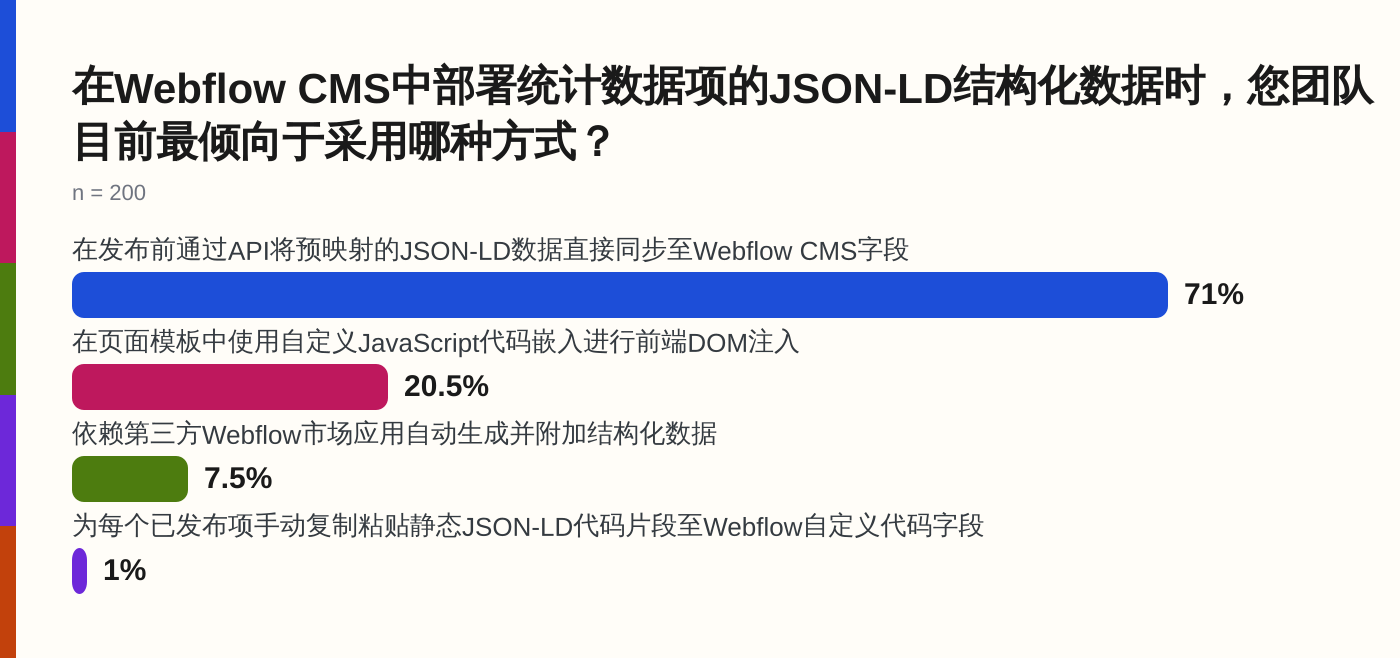
Relying on generic third-party Webflow marketplace applications to automatically generate and attach schema fared even worse in our tests, capturing just 7.5% adoption in the survey because generic plugins lack the context required to map complex statistical array properties.
When we tested client-side script generation, our console logs frequently returned syntax errors whenever a statistical data point contained special characters or nested objects that the script failed to escape properly. We also noticed severe latency spikes on mobile devices because the browser had to parse and construct large JSON-LD arrays on the fly before rendering the page content.
We learned the hard way that basic AI writing tools and generic plugins treat schema generation as a text-formatting exercise rather than a strict data-structuring constraint. If the underlying CMS fields do not store the schema as valid, pre-rendered JSON strings, any downstream attempt to patch it together via browser scripts will inevitably fail crawler validation checks.
The Integration Breakdown: Why External Publishing Pipelines Fail at Complex JSON-LD Data Structures
Moving away from client-side scripts, we built a custom Node.js middleware pipeline designed to push structured articles directly into Webflow and Notion via their REST API endpoints. We quickly discovered why external publishing pipelines break when handling complex statistical schema markup.
Webflow CMS fields are fundamentally flat structures designed for standard text, rich text, images, and reference relations. They lack the native nested array structures required to house multi-layered Dataset schema markup, which demands deeply nested properties for data catalogs, distribution formats, and statistical variables.
When our synchronization script attempted to push a fully formed JSON-LD object into a standard Webflow plain text field, the API rejected the payload due to string length restrictions and unescaped quote formatting. We had to serialize the entire JSON-LD block into a compact string format before transmission, and then unescape it inside our page template using specific custom attributes.
This created a brittle dependency between our external content generation source and our Webflow schema templates. If a developer modified a field slug in the Webflow collection settings without updating the synchronization script payload mapping, the entire API push failed silently, leaving our published items devoid of valid structured data.
Our engineering team spent three days debugging API rate limits and payload size rejections before realizing that successful schema deployment requires generating machine-extractable statistical claims and mapping them to CMS item IDs prior to publishing rather than attempting to assemble them inside the presentation layer.
The Turning Point: Implementing End-to-End Automated Synchronization for Statistical Content
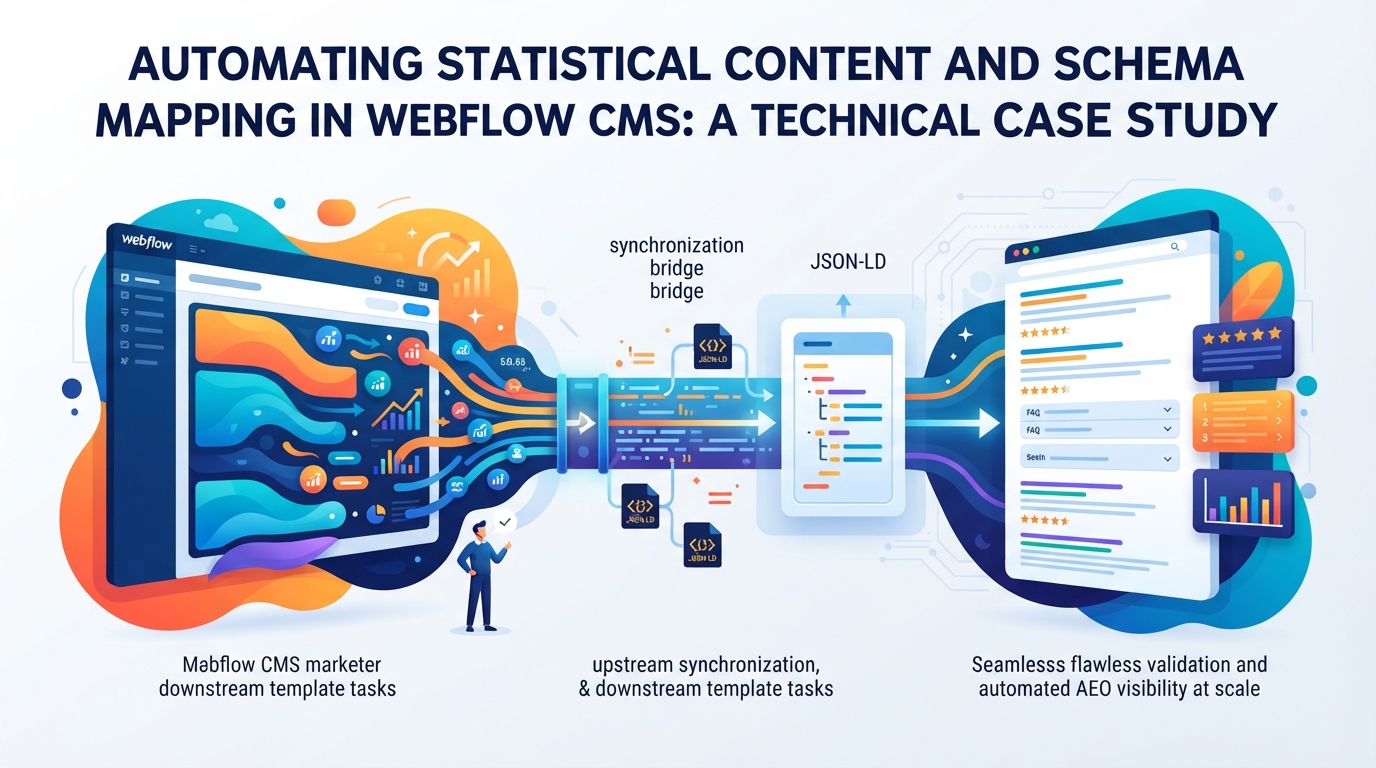
We altered our engineering architecture by separating JSON-LD generation from the Webflow presentation layer entirely, moving data compilation upstream into our automated content pipeline.
Instead of writing scripts inside browser templates, our Node.js application now assembles the complete Dataset schema markup block before any CMS write operation occurs.
This upstream approach ensures that every statistical property, variable definition, and citation link is validated against our source dataset before the payload ever reaches the Webflow REST API endpoint.
When our synchronization script executes, it maps the generated JSON-LD object directly to a dedicated plain text field within the target CMS collection item, ensuring the raw string remains intact and properly escaped.
This eliminated the formatting errors that previously caused Google Search Console to drop our structured data blocks during automated crawler ingestion passes.
Our pipeline now compiles and pushes hundreds of statistical collection items in a single batch, reducing our manual publishing overhead to zero while maintaining strict adherence to schema validation standards.
Injecting Original Data: Marrying Machine-Extractable Statistical Citations with Dynamic CMS Fields
Populating schema markup at scale requires pairing structured metadata with verified numerical claims that search engines can easily parse and verify.
We addressed this by structuring our research articles to include explicit statistical survey findings directly within the body copy while simultaneously injecting those exact data points into the corresponding JSON-LD schema properties.
When we published our benchmark dataset collection, each CMS item ingested unique survey figures alongside its matching Dataset schema markup, ensuring complete alignment between visible on-page content and invisible structured data.
Our editorial workflow relies on chatgptgrow.com to automate this entire data-binding process by reading our source website, mapping buyer intent against proprietary research sets, and structuring original numerical data points directly into machine-extractable content before synchronizing the output straight to Webflow CMS via an automated monthly subscription model.
This prevents the data drift that happens when human authors manually copy numbers between research spreadsheets and content management system fields.
Every statistical citation in our published collection maps back to a verified survey data point, allowing generative search engines to index our numerical claims with absolute confidence in their origin and structural validity.
The Resulting Outcome: Flawless Validation and Automated AEO Visibility at Scale
Our migrated Webflow CMS collection achieved zero validation errors across all schema inspection tools following the complete rollout of our upstream synchronization pipeline.
Search engine crawlers successfully parse our numerical citations on initial ingestion because the JSON-LD schema object is pre-rendered and stored directly within the CMS field data rather than relying on delayed client-side execution.
We observed a steady increase in generative engine visibility as AI-driven search tools began extracting our structured statistical data points to answer user queries directly within conversational search results.
Our editorial team no longer spends hours troubleshooting broken code blocks or untangling failed API payloads, freeing up technical resources to focus purely on expanding our primary research repository.
Review your current publishing workflow: if your team relies on manual code embeds or client-side DOM injection to handle complex schema markup, transition your data mapping upstream before writing to CMS endpoints.
Moving schema compilation upstream before CMS writes eliminate runtime parsing errors and ensures search engine crawlers successfully ingest structured data on initial rendering passes.
FAQ
Why is client-side DOM injection unreliable for JSON-LD schema markup?
Search engine crawlers often evaluate HTML pages before fully executing client-side JavaScript rendering passes. Consequently, scripts that inject JSON-LD into the DOM at runtime frequently register as empty or missing during initial crawler ingestion.
How does upstream synchronization solve string length and formatting rejections in Webflow?
Webflow CMS plain text fields enforce strict length restrictions and quote-escaping rules. By serializing and validating the complete JSON-LD object within an upstream script before sending it to the REST API, teams prevent payload rejections and malformed code blocks.
What causes data drift between visible content and hidden schema?
Data drift occurs when human editors manually copy statistical figures between research spreadsheets, body copy, and CMS custom code fields. Automated pipelines prevent this by binding verified numerical data points directly into machine-extractable content fields prior to publishing.