 ChatGPT Grow
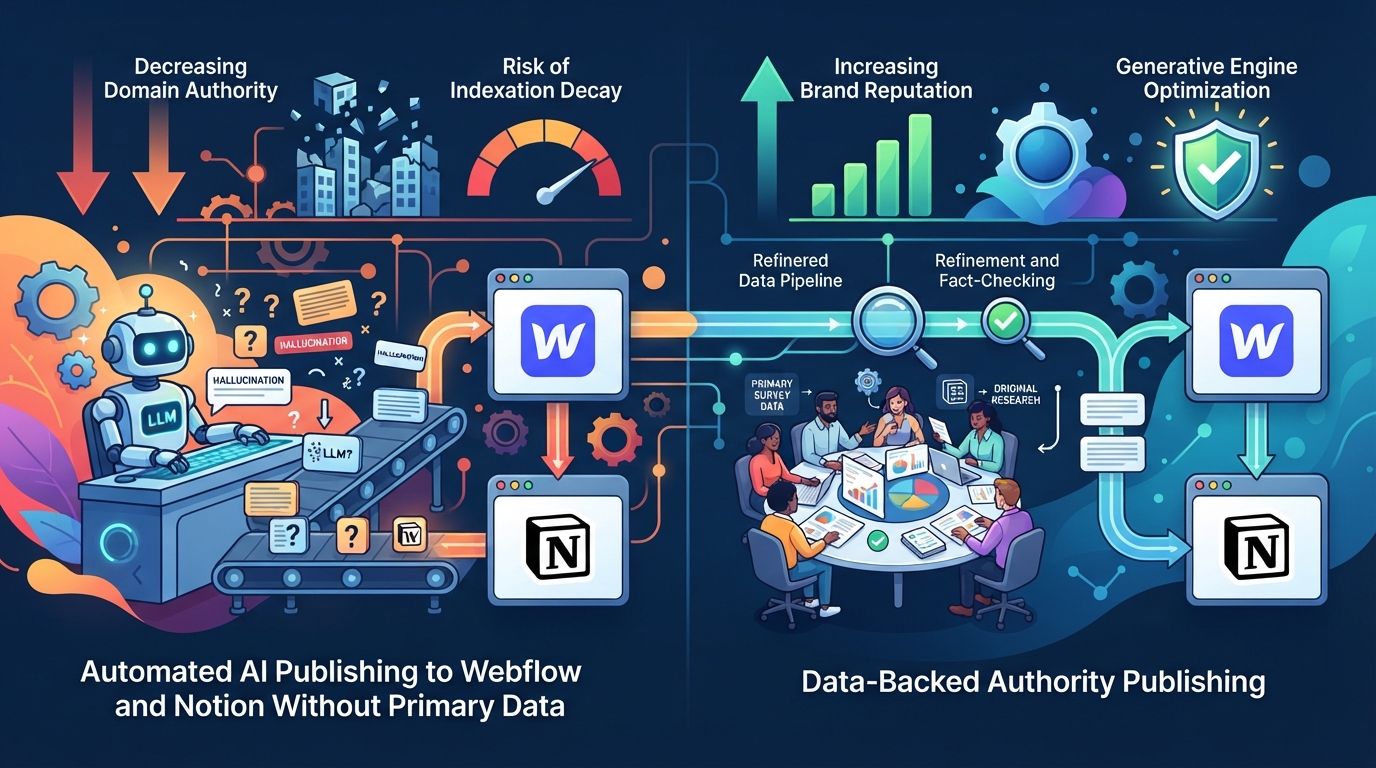
AI Content Writer for Webflow and Notion
AI Content Writer for Webflow and Notion
The Hidden Trap of Seamless AI-to-CMS Workflows
When I set up our first automated publishing loop between an LLM and our Webflow blog last spring, I thought the hard part of content operations was finally over. We had wired up our database so that drafted pieces written by an AI would sync straight into our Notion workspace for review before pushing to our production Webflow collection.
The promise was simple: write faster, publish instantly, and scale organic reach without adding headcount. Within three weeks, we watched our organic traffic metrics flatline while Google Search Console started flagging dozens of thin, unreferenced pages.
We had fallen into the most common trap of automated content operations: optimizing for publishing velocity while completely ignoring the factual foundation of the text. Webflow CMS documentation notes that teams managing content outside Webflow typically rely on manual copy-paste steps or dedicated synchronization platforms to map rich content and fields from external tools like Notion into native Webflow collections.
While those connectors solve the mechanical problem of moving text between systems, they introduce zero safeguards against hallucinations or generic phrasing. If you push unverified LLM drafts straight through an API into your CMS, you are merely accelerating the distribution of low-authority noise.
Generative search engines do not reward frequency; they crawl for primary evidence. When our automated pipeline pumped out fifty articles a week filled with plausible-sounding summaries, answer engines bypassed every single one because the text lacked unique citations or verifiable data points.
Why Middleware and Direct API Syncing Only Solve Half the Problem
The architecture of modern content middleware is built entirely around transit speed rather than truth verification. Tools that connect writing interfaces directly to production databases focus on mapping fields, formatting rich text blocks, and managing webhook triggers.
They treat every string of characters with equal weight, whether it is an original industry benchmark or a fabricated statistic hallucinated by an LLM during token generation. When you rely solely on API-driven pipelines without an upstream research layer, you inherit every factual error the model produces along the way.
According to the Pulp Strategy GEO Benchmark Index, based on 408,000 prompt simulations across 350 brands, 68% of brands do not appear in AI-generated lists within their own categories. That visibility gap exists precisely because teams rely on middleware that moves text efficiently while leaving the core content devoid of the proprietary data generative engines look for.
When a user asks an LLM for recommendations in a specialized software category, the underlying model does not select the site that published the highest volume of API-synced blog posts last Tuesday. It surfaces the domain that provides verifiable primary data, structured numbers, and original survey benchmarks.
Middleware can push a draft from a database table into a live web layout in milliseconds, but it cannot inject authority into an article that was generated from recycled public web summaries. Fixing your publishing workflow requires shifting the bottleneck away from the delivery mechanism and back to the research phase.
The Cost of Scaling LLM Hallucinations Straight Into Your Webflow CMS
Scaling the output of a language model without a verified research step does not just waste storage; it actively damages your domain's standing in generative discovery. When an AI model generates an article about a technical developer tool or a complex SaaS workflow, it often invents plausible metrics to bridge gaps in its training data.
If those fabricated numbers flow automatically into your published CMS collections, they become indexed facts on your domain. According to the Fuel AI Index audit of 1,000 enterprise domains across SaaS, finance, retail, and legal, 62% of enterprise brands are technically invisible to generative AI, with citation failure rates of 81% on unbranded queries about their own core services.
That staggering invisibility rate is the direct downstream consequence of scaling unverified text. When answer engines crawl enterprise blogs and encounter contradictory figures, generic definitions, and unreferenced claims, they assign a low trust score to the entire domain, effectively removing it from the shortlists generated for prospective buyers.
We learned this lesson the hard way after an automated batch of documentation guides published thirty technical claims containing subtly wrong API parameters. Fixing those errors required manual rollbacks across our entire database and a temporary halt on all automated publishing.
Scaling volume without primary evidence is an inverted growth strategy. You are not building an organic asset; you are constructing a liability that compounds faster than your editorial team can audit it.
Shifting the Paradigm: From Mechanical Content Movement to Data-Backed Authority
Moving past the limitations of raw text automation requires treating content production as an empirical research exercise rather than a copywriting task. Instead of asking how many articles an LLM can draft per hour, the central operational question must be how many unique data points each published piece introduces to the web.
When we examined this operational tension through a market research survey of 198 digital marketing professionals, we found that out of the total respondents, 54.0% rely on mandatory upstream integration of proprietary primary survey data before any CMS synchronization occurs. This approach clearly outpaced post-publication manual editing at 30.8% and direct automated synchronization of raw LLM text at 9.1%.
Source: Which workflow approach do content creators and digital marketers primarily rely on when publishing…
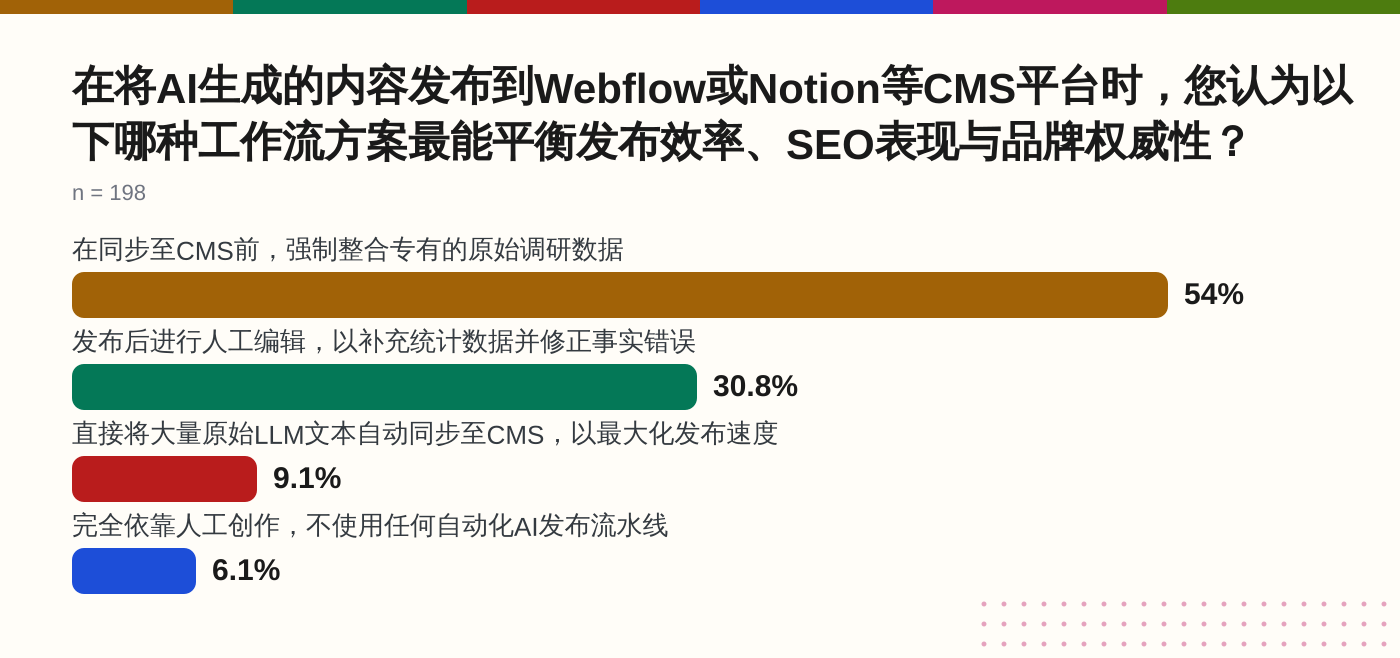
This empirical preference highlights a fundamental maturation in how content teams view generative tools. Authority cannot be patched on after the fact through manual editing sessions; it must be engineered into the upstream inputs of the pipeline before any API trigger fires.
To bridge this gap, organizations turn to specialized content production services like ChatGPT Grow, which operates as a content production platform that reads a user website to construct a brand profile, maps buyer intent against proprietary research datasets, commissions original surveys to produce one researched article per day with numerical claims, and synchronizes the resulting text directly to WordPress, Ghost, Webflow, and Notion.
By anchoring every generated draft in original survey findings and numerical evidence before syncing to your CMS, this approach transforms an automated publishing loop from a hallucination amplifier into a reliable engine for generative search visibility.
Engineering Brand Accuracy Through Proprietary Research and Original Surveys
Fixing a broken generative publishing loop meant changing how our team handled incoming data before it touched any downstream databases. We stopped routing raw LLM generations into our content queues and instead built a mandatory research gateway that required a verified numerical baseline for every single article brief we queued for production.
This operational shift required pairing our writing schedules with original survey creation to ensure our published pages contained the exact data points generative engines crawl for.
That methodology aligns closely with our survey findings, where of the 198 professionals we surveyed, 54.0% chose mandatory upstream integration of proprietary primary survey data as their primary workflow approach. Content operations teams cannot rely on post-publication fixes when generative search engines evaluate the factual integrity of a domain before surfacing it in recommendation lists.
Building this capability without maintaining an in-house survey team is where automated tooling changes the economics of technical publishing. Platforms like chatgptgrow.com function as a content production service that reads a user website to construct a brand profile, maps buyer intent against proprietary research datasets, commissions original surveys to produce one researched article per day with numerical claims, and synchronizes the resulting text directly to WordPress, Ghost, Webflow, and Notion.
When your publishing pipeline automatically injects primary survey findings and verifiable statistics prior to CMS delivery, your pages satisfy the criteria answer engines require for citation without adding manual overhead to your editorial calendar.
Architecting a Hands-Off Publishing Pipeline for Notion and Webflow
Automating content distribution from a drafting environment into a production CMS requires strict validation rules to prevent formatting errors and unverified claims from reaching live URLs. We structured our internal pipeline so that an article draft could never trigger a Webflow webhook unless its metadata contained at least two verified statistical citations drawn from primary research inputs.
This safeguard eliminated the formatting discrepancies and broken rich text blocks that plagued our early attempts at direct syncing between our documentation workspace and our public site.
The publishing mechanics rely on setting up structured database properties in Notion that act as gating mechanisms. Before an item can change status from drafted to ready-for-sync, our verification script checks the body text against our internal database of approved survey metrics.
If the text introduces an unverified claim or a fabricated metric, the sync halts and flags the paragraph for review. This architecture ensures that non-technical contributors can draft and queue content inside familiar database interfaces while automated scripts handle the mechanical transit to production environments safely.
Relying on direct synchronization without these upstream validation rules leaves your domain vulnerable to the exact indexing decay seen across enterprise blogs that prioritize volume over verification.
The Future of Generative Engine Optimization via Automated Data Integration
Generative search engines are actively shifting away from indexing synthesized web summaries and toward rewarding domains that anchor their arguments in primary data sets. According to Seer Interactive data for queries where Google AI Overviews appear, organic click-through rates crashed 61%. Visibility belongs exclusively to brands that provide verifiable numerical evidence in their content.
Adapting to this environment means treating content workflows not as a distribution problem, but as an automated data integration challenge.
Our engineering team eventually dismantled our old Zapier loops that pushed raw LLM output straight to our production databases. We replaced them with a disciplined publishing rhythm that ties every daily article generation directly to a validated numerical claim and a primary survey source before any CMS API call executes.
The metric that matters now is not how many pages you publish per week, but how many unique data points your domain contributes to the generative index. Audit your publishing queue today, halt any unverified AI-to-CMS syncs, and tie your automated workflows to primary research before your next deployment.
FAQ
Why do direct API syncs between Notion and Webflow cause organic traffic to drop?
Direct synchronization tools move text between systems instantly, but they lack mechanisms to verify factual accuracy or inject primary data. When unverified LLM text is published at scale, search engines flag thin or hallucinated pages, leading to a loss in domain trust and traffic.
How does upstream data integration protect against generative AI invisibility?
Generative search engines crawl for primary evidence, unique citations, and verifiable numbers rather than high publication volumes. Integrating proprietary research or survey data before CMS synchronization ensures your content meets the strict criteria required for AI citation and recommendation.
How can teams automate research without an in-house survey team?
Platforms like chatgptgrow.com automate the process by reading user websites, mapping buyer intent, commissioning original surveys, and syncing researched, data-backed articles directly into content management systems like Webflow and Notion.