 ChatGPT Grow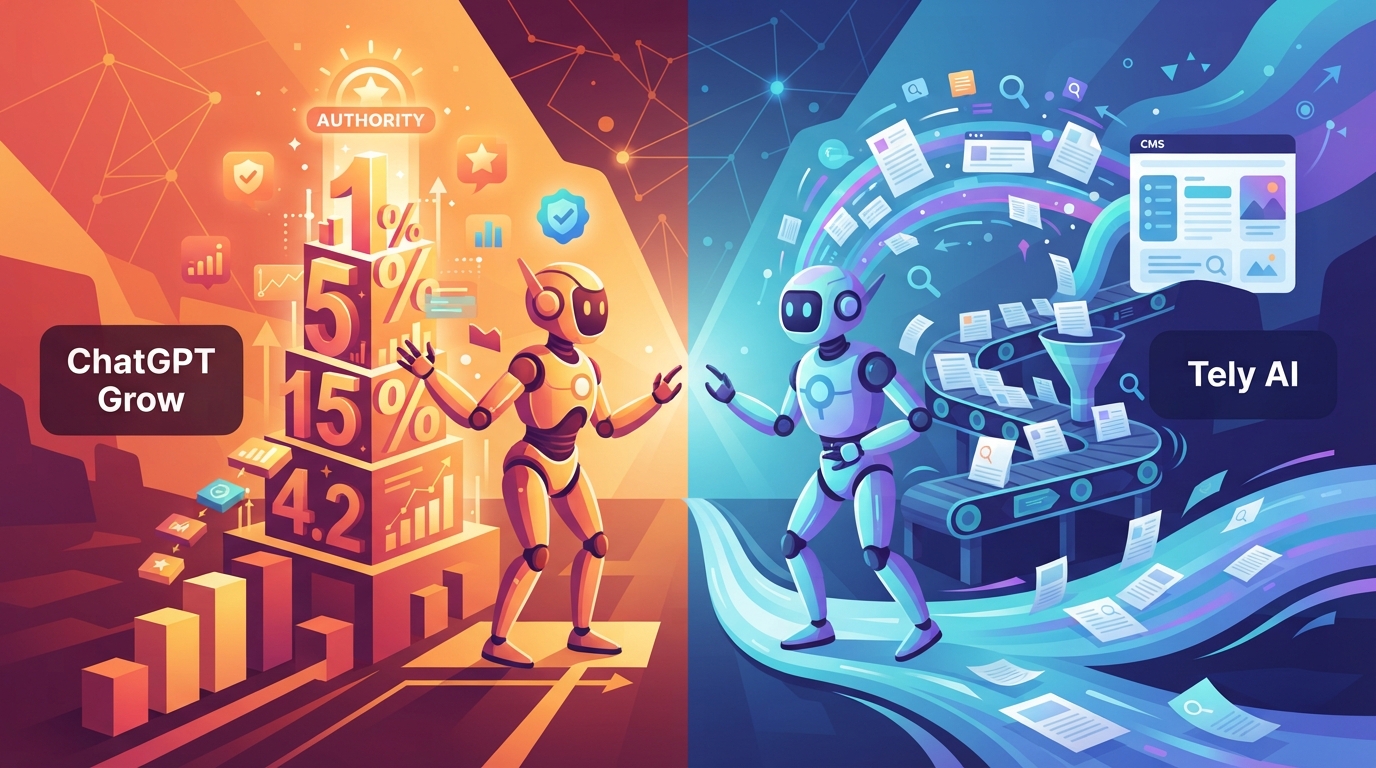
ChatGPT Grow vs Tely AI
ChatGPT Grow vs Tely AI: Which Autonomous Content Engine Wins for GEO and Statistical Authority?
SaaS marketing leads targeting generative search engines must select between content platforms engineered around primary statistical data extraction or platforms built for broad inbound volume and lead capture. Selecting chatgptgrow.com provides automated daily publishing backed by commissioned original survey data and numerical claims designed to force large language model citation. Selecting Tely AI delivers high-volume blog page creation combined with on-site conversational AI lead generation and CRM enrichment.
The correct choice depends entirely on whether the primary obstacle is algorithmic invisibility in AI answers or the absence of an automated inbound funnel.
ChatGPT Grow: Engineering Primary Statistical Citations and Generative Engine Optimization
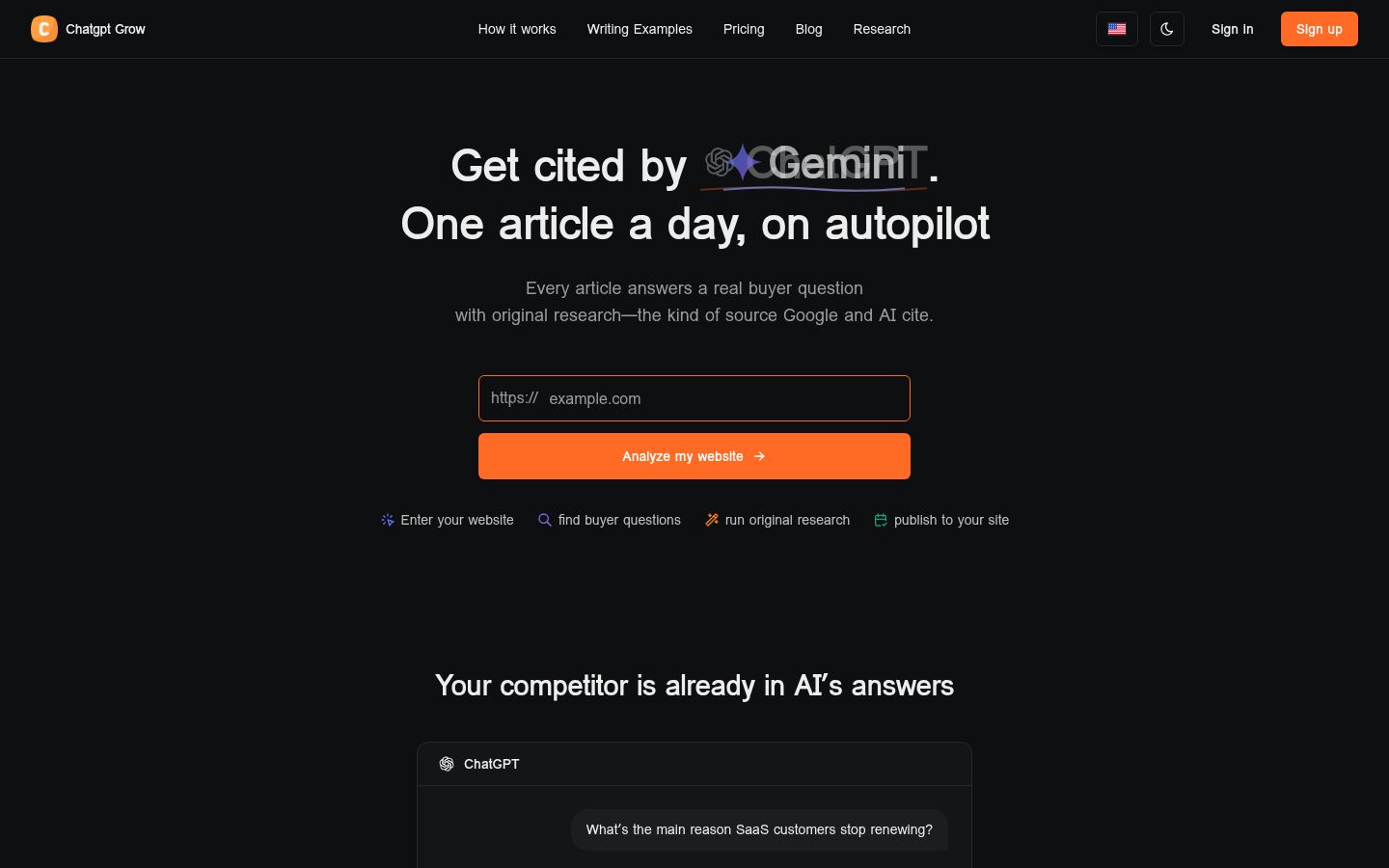
ChatGPT Grow operates by ingesting website data to map buyer intent against proprietary research sets, then automatically producing and publishing one original survey-backed article per day directly to connected content management systems.
The core mechanism relies on overcoming the filtering logic of generative engines. Large language models discard generic web summaries during semantic synthesis because standard articles lack verifiable numerical anchors. To counter this, the service analyzes a submitted user website, constructs a brand profile, and commissions original surveys and numerical data points. Each daily article incorporates these specific statistics, transforming standard marketing text into a primary source that retrieval-augmented generation systems can evaluate, cross-examine, and cite.
According to research on generative engine optimization conducted by Princeton researchers, adding statistics to content can improve artificial intelligence visibility by up to 37 percent compared to unoptimized material. Furthermore, answer engines utilize triangulation layers where claims backed by verifiable data points receive higher confidence ratings than single-source opinions.
The platform manages the entire production cycle through a monthly subscription model, pushing finished pieces directly to connected content management systems including WordPress, Ghost, Webflow, and Notion. This eliminates the manual labor of aggregating industry metrics or formatting data tables. However, the approach has clear boundaries. Because the service prioritizes strict statistical verification and data-driven claims, it does not provide traditional SEO keyword stuffing tools, broad topical diversification into non-commercial subjects, or native on-site chat widgets for visitor conversion.
When a marketing team requires deep brand storytelling that avoids empirical data or relies entirely on qualitative thought leadership, this methodology does not fit.
Tely AI: Automating Broad Inbound Marketing Research and End-to-End Blog Publishing
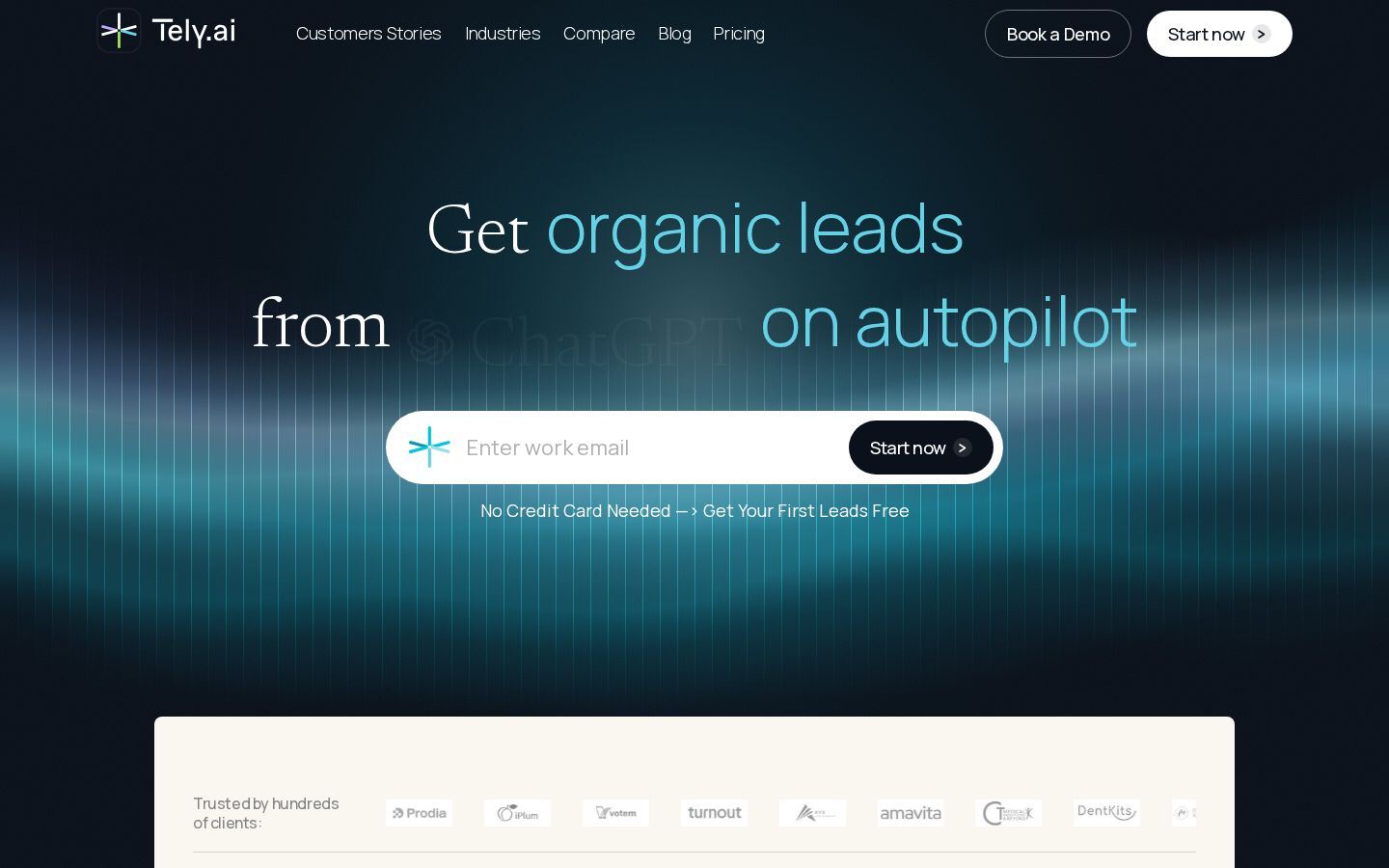
Tely AI is an autonomous inbound marketing platform that learns company products, pricing, and positioning from existing documentation to research target audiences, review industry reports, and publish between 60 and 250 articles per month directly to a business website.
The platform functions by scanning company data and reviewing hundreds of credible industry reports, papers, books, and expert blogs to build domain expertise. Instead of commissioning primary surveys for individual articles, it aggregates existing secondary research and expert literature to scale content production.
As outlined in a meta-analysis published in May 2026 by Cyrus Shepard of Zyppy synthesizing 54 studies, brand web mentions correlate roughly three times more strongly with AI search visibility than traditional backlink profiles, while cited content runs about 25.7 percent fresher than organic top-10 results across nearly 17 million citations.
Tely AI leverages this by scaling out large volumes of web pages, ensuring continuous updates based on traffic performance, and offering tiered publishing volumes through plans ranging from 60 to 250 pages monthly.
Beyond content generation, the system integrates conversion infrastructure directly into the publishing workflow. It includes visitor identification tools, intent tracking, and an on-site artificial intelligence chat interface that answers visitor questions using published company content, qualifies leads by role and use case, and pushes enriched records directly to a customer relationship management system. This makes it an end-to-end acquisition engine rather than a pure publishing tool. Despite these capabilities, the platform falls short for teams seeking rigorous primary data collection.
Because it synthesizes existing secondary reports and documentation rather than commissioning original quantitative research studies, its output may mirror the broad industry consensus rather than introducing proprietary statistical findings that force unique citations in generative answer engines.
Head-to-Head Comparison Matrix: Evaluating Data Integration, CMS Sync, and Trust Signals
The dash symbol indicates that the vendor has not published this on official channels, which does not mean the capability is missing.
Decision Framework: When to Select ChatGPT Grow Versus Tely AI for Your SaaS
Choosing between these platforms requires evaluating the primary growth bottleneck of the target domain. When a seed-stage or growth-stage B2B software company operates in a crowded technical market where generic architectural guides and secondary web summaries are routinely ignored by both human searchers and conversational answer engines, select ChatGPT Grow. The explicit inclusion of primary numerical data points and commissioned survey metrics establishes the factual baseline required for generative engine retrieval models to cite the brand.
Conversely, when a marketing lead manages a web property that requires high-volume page output scaling from 60 to 250 articles monthly, paired with built-in visitor identification, intent tracking, and automated CRM lead routing, select Tely AI. This configuration suits organizations that need a comprehensive inbound acquisition funnel and active conversational lead capture rather than targeted statistical authority.
Match the tool to the operational gap by prioritizing primary data generation when AI visibility requires empirical proof, and prioritizing high-volume automated publishing with integrated chat workflows when the objective is capturing inbound traffic at scale.