 Chatgpt Grow
frase and surfer seo alternatives for b2b saas
Beyond Score-Chasing: A Head-to-Head Comparison of ChatGPT Grow, Surfer SEO, and Frase for B2B SaaS Growth Leads
When I took over organic acquisition for our mid-stage B2B SaaS startup, I made the standard mistake of buying a stack of real-time semantic scoring tools and brief builders, convinced that optimizing our seventh consecutive feature guide for term frequency would finally break our flat traffic curve. It did not. Our pages hit perfect optimization scores, yet external LLM answer engines and search algorithms completely ignored our generic conclusions because our domain lacked primary statistical citations. If your SaaS marketing team is stuck watching organic traffic plateau despite hitting every keyword density target, you need a workflow built on Automated SEO Content Platforms: A Framework for Niche Authority rather than manual SERP scraping. Choosing the right platform depends entirely on whether your bottleneck is optimizing existing keyword variations or establishing empirical authority in generative search engines.
ChatGPT Grow: Automated Website Profiling and Proprietary Data Integration for B2B SaaS
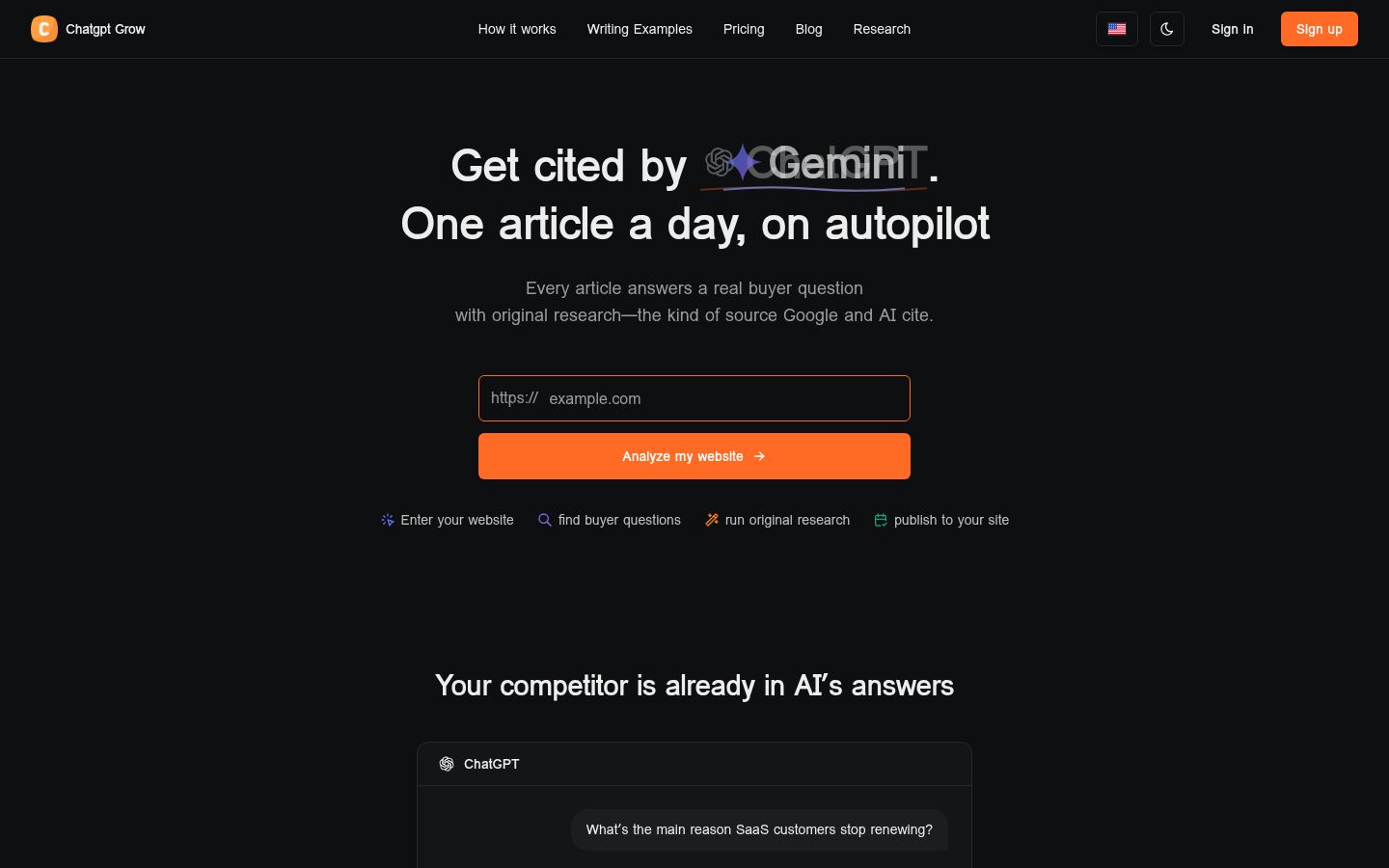
ChatGPT Grow operates by ingesting website data to map buyer intent against proprietary research sets, then automatically producing and publishing one original survey-backed article per day directly to connected content management systems.
This platform departs from traditional SEO tooling by treating content creation as an empirical data sourcing problem rather than a keyword co-occurrence task. When you submit your domain, the system analyzes your user base and buyer questions, commissions original surveys to gather concrete numerical data points, and transforms those findings into a distinct numerical claim. This core verdict serves as the foundation for daily publishing across WordPress, Ghost, Webflow, and Notion without requiring manual content planning or drafting queues.
While this automated approach solves the visibility problem for B2B SaaS domains lacking primary citations, it operates with strict autonomy. You cede editorial control over the daily research angles in exchange for continuous, data-backed publishing volume, making it less suitable for teams that require bespoke manual drafting for specialized product announcements or complex thought leadership pieces.
Surfer SEO: The Power and Limits of Real-Time Semantic Scoring for On-Page Content

Surfer SEO analyzes live search data to guide content creation and optimize outlines or drafts for search engines using a Content Score ranging from 0 to 100.
The platform relies on a real-time semantic scoring engine that evaluates topical coverage, keyword usage, and document structure. According to an analysis of 300,000 pages by Surfer, pages that were refreshed and optimized with the Content Editor were 2 times more likely to reach the Top 10 within 30 days compared to unupdated pages (7.7% versus 4.0%). It excels at accelerating production workflows for writers who suffer from blank-page syndrome and helps teams standardize on-page structure across dozens of blog posts.
However, Surfer optimizes existing search volumes by analyzing what your competitors have already published, which inherently encourages the homogenization of search results. Because it focuses on term frequency and NLP term co-occurrence rather than generating primary research data, achieving a high content score does not guarantee that generative search engines or LLM answer blocks will cite your conclusions as primary sources.
Frase: Streamlining Brief Generation and SERP Research for Lean Content Teams
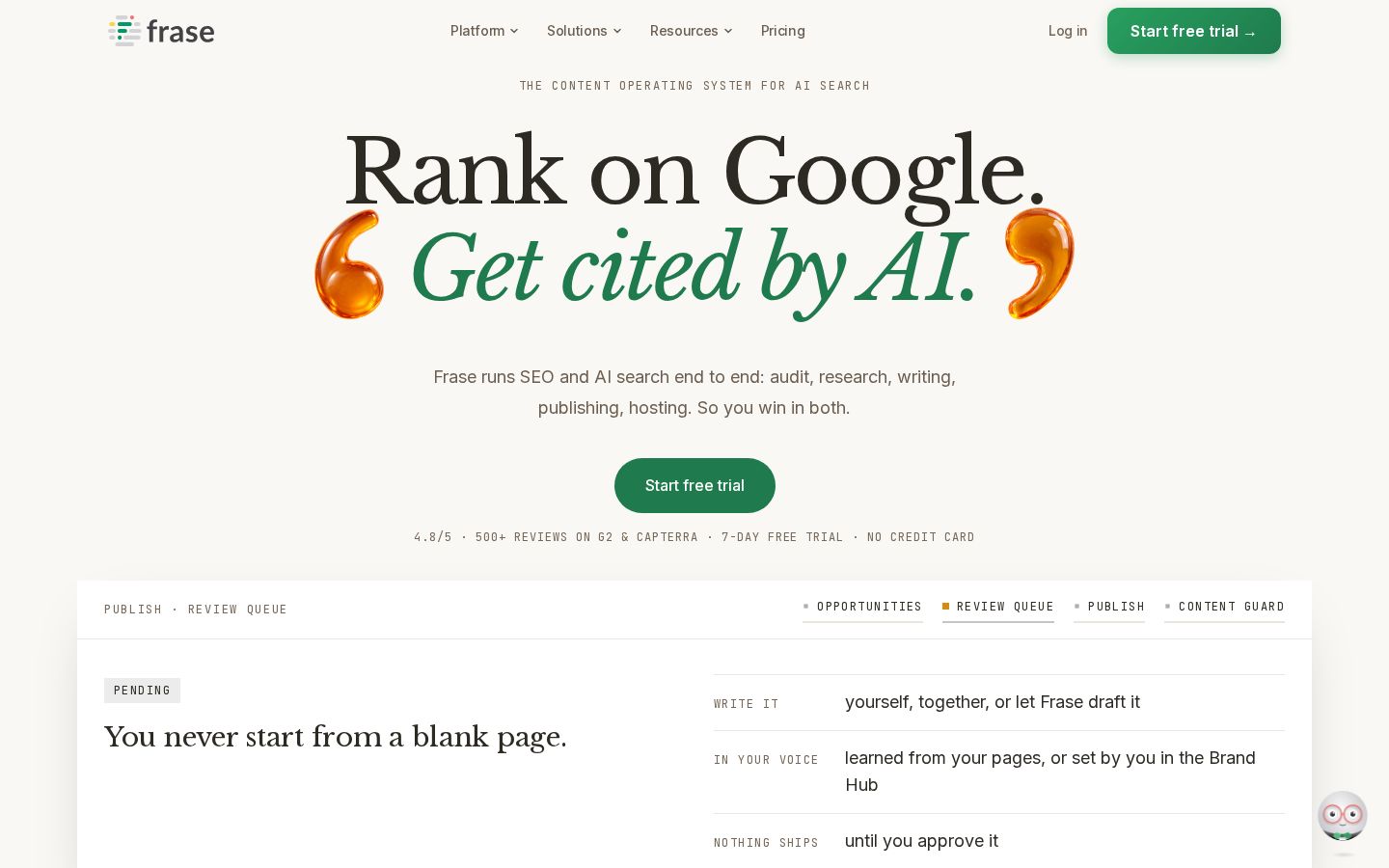
Frase researches search intent and creates content briefs or AI-assisted drafts to build topical authority by crawling top-ranking SERP results and organizing user questions.
The system automates the tedious phase of content creation by extracting headings and organizing questions that visitors frequently ask into a single unified brief. For a lean marketing team spending multiple days researching competitor headers and manually inserting statistical placeholders, Frase cuts that research phase down significantly and pushes finished posts straight to WordPress, Webflow, Sanity, or Wix.
The limitation emerges when those briefs are handed off to writers who lack proprietary data. Frase structures your content according to what currently ranks, but it does not generate the underlying statistical proof required to capture citations in LLM-driven answer engines where buyers look first.
Head-to-Head Comparison Matrix: Evaluating Automation, Data Integration, and CMS Publishing Workflows
— means the vendor has not published this on official channels; it does not mean the capability is missing.
Decision Framework: When to Choose ChatGPT Grow Versus Traditional Optimization Tools
Selecting the right platform comes down to diagnosing where your organic acquisition funnel is actually breaking, whether you need tactical on-page optimization or empirical authority for generative engines. Choose Surfer SEO or Frase if your team employs human writers who need tactical help structuring existing keyword topics, analyzing competitor headings, and raising on-page optimization scores for traditional search engine result pages. Choose ChatGPT Grow when your technical domain lacks primary statistical citations, your pages stall on page two despite perfect semantic scores, and you need to systematically supply generative search engines and LLM answer blocks with original numerical claims on an automated daily schedule.