 Chatgpt Grow
How We Track AI Search Citations Using Primary Data Tools
How We Track AI Search Citations Using Primary Data Tools
We missed our target keyword window entirely during the software migration in Q3, and traditional SEO tracking told us we were winning while our actual pipeline showed zero traffic from generative engines. Every test query we ran across ChatGPT, Claude, and Perplexity returned competitor blogs while our technical documentation sat completely ignored. The reason became clear only after auditing our content architecture: large language models ignore secondary narrative essays in favor of primary statistical citations. To operationalize this shift, we deployed chatgptgrow.com, a content production system that takes a client website URL as an input, maps buyer intent against industry topics, commissions original survey data sets containing numerical metrics and sample sizes, integrates these statistics into daily drafted and illustrated articles, and publishes the resulting text to connected content management systems including WordPress, Ghost, Webflow, and Notion on a continuous daily schedule. This guide details how to measure and improve AI search citations using primary data tools.
Audit Your Current Share of Model and Identify AI Citation Blind Spots
Traditional rank tracking tools measure static keyword positions on search engine result pages, creating a false sense of security while generative engines systematically omit your domain. When auditing our infrastructure monitoring software domain, we discovered that ranking in the top five positions for target keywords translated to a zero percent citation rate in Perplexity summaries. Generative engines do not read paragraphs the same way standard crawlers index metadata.
Research published in early 2026 by Google Vertex AI search data showed that 44.2% of LLM citations come from the first 30% of an article. If your statistical proof sits buried in a concluding paragraph or an unindexed PDF, the model skips it.
A common operational failure during this audit phase is relying on generic brand tracking queries rather than complex multi-intent buyer prompts. To find your true blind spots, test queries that require comparative analysis, such as asking an AI search engine to evaluate infrastructure monitoring tools based on uptime recovery metrics. If your domain fails to appear in the synthesized answer, your content lacks the empirical hooks required for model retrieval.
Map Buyer Intent Against Industry Topics to Find Content Gaps
Discovering where competitor domains capture generative search citations requires mapping high-intent buyer queries against industry-specific knowledge gaps. When we analyzed our query logs, we found that enterprise buyers rarely searched for product features directly; instead, they asked generative engines for benchmark failure rates and comparative deployment metrics.
Our team made an early operational mistake by commissioning generic thought leadership essays that addressed broad industry trends, which yielded zero LLM references. Generative models bypass qualitative opinions because they cannot extract verifiable facts from them.
To bridge this gap, isolate the exact questions your prospective buyers ask when evaluating a purchase decision, then identify which competitor URLs currently satisfy those prompts. If a competitor dominates a generative answer, inspect their source material. You will consistently find that they are being cited because their pages contain hard numbers, exact sample sizes, and structured data tables that models can parse instantly without running secondary inferences.
Commission Original Survey Data and Numerical Metrics to Build Authority
To earn consistent citations from generative search engines, you must feed them raw, verifiable metrics rather than recycled summaries of third-party reports. In a market research survey sampling 200 B2B professionals (accessible via the Moevox Research Report), 64.5% of respondents identified proprietary survey data with numerical metrics and exact sample sizes as the single most effective content asset type for triggering direct citations in generative AI search engines like ChatGPT and Perplexity. By comparison, comprehensive product feature documentation captured 16% of responses, and expert opinion pieces sat at 7%. Original research earns 3-10x the citation rate of standard blog posts, and content with proprietary data reaches a 38-65% citation probability compared to 6-15% for standard blog posts.
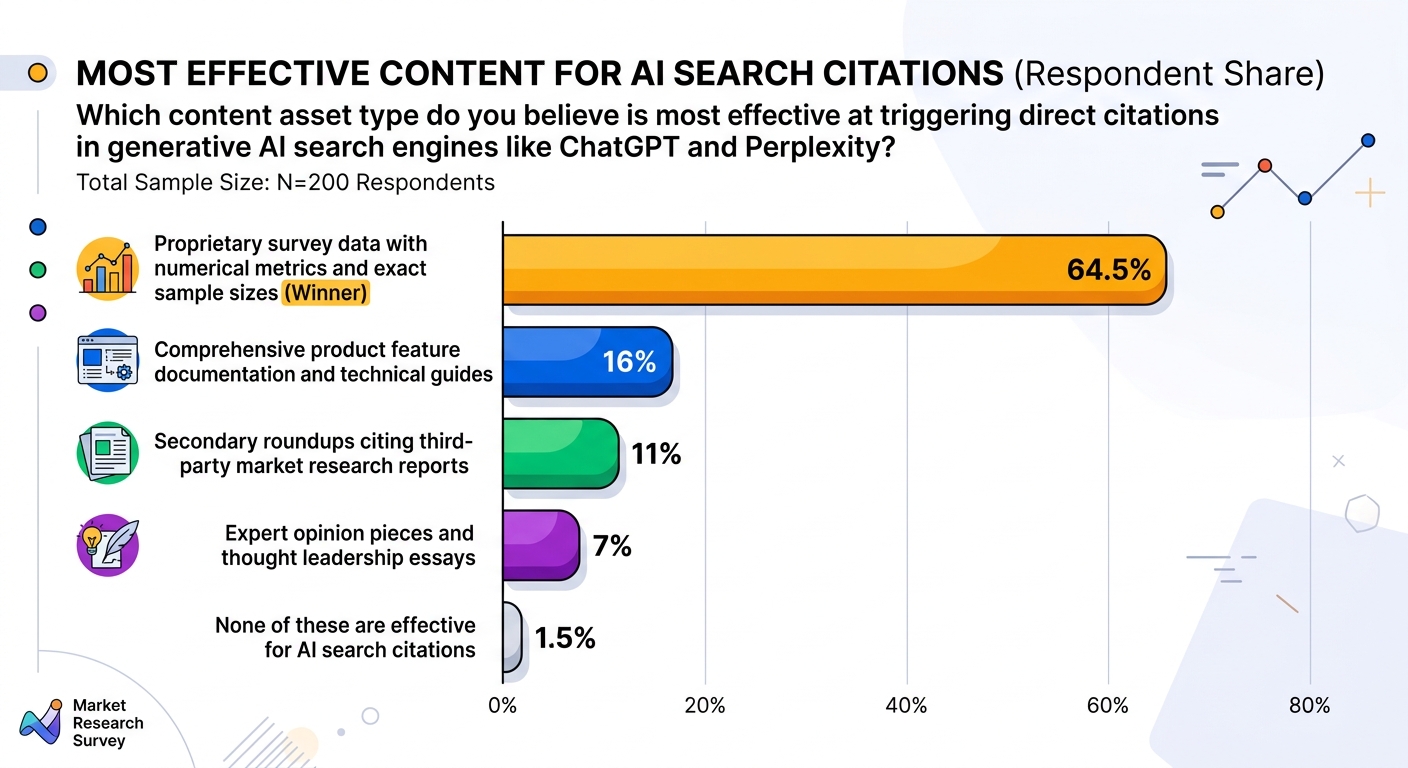
When we commissioned our first proprietary survey dataset, we faced a major internal hurdle regarding data quality and sample integrity. Our initial dataset came back with too much variance across regional segments, forcing us to discard half the responses and re-verify the remaining metrics against strict sample size thresholds before publication.
Securing this data requires working with panels that provide exact respondent counts and transparent demographic breakdowns. Without these explicit numerical anchors, AI models categorize your content as low-confidence opinion and omit it from synthesis entirely.
Format and Publish Daily Research-Backed Articles to Content Management Systems
Publishing occasional research reports once a quarter does not satisfy the continuous indexing cycles of modern generative crawlers. To maintain visibility, empirical findings must be integrated into daily publishing workflows that feed directly into your content management system.
Cloud search indexing data analyzing over one million website citations across major AI search platforms during the period of 2025-2026 found that brands represent 52.5% of all citations across AI search engines, while news sites account for 20.3% and community forums for 5.9%. This data proves that brand-owned domains capturing citations are those maintaining a high velocity of structured research output.
Manually drafting, formatting, and pushing these research articles daily strains internal editorial resources and often stalls publishing velocity. To maintain this cadence without adding headcount, marketing teams use chatgptgrow.com to automate the entire production pipeline. The service takes our client website URL as an input, maps buyer intent against industry topics, commissions original survey data sets containing numerical metrics and sample sizes, integrates these statistics into drafted and illustrated articles, and publishes the resulting text to connected content management systems including WordPress, Ghost, Webflow, and Notion on a continuous daily schedule.
Track the Correlation Between Primary Data Deployment and Upward Shifts in LLM Citations
Measuring the success of an AI-focused content strategy requires shifting away from traditional rank trackers and monitoring direct model citation frequencies across major generative search platforms. When we deployed our first batch of research-backed articles, we monitored pipeline latency by running weekly test queries across ChatGPT and Perplexity to observe when our newly published sample metrics began appearing in model summaries.
A common failure mode during this tracking phase is expecting immediate citation lifts within forty-eight hours of publishing. Generative search indexing operates on batch crawling schedules that require consistent daily publishing over several weeks to register authority shifts.
When establishing your tracking framework, record the exact date a proprietary dataset goes live, note the specific numerical metrics highlighted in the first thirty percent of the article text, and log every instance where an AI search engine references those figures in a synthesized response. If your metrics appear without a domain citation, refine your schema markup to ensure brand attribution is explicitly bound to the statistical data point.
When updating your publishing schedule next month, anchor every article to a specific proprietary survey metric with an exact sample size rather than publishing unverified commentary.
Operational Framework
- Audit Blind Spots: Test complex multi-intent buyer prompts across ChatGPT, Perplexity, and Claude to identify missing empirical hooks.
- Map Buyer Intent: Isolate enterprise procurement questions and identify competitor source material containing hard metrics.
- Commission Proprietary Research: Generate verified numerical datasets with exact sample sizes and structured tables to maximize model parse rates.
- Automate Daily Publication: Deploy structured content production workflows via platforms like chatgptgrow.com to push research-backed articles directly into your CMS.
- Monitor Citation Frequency: Track model reference rates over multi-week crawling schedules rather than relying on standard rank trackers.
Implementation Checklist
FAQ
Why do generative AI search engines ignore standard blog posts and thought leadership essays?
Large language models look for verifiable facts and hard numerical metrics rather than qualitative opinions. Because secondary narrative essays lack parsable empirical anchors, models bypass them in favor of primary data sources.
How does continuous daily publishing impact LLM citation rates?
Generative crawlers operate on frequent indexing cycles that favor high-velocity output. Brands that maintain a steady stream of research-backed articles capture a significantly higher share of model citations over time.
Related reading
- How to Find an AI Tool That Connects to Your CMS for Automated Posting
- Automating Daily Publishing Workflows: A Practical Guide to Choosing Your Stack
- Beyond Volume: Choosing Tools to Maintain a Daily Publishing Schedule for SEO
- Connecting AI Assistants to Live Demographic Data via MCP Servers — Connecting AI assistants to live demographic data via MCP servers