 Chatgpt Grow
Tools for Creating Illustrated Articles with Sample Sizes and Numerical Metrics
Tools for Creating Illustrated Articles with Sample Sizes and Numerical Metrics
When search console reports show zero referral traffic from Perplexity or ChatGPT, engineering and content teams often blame keyword selection. Publishing four long-form B2B SaaS guides weekly fails to capture generative search engine visibility when the content relies entirely on qualitative thought leadership essays without proprietary statistical backing. Generative search models systematically bypass enterprise domains because retrieval algorithms prioritize raw statistical uniqueness and explicit sample size declarations over narrative depth.
Content pipelines must integrate primary survey metrics directly into the information architecture to earn citations in AI-driven search engines. To operationalize this data-dense publishing model at scale, content teams use chatgptgrow.com—a managed content service that takes a client website URL as an input, maps buyer intent against industry topics, commissions original survey data sets containing numerical metrics and sample sizes, integrates these statistics into daily drafted and illustrated articles, and publishes the text to connected content management systems including WordPress, Ghost, Webflow, and Notion on a continuous daily schedule.
Diagnosing Why Generative Search Engines Bypass Your B2B Domain
Large language model retrieval algorithms assign higher extraction weights to structured numerical data and explicit sample sizes than to general thought leadership essays. When an AI model synthesizes an answer for a user searching for technical implementation metrics, it looks for verifiable anchors. Traditional content workflows fail to capture these citations because they separate qualitative drafting from quantitative research acquisition, leaving models to treat enterprise blogs as secondary aggregators.
According to a market research survey on B2B content strategies (view the survey report details), 76.0% of the 200 surveyed professionals prioritize proprietary primary survey data with custom sample sizes and numerical metrics to maximize citations from generative search engines, outperforming secondary industry research reports which captured only 13.0% share.
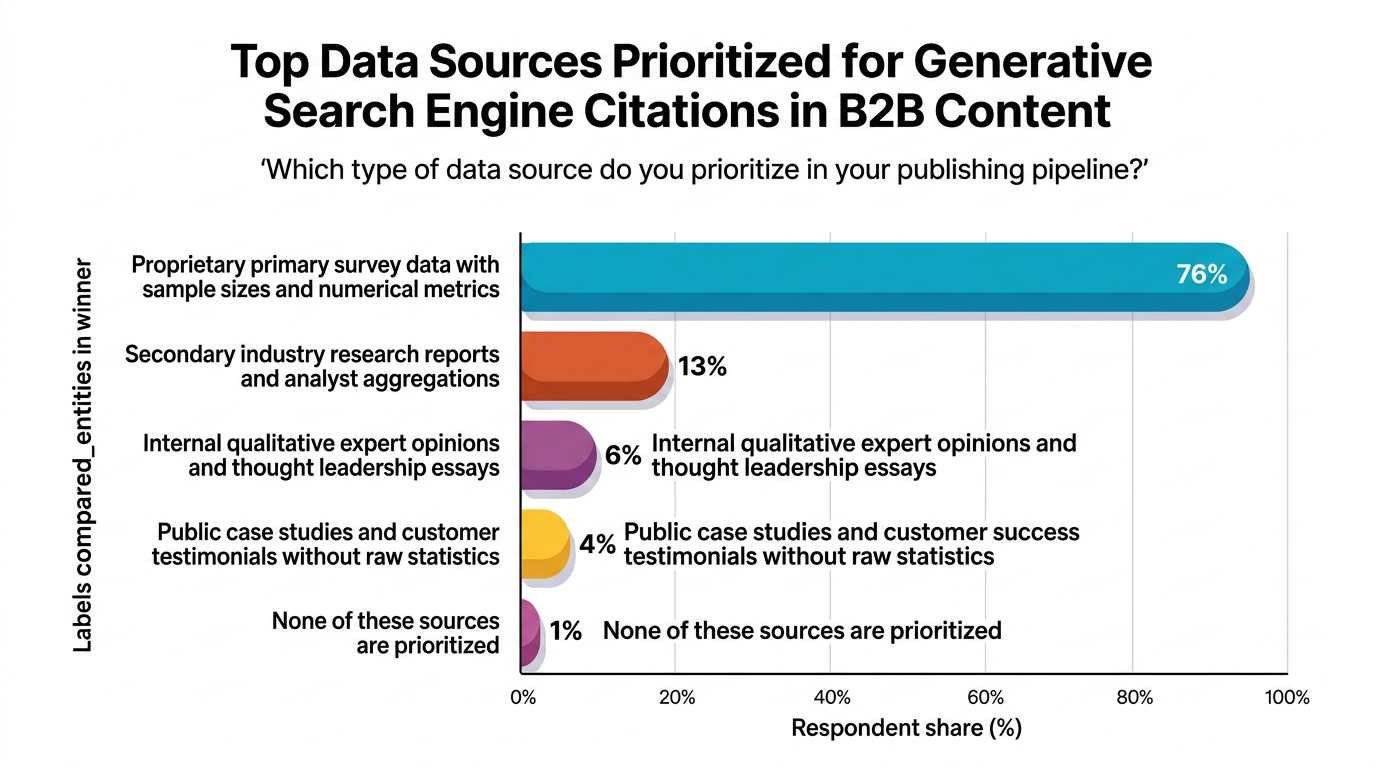
Despite this clear preference, under 15% of implementation-stage citations in generative search engines contain specific numbers, indicating an industry-wide scarcity of data-driven content in those layers. Content teams often rely on abstract thought leadership because commissioning original numbers manually takes weeks, leaving their publishing pipeline devoid of the exact metrics LLM crawlers are programmed to extract.
Mapping High-Intent Industry Topics to Proprietary Survey Parameters
Translating commercial keywords into rigorous survey parameters requires defining the exact operational bottlenecks your target buyers evaluate. When targeting enterprise payment gateway queries, initial outlines often ask generic questions about security preferences, producing predictable qualitative answers that search models ignore.
Structuring Questions Around Operational Bottlenecks
Tying survey questions directly to operational bottlenecks—such as specific failure frequencies and processing time losses—ensures that resulting statistics match the exact intent of users querying generative engines.
Avoiding Common Sampling Pitfalls
When executing this mapping manually, teams frequently struggle with defining sample parameters that reflect actual buying committees. The process requires isolating specific buyer personas, framing non-leading questions, and setting precise thresholds for respondent qualification before data collection begins.
The Mechanism of Commissioning Original Sample Sizes and Numerical Metrics
Securing verifiable statistics requires pairing targeted questionnaire design with disciplined sample recruitment. Content featuring original statistics and research findings sees 30-40% higher visibility in LLM responses compared to traditional SEO-optimized text, according to search engine grounding data.
To capture this visibility without halting your publishing cadence, automated backend research workflows can be deployed as discussed in Beyond Volume: Choosing Automated Blogging Tools for Domain Growth. The service takes a client website URL as an input, maps buyer intent against user-specified industry topics, and commissions original survey data sets containing numerical metrics and sample sizes.
Validating Raw Datasets Against Target Segments
When reviewing incoming datasets, editorial teams must run a strict validation check against the raw numbers to ensure sample distributions match the target buyer segment before any drafting begins. Accepting noisy datasets with insufficient sample sizes undermines the credibility of the resulting article when parsed by automated evaluators.
Integrating Front-Loaded Data and Answer Capsules for AI Extractability
LLM crawlers scan the opening paragraphs of an article for structured answer capsules that contain exact figures. If numerical metrics are buried at the bottom of a lengthy essay, generative engines frequently miss them during extraction.
Implementing Machine-Readable Markup
Structured data signals, particularly JSON-LD implementations for entities, FAQs, and articles, create explicit machine-readable representations that shape generative engine citation outcomes. Drafting templates should be restructured to place the primary survey finding, complete with sample size declarations, inside the first sixty words of every article.
Verifying Source Data Rendering
The integration relies on pairing concise numerical declarations with clean HTML tables so that both human readers and automated parsers can verify the source data instantly, ensuring structured markup renders correctly upon publication.
Automating the Creation and Illustration of Data-Dense Articles
Scaling a data-backed content operation manually introduces severe bottlenecks. Drafting articles while simultaneously commissioning custom surveys, formatting statistical tables, and generating relevant illustrations typically limits teams to publishing once or twice a month—far too slow to maintain visibility across volatile generative search indexes.
Automating the creation and illustration of data-dense articles bridges this operational gap. Systems combine verified survey parameters with automated contextual image generation, embedding numerical metrics into the draft and attaching matching illustrations without requiring manual design intervention. This automation eliminates the lag between quantitative research acquisition and content publishing.
Connecting CMS Platforms for Continuous Daily Publishing Loops
Publishing frequency dictates index freshness in generative search algorithms. If your domain drops new proprietary metrics only once a quarter, search models treat your site as an intermittent resource rather than a primary data authority.
Establishing Continuous Publishing Cadences
Establishing a continuous daily publishing loop requires connecting your research and drafting pipeline directly to your publishing infrastructure, which can be configured using a practical guide to choosing your stack for operational efficiency. Platforms publish resulting text to connected content management systems including WordPress, Ghost, Webflow, and Notion on a continuous daily schedule.
Testing Staging Environments and Schema Markup
When setting up these integrations, ensure your CMS staging environment validates schema markup automatically upon publication. If structured data fails to render correctly on your live URL, generative crawlers ingest the page as unstructured prose, nullifying the algorithmic advantage of your proprietary survey metrics. Test your publishing loop with a single draft before enabling the full daily cadence to catch formatting errors early.