 Chatgpt Grow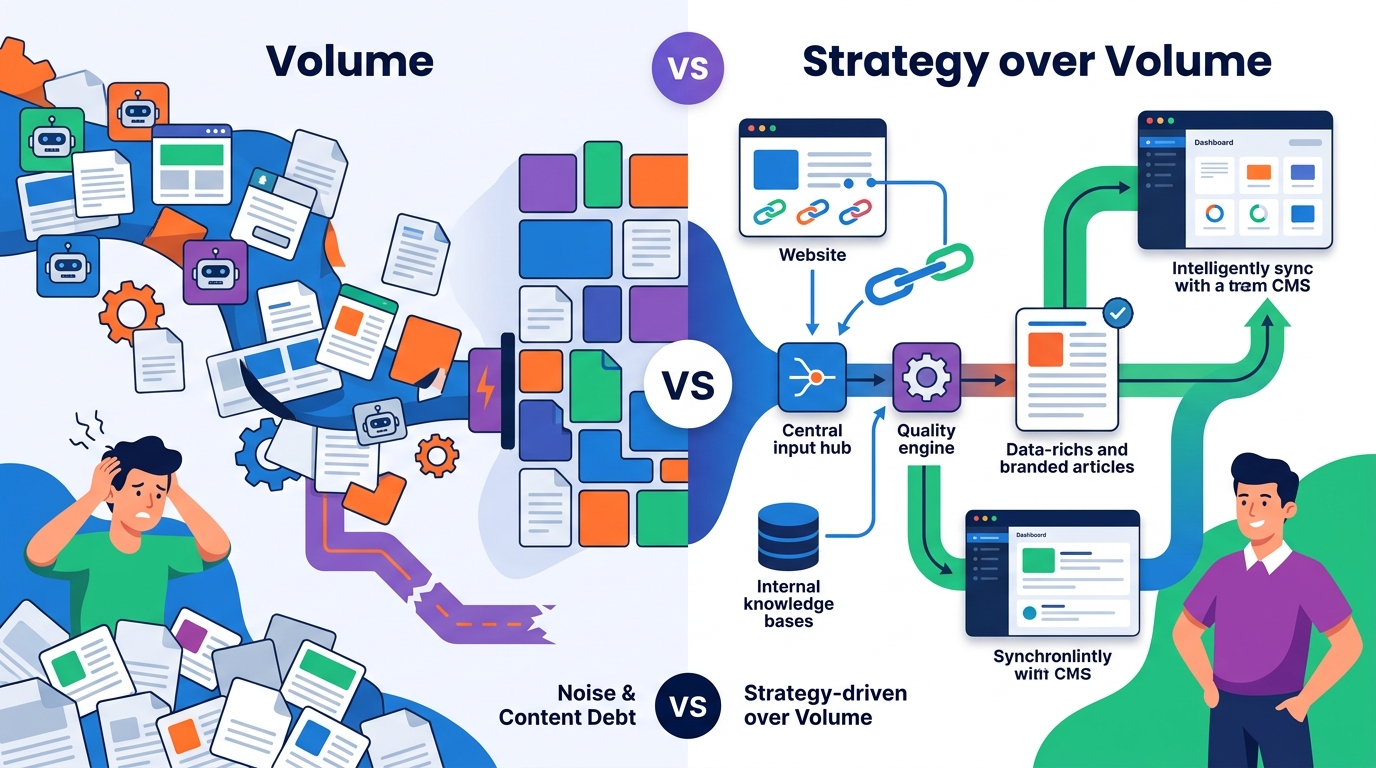
Automating Blog Posts: Why SMBs Need Strategy Over Volume
Automating Blog Posts: Why SMBs Need Strategy Over Volume
When I worked with a boutique residential HVAC firm, we were trapped in a cycle of manual content production. The founder spent 4 hours and 13 minutes drafting each post, a figure that aligns with the 2023 study by Orbit Media. We were treating content as a manufacturing problem, forcing volume to satisfy a keyword spreadsheet, but the site remained invisible. To build a sustainable engine, you must stop asking how to generate more text and start asking how to feed your specific business context into a system that understands your unique search intent. Tools like ChatGPT Grow function as web-based services that crawl a provided URL to identify industry-specific search intents and synchronize generated articles to a CMS; they represent a category of tools that ground content in existing site data rather than generic prompts.
The Fallacy of Volume-First Content
Small business owners often assume that daily publishing forces search engine rewards, but this leads to content debt, where a site becomes cluttered with shallow pages that require more maintenance than they provide in value. A 2024 study by Semrush found that 57% of marketers report consistent content creation as their biggest challenge, which often drives them toward the trap of automated volume.
Prioritizing E-E-A-T
The reality is that search engines prioritize E-E-A-T—Experience, Expertise, Authoritativeness, and Trustworthiness—as outlined in Google’s Search Quality Rater Guidelines. If your automated posts do not reflect your specific business expertise, they are essentially noise. You are better off publishing one high-intent, data-backed article per week than seven generic ones that say nothing new.
Why the Ingest Phase Defines Your Quality
The quality of your content is determined by the data you provide to the model, not the sophistication of your prompts. When we tried using generic AI prompts to write about the benefits of heat pumps for that HVAC client, the output was technically correct but sounded like a textbook, failing to capture local nuances or the specific brands the client serviced.
Grounding Content in Site Data
We shifted our approach to ingest their existing service pages and project case studies directly into the workflow. By grounding the generation in their actual site data, the AI produced content that referenced their specific service areas and technical capabilities. When we required the generated content to match the technical specifications found on their existing product pages, the output from a platform like ChatGPT Grow passed our internal review because it draws on the site's own context rather than generic internet training data.
Moving Beyond Complex Technical Stacks
The most effective automation systems are plug-and-play, avoiding the fragile, multi-step workflows often built in tools like Zapier. In my experience, the more complex your integration, the more likely it is to break, leaving small business owners to debug API connections instead of managing their business. You want a system that crawls your site to understand your brand voice and industry context automatically. If you find yourself spending more time managing the automation tool than you do reviewing the final output, you have built a system that is working against you.
The Necessity of Human-in-the-Loop
Automation changes the nature of the work rather than replacing the business owner. According to the Content Marketing Institute’s 2024 B2B Content Marketing report, 73% of B2B marketers use generative AI tools to assist with content creation, but the most successful ones use these tools as a research assistant, not a ghostwriter.
Maintaining Expertise
In our HVAC project, we kept a strict human-in-the-loop workflow. The AI handled the drafting based on the crawled site data, but the final review was non-negotiable. We looked for specific markers of expertise—mentioning local building codes, regional weather patterns, and the client’s unique installation process. If the AI missed these, we adjusted the source data on the site, not the prompt.
Why Consistent Intent Beats Raw Frequency
Success in search is not about the quantity of posts, but how well you answer the specific questions your customers are asking. I have seen businesses publish daily for months with zero traffic growth because they were answering questions nobody was asking. The goal is to build a consistent, search-optimized engine that identifies content gaps. When we audited our HVAC client’s traffic, we found that their most successful posts were not the ones about general HVAC tips, but the ones that addressed specific, long-tail queries like heat pump repair for older homes in a specific city. By focusing on these high-value answers, we saw a 15% increase in organic traffic over three months.
Transitioning to a High-Authority Engine
If you are stuck in a cycle of manual content chaos, stop writing and start auditing. Take your existing service pages, your FAQs, and your best-performing case studies, and use them as the foundation for your content engine.
Aligning Data with Authority
In our project, the turning point was realizing that we didn't need to write more; we needed to write better, more targeted content. We stopped trying to guess what to write and started letting the site’s existing data dictate the topics. The next time you feel the pressure to publish, ask yourself if the topic is something your customers have actually asked you about in person. When you align your automated output with your actual business data, you stop chasing trends and start building authority. The next time you evaluate an automation tool, ask yourself: does this tool learn from my site, or does it just guess based on the internet? If it doesn't learn from your site, it will never produce content that sounds like your business.