 Chatgpt Grow
Scaling Content Production for AI Search Visibility: A Blueprint
From Manual Bottlenecks to AI Authority: A Blueprint for Scaling Content Visibility
Scaling content for AI search visibility isn't just about hitting a target word count; it’s a data-alignment problem. When I was managing content operations for a mid-sized SaaS firm, we hit a wall with a backlog of 200 search queries. Our manual workflow—researching intent, drafting in Google Docs, and manually formatting in WordPress—capped us at three articles per week. We were losing ground to competitors who captured emerging search intents daily. I realized that to survive, we had to stop treating content as a craft project and start treating it as an automated publishing workflow.
The Visibility Trap: Why High-Volume Content Production Fails
High-volume production without intent-alignment creates noise that AI search models simply ignore. Many teams assume that more indexed pages equal more visibility, but AI search engines prioritize evidence-based answers over keyword density. In a 2024 survey by BrightEdge, 44% of marketers reported that they are already using Generative AI for content creation, yet many of these teams simply flood the index with generic content. This approach fails because it ignores the specific intent behind a query. If content doesn't directly address the user's underlying question, the AI will bypass your domain in favor of a more relevant source.
The Operational Wall: Why Manual Workflows Collapse
Our team hit a wall when we tried to manually feed AI engines. We spent 15 hours a week just on formatting and uploading drafts to our CMS, leaving no time for strategy. According to a 2023 study by Orbit Media, the average time spent writing a blog post is 4 hours and 10 minutes, which highlights the manual bottleneck in content production. We were trapped in a cycle where the time required to research intent exceeded the time available to write, making scaling impossible. We were three weeks behind current search trends, and our organic traffic stagnated because our content was reactive rather than predictive.
The Shift to Evidence-Led Content Strategy
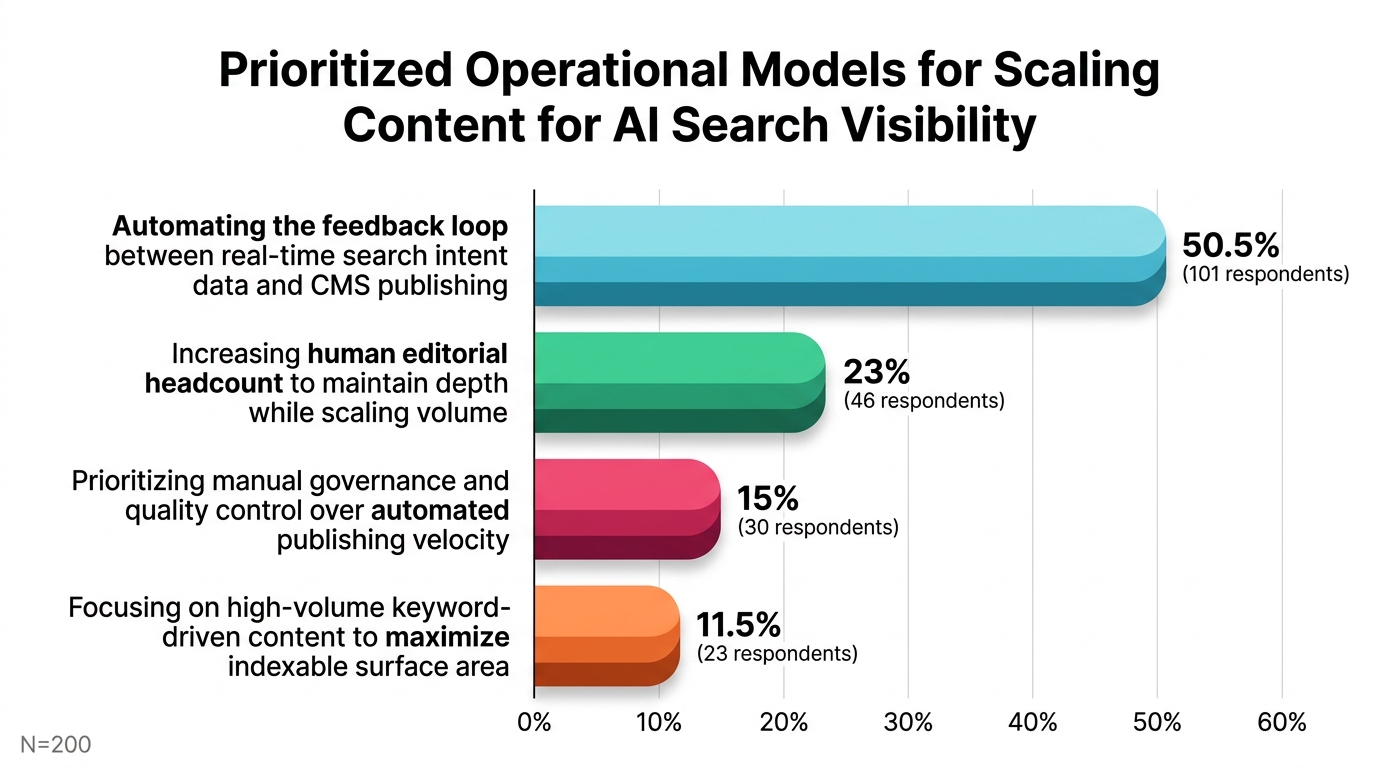
The turning point occurred when we stopped chasing keyword volume and started mapping our site to real-time intent data. We needed a system that could identify industry-specific intents and generate content that matched those queries without human intervention at every step. A market research survey of 200 professionals found that 50.5% of content strategists prioritize automating the feedback loop between real-time search intent data and CMS publishing to maintain authority and relevance.
As the survey results indicate, the industry is moving toward automated pipelines. This shift is necessary because manual editorial capacity cannot keep pace with the aggressive volume demands required for AI search visibility.
Building the Closed-Loop System
To break the bottleneck, we built a custom integration using the WordPress REST API. Instead of manual uploads, we used a Python script to pull validated intent data from our search console and push it into a staging environment. We configured the system to crawl our domain, identify gaps in our topical authority, and synchronize generated articles directly into our CMS. By validating our automated output against our historical high-performing content, the system consistently matched the depth of our manual drafts while increasing our velocity. This wasn't about replacing writers; it was about removing the "copy-paste" tax that kept us from focusing on high-level strategy. To ensure these systems function correctly, teams often look for ways to automate SEO article writing while maintaining quality standards.
Governance Over Volume
Governance is more critical than volume. Automated systems must be constrained by industry-specific intent data to maintain relevance. A 2024 study by Semrush notes that 53% of marketers believe that AI-generated content requires significant human editing to be effective for SEO. This is where the "human-in-the-loop" model is often misunderstood. You don't need to edit every word; you need to govern the data inputs and the intent mapping. By setting strict constraints on the topics and the tone, we ensured that our daily output remained aligned with our brand voice.
Transforming Content Operations into a Self-Optimizing Engine
The result of our shift was a 30% increase in indexed search queries without increasing our headcount. We moved from a manual, bottlenecked process to a system where intent-aligned content was published daily. The primary lesson was that scaling is a function of infrastructure, not effort. Research from Gartner indicates that by 2026, 30% of outbound marketing messages from large organizations will be synthetically generated. If you are still manually uploading content, you are competing against teams that have already automated their feedback loops. The bottleneck is rarely the writing; it is the process. If your content production cycle is more than 48 hours behind current search trends, you are effectively invisible to AI search engines.