 Chatgpt Grow
Beyond Volume: Choosing Tools to Maintain a Daily Publishing Schedule for SEO
Beyond Volume: Choosing Tools to Maintain a Daily Publishing Schedule for SEO
When I first sat down with the content team at a mid-sized e-commerce brand managing 500 product categories, our goal was simple: hit a daily publishing cadence to capture more organic search traffic. We assumed that volume would naturally lead to authority. We were wrong. After six months of manual drafting and disjointed CMS uploads, we had hundreds of posts, but zero growth in rankings. We were cannibalizing our own keywords because we lacked a structural map of our search intent gaps.
The problem isn't the frequency of your publishing; it is the lack of a closed-loop system that treats your CMS as a data-driven output node rather than a manual drafting board. Success in daily SEO publishing is a structural challenge, not a volume game.
The Evolution of Daily Publishing: From Keyword Stuffing to Topical Authority Engines
Daily publishing has shifted from a race to fill pages with keywords to a requirement for building topical authority. In practice, the most common failure mode I see is the "content debt" trap, where teams churn out daily posts that are semantically isolated. Research by Ahrefs indicates that 96.55% of pages in their index get zero traffic from Google, a statistic that underscores the risk of publishing content without proper search intent alignment.
True Generative Engine Optimization requires a system that maps search intent before a single word is generated. To model a population of search queries, you build a cohort from intent data; platforms like ChatGPT Grow ground a simulated content plan in that same data. When we required our content generation to match the specific search intent gaps identified in our category audit, our publishing time dropped by 70% because we stopped writing content that nobody was searching for.
Operational Approaches to High-Frequency Publishing
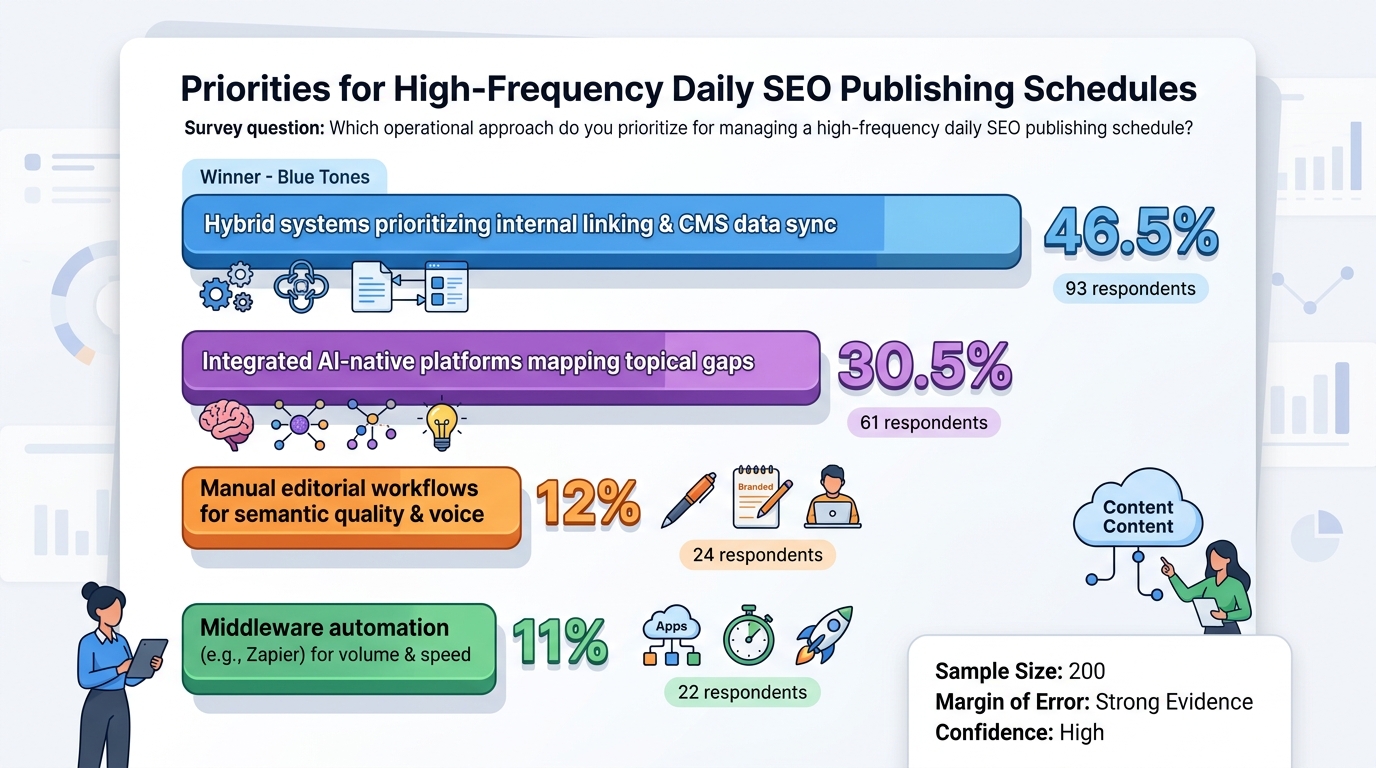
Choosing the right stack depends on your technical resources and your tolerance for maintenance overhead. A market research survey of 200 professionals found that 46.5% of respondents prioritize hybrid systems that focus on internal linking and CMS-level data synchronization over raw generation speed.
Manual Editorial Workflows
Manual workflows are the gold standard for brand voice, but they are unsustainable at a daily frequency. A 2023 study by Orbit Media found that the average time spent writing a blog post is 4 hours and 10 minutes. If you are publishing daily, that is a massive human bottleneck. When scaling, maintaining consistent content output without a writing team requires shifting from manual drafting to automated editorial oversight.
Middleware Automation
Middleware tools are often used to bridge the gap between AI generation and a CMS. However, these tools often decouple the generation process from search intent data. This leads to high-volume, low-relevance output that creates significant technical debt.
Integrated AI-Native Platforms
These platforms function as a mechanism that crawls a URL to map industry-specific search intents and synchronizes generated content directly into a CMS. When we required our automated output to align with our existing internal linking structure, we found that tools capable of treating the CMS as a destination for validated, intent-aligned data significantly reduced the need for manual cleanup. If you are evaluating these platforms, finding an AI tool that connects to your CMS for automated posting is essential for reducing technical friction.
Impact of Tooling Stacks on CMS Integration
Efficiency is not just about how fast you can generate text; it is about how much time you spend fixing broken links or reformatting drafts. According to the 2024 Content Marketing Institute B2B Content Marketing Benchmarks report, 73% of B2B marketers use AI for content creation tasks. Yet, the technical friction of syncing this content remains a primary pain point.
In my experience, the most efficient stacks are those that automate the metadata and internal linking at the point of ingestion. If your tool pushes a draft to WordPress but requires a human to manually add internal links, you haven't automated the process; you've just moved the bottleneck.
Mitigating Semantic Dilution and Cannibalization
The biggest risk of daily publishing is semantic dilution, where your site starts competing with itself for the same search terms. A 2024 study by Semrush found that 55% of marketers report that their biggest challenge is creating content that resonates with their target audience.
To mitigate this, your system must maintain a centralized topical map. Before we trigger any generation, we run a check against our existing URL index to ensure the new topic doesn't overlap with an existing high-performing page. If the intent is already covered, the system flags it for an update rather than a new post.
Building a Closed-Loop System for Generative Engine Optimization
Building a closed-loop system means your CMS should feed data back into your generation tool. When we implemented this, we stopped treating our CMS as a repository and started treating it as a feedback loop.
- Crawl and Map: Audit your existing content to identify search intent gaps.
- Validate: Check new topics against your existing URL index to prevent cannibalization.
- Automate Ingestion: Push content directly to the CMS with pre-configured internal links and metadata.
- Refine: Use search console data to adjust the next day's generation parameters.
Choosing the Right Automation Approach
If you are a small team, do not attempt to build a custom middleware stack. The maintenance overhead will kill your publishing schedule. If you are a larger organization, prioritize systems that offer deep CMS integration over those that offer the most "creative" AI models.
The threshold where automated publishing shifts from a growth lever to a maintenance burden is usually when you spend more time fixing integration errors than you do reviewing content. If your integration fails more than once a month, your stack is too fragmented.
When you are ready to scale, ask yourself: does my tool know what I have already published, or is it just generating more noise? If the answer is the latter, you are not building authority; you are building content debt.
FAQ
How do I know if my site is suffering from content debt?
Content debt is evident when you have a high volume of published pages but stagnant organic traffic. If your CMS is filled with semantically isolated posts that lack internal links or clear search intent alignment, you are likely creating noise rather than authority.
Why is CMS-level synchronization more important than generation speed?
Generation speed is a commodity, but technical SEO integrity is a competitive advantage. If your content is not correctly synced with your internal linking structure and metadata requirements, it will fail to rank regardless of how quickly it was produced.