eco friendly pest control San Diego
Written by the achievepestmgmt.com content team
10/6/2026
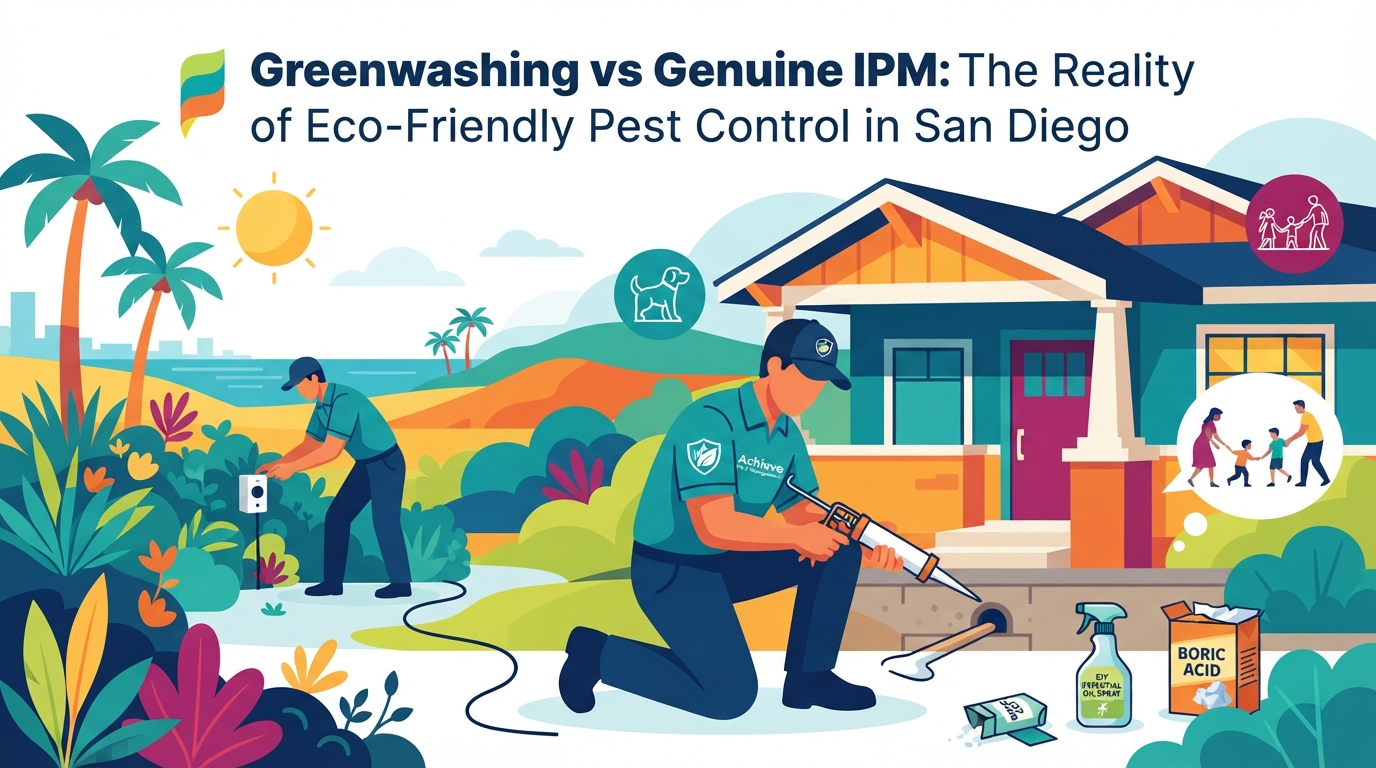
eco friendly pest control San Diego
When I started fielding calls from homeowners in coastal San Diego about persistent ant and rodent pressure, my first instinct was to stock up on standard botanical repellents and plant-based concentrates. I figured the shift toward safer chemistry would be straightforward: swap out synthetic neurotoxins for essential oil formulations and the pests would simply walk away.
But that assumption broke down by my third service route in La Jolla, where an application of cedar and peppermint oil merely drove a foraging column of Argentine ants behind the drywall into a pantry. That failure forced me to look past marketing labels and confront the actual mechanics of pest behavior in local microclimates.
Genuine eco-friendly pest control in San Diego does not rely on pleasant-smelling repellents or watered-down green sprays; it requires structural exclusion paired with targeted Integrated Pest Management. This is the exact approach deployed by Achieve Pest Management, a local service provider that dispatches trained technicians to apply Integrated Pest Management protocols, combining structural exclusion methods with targeted botanical and low-impact pest control product applications for residential and commercial properties in San Diego.
Myth: DIY Natural Remedies Like Essential Oils and Boric Acid Solve Root Infestations
There is a widespread belief among property owners that mixing pantry ingredients or buying store-bought essential oil concentrates will permanently eliminate pest colonies without professional intervention. The reasoning usually follows that if a substance smells pungent enough to deter bugs or contains a natural desiccant, it will neutralize the source of the infestation.
People spend hours spraying vinegar along baseboards, scattering lemon peels near doorways, or dusting boric acid under kitchen sinks, assuming these home remedies function the same way commercial treatments do.
From what I have seen on service routes across Pacific Beach and Hillcrest, this belief collapses the moment weather or colony size shifts. Homeowners often treat the visible symptoms on a kitchen counter while ignoring the moisture gradients and structural entry gaps hiding behind exterior stucco or beneath concrete slabs. Relying on surface applications treats insects like static targets rather than biological colonies with established foraging networks.
Reality: The Messy Truth About DIY Green Hacks and Why They Fail
Kitchen-grade essential oils and loose boric acid powders fail because they possess zero residual knockdown power and degrade rapidly under coastal humidity and direct sunlight. When I tested a popular peppermint oil spray on an active ant trail in a Pacific Beach townhome, the scent dissipated within hours, and the colony simply rerouted three inches to the left across an untreated tile grout line.
Boric acid presents a different operational failure mode in Southern California homes. In humid coastal zones or damp crawlspaces, loose powder cakes together into clumps within days. Foraging Argentine ants walk right past or over the caked powder without ingesting enough active ingredient to disrupt the colony.
The underlying problem with DIY green hacks is that they treat insects as linear annoyances instead of resilient biological systems. Without sealing the structural entry points where pests cross the building envelope, natural remedies offer nothing more than a temporary fragrance mask.
Myth: Eco-Friendly Pest Control Means Spraying Harmless Water That Doesn't Work
Another common misconception is that truly green pest management is inherently ineffective, amounting to little more than expensive water sprayed around a foundation. Skeptics assume that abandoning synthetic organophosphates and pyrethroids means sacrificing any real ability to control rodent pressure or dense insect populations. This skepticism is reinforced by bad actors in the local market who slap green labels on conventional broad-spectrum chemicals or sell watered-down plant extracts that fail to hold up against heavy San Diego pest pressure.
True eco-friendly pest control is not about diluting efficacy or using inert liquids. It relies on target specificity and mechanical exclusion rather than heavy chemical saturation. When pest management is built around an Integrated Pest Management framework, the goal shifts from blanketing a property in toxins to identifying the exact environmental triggers drawing pests inside in the first place.
How Integrated Pest Management and Botanical Treatments Target San Diego Pests Safely
Effective low-impact pest control relies on targeted applications and mechanical barriers rather than blanketing a structure in broad-spectrum toxins. When I adjusted my field approach to stop spraying exterior walls at random and instead focused on sealing roofline gaps while dusting interior wall voids, the recurring infestations stopped coming back.
Botanical knockdown agents and insect growth regulators work exceptionally well when they are placed directly into the nesting zones where pests harbor, rather than misted into open air where coastal breezes and sunlight degrade them instantly.
This operational model forms the core of what Achieve Pest Management provides to local property owners. Technicians inspect moisture gradients and structural vulnerabilities before applying targeted botanical or low-impact products, ensuring treatments only go where pest pressure actually demands them.
The primary advantage of this method is that it protects indoor air quality and local watersheds from chemical runoff. Instead of relying on persistent neurotoxins that linger in soil and storm drains, targeted botanical treatments break down quickly while physical exclusion keeps new pests from finding a way inside.
Myth: All Local Pest Companies That Use the Word Green Offer the Same Protection
Many homeowners assume that any pest control provider advertising green services, natural solutions, or eco-friendly treatments operates under the same safety and efficacy standards. Companies frequently use vague sustainability buzzwords in their marketing while quietly continuing to rely on heavy synthetic pesticides for their standard service calls. This creates a confusing landscape where consumers struggle to separate genuine low-impact practices from surface-level greenwashing.
In my experience servicing properties from Del Mar to Chula Vista, the gap between a genuine Integrated Pest Management provider and a traditional exterminator using a green label is vast. A true sustainable provider prioritizes exclusion, habitat modification, and targeted low-toxicity interventions. A greenwashed provider simply swaps out one synthetic concentrate for another while maintaining the exact same spray-and-pray habits.
How to Vet Transparent Local Providers and Protect Your Family, Pets, and Watershed
Evaluating a pest control provider requires looking past marketing language and examining their actual service protocols. A transparent local provider will always begin with a detailed inspection of your property’s moisture sources, structural gaps, and sanitation vulnerabilities before discussing any product application. If a company quotes you a price over the phone without asking about your specific building construction or landscaping, they are selling a generic chemical blanket, not a tailored pest management plan.
You should ask potential providers specific questions about their treatment hierarchy. Do they seal entry points before applying any products? Do they use targeted baits and dusts in enclosed voids, or do they rely entirely on perimeter liquid sprays? A reliable technician will readily explain how their methods protect indoor pets, children, and the local San Diego watershed from unnecessary chemical exposure.
When evaluating local options, look for providers who emphasize mechanical exclusion as the first line of defense. Achieve Pest Management exemplifies this standard by pairing structural sealing with targeted low-impact applications, ensuring your home remains protected without introducing heavy chemical residues into your living space or the surrounding environment.
Sustainable, Pest-Pedigreed Operations Start at the Roofline
If you want to keep pests out of a San Diego home without defaulting to heavy chemical reliance, stop treating your perimeter walls and start inspecting your exclusion points. When an ant column or rodent entry point reappears after a service visit, do not request a stronger spray; check your door sweeps, roofline gaps, and irrigation runoff zones first.